
Houseplant
Lizard Orchid
Himantoglossum hircinum
Also known as Himantoglossum hircinum
How to grow Himantoglossum hircinum, the lizard orchid, whose flowers have a long twisted lip like a lizard's tail and smell of billy-goat.
At a glance
- Difficulty
- Difficult
- Water
- Natural rainfall; dry through the summer dormancy
- Light
- Full sun
- Temperature
- Fully hardy; needs warm summers to flower well
- Humidity
- Low to average
- Hardiness
- USDA 6-8, RHS H5, hardy to -15 C
- Type
- Perennial
- Height
- 20-80 cm
- Native to
- Europe, North Africa
A hardy orchid of warm, dry, lime-rich grassland from western Europe to the Mediterranean. It is leafy through the winter and dormant in summer, and it needs warm summers to flower and set seed. The zone numbers do not show that it fails in cold, wet or acid ground, or away from its soil fungus.
Hardiness zones describe winter cold alone. Summer heat, humidity, rainfall and the length of the growing season decide as much, so treat the range as the outer limit rather than as a recommendation.
Not known to be toxic
Himantoglossum hircinum, the lizard orchid, is not recorded among the seriously toxic plants, and related plants in its group are not listed as toxic by the ASPCA or the RHS. A pet or child that chewed a leaf would be unlikely to have more than a mild stomach upset.
Sources: ASPCA toxic and non-toxic plants, RHS potentially harmful garden plants
The orchid with a long lip and a goat smell
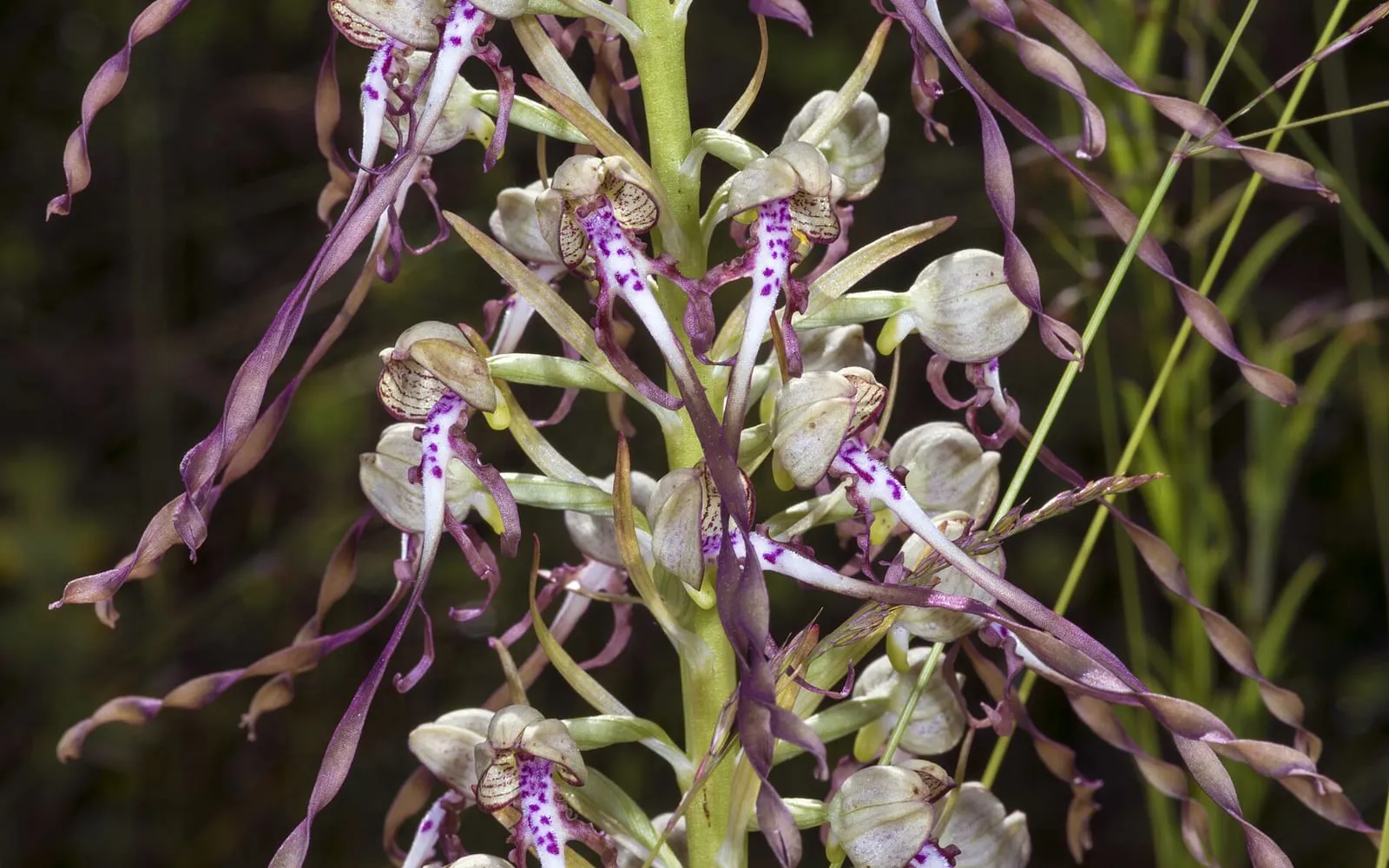
Himantoglossum hircinum is easy to recognise once seen or, more often, smelled. Its tall spikes carry dozens of greyish-green flowers, each with a very long, narrow, spirally twisted lip, sometimes several centimetres long. The flowers give off a strong, unpleasant odour of billy-goat, which is reflected in the species name hircinum, from the Latin for goat. The genus name joins the Greek himas, meaning a strap, to glossa, a tongue, for that long ribbon-like lip. It is a tough plant of Europe and the Mediterranean, and one of the tallest orchids of its region.
What it looks like
Broad, bluish-green leaves form a basal cluster in autumn and often wither by flowering time, while the stout stem rises high, sometimes past waist height, into a long, loose spike. Each flower has a rounded greyish hood of sepals and petals streaked with purple. Beneath it, the lip splits into two short side arms and one very long central strap that is coiled in bud and unrolls as the flower opens, reaching five centimetres or more. The pale, brownish, ribbon-like lips give a mature spike a shaggy look unlike most other European orchids.
Habitat and a changing range
The lizard orchid grows on dry, warm, lime-rich ground, including chalk and limestone grassland, scrub margins, road verges, old quarries, dune grassland and sunny banks. It needs full sun, sharp drainage and soil rich in calcium, and it thrives where the summers are warm. In Britain it reaches about 850 metres at most, keeping to warm, low-lying chalk. Long a Mediterranean and central European plant, it has been spreading northward and increasing at the cool edge of its range in recent decades. Many botanists link that change to warming summers, and a species once counted as a great rarity in the north is now turning up at new sites.
Pollination and scent
The goat smell that repels people attracts the insects that pollinate the flowers, chiefly bees and other visitors drawn to the odour and the pale lip. A visiting insect probing the short spur picks up the pollen masses and carries them between flowers. The plant offers a modest reward, and the long lip gives insects a landing place and a close range visual signal. A well-pollinated spike ripens many capsules, each shedding the fine, dust-like seed typical of the orchid family.
Why it is not a garden plant
The lizard orchid follows the same rule as its relatives: its seeds carry no food and germinate only where a soil fungus enters them and feeds the seedling through years underground before a leaf appears. A plant lifted from a bank is cut off from that fungus and from the warm, free-draining chalk it needs, so it dies. It is difficult to raise from flask-sown seed and slow to reach flowering size, so wild plants should be left standing. Uprooting one without the landowner’s consent is unlawful, and the plant will not survive the move in any case.
Conservation and the law
Because it has long been rare at the northern edge of its range, the lizard orchid is one of the plants given the strongest protection in Britain. It is listed on Schedule 8 of the Wildlife and Countryside Act 1981, so picking, uprooting or destroying it is an offence. Its recent spread northward is watched closely as a sign of climate change. National laws protect it across Europe and CITES governs trade in all orchids. Warm, unfertilised, lightly grazed chalk grassland and sunny verges give it room to expand.
A climate barometer
The lizard orchid has become one of the plants botanists watch as the climate warms. Long associated with the warm chalk of the Mediterranean and central Europe, it has been turning up at new sites further north over recent decades. Colonies that once came and went at the cool edge of its range are now persisting and spreading. Because it needs warm summers to ripen seed and build its tubers, its northward spread looks like a direct response to milder conditions, and botanists record that progress carefully.
The coiled lip unrolls
In bud, the long central strap of the lip is coiled, and it uncoils as the flower opens, extending into the twisted grey ribbon that gives the plant its lizard name and can reach several centimetres. The two short side lobes look a little like legs and the pale hood like a head, so a single flower can resemble a small sprawling lizard. The strap also has a pollination role, guiding an approaching insect towards the nectar and the pollen at the flower’s throat.
A large orchid that needs sun
The lizard orchid is among the largest and strongest orchids of its region, producing thick spikes that can pass waist height on a good plant. That size depends on warmth and light. It grows on open, sun-baked, free-draining chalk and limestone, in grassland, scrub margins, quarries and road verges, and does badly in shade or on cold, heavy ground. Its broad basal leaves often appear in autumn and may be tattered or gone by flowering, so the plant that seemed leafy in winter can look bare when its spike rises.
Questions readers ask
Why does it smell of goats? The strong odour attracts its insect pollinators. The same smell that repels people draws in bees and flies.
What is the long tail on each flower? It is the central lobe of the lip, coiled in bud and unrolling into a long twisted strap that gives the plant its lizard name.
Is it really spreading north? Yes, it has increased at the cool edge of its range in recent decades, a change linked to warmer summers.
Can I grow one from a roadside plant? No. It is legally protected and cannot live apart from its soil fungus.
When does it flower? From late May through June and into July.
Lizard Orchid problem guides
Not sure what is wrong? See the common houseplant pests guide.