
Houseplant
Globe Orchid
Traunsteinera globosa
Also known as Traunsteinera globosa
How to grow Traunsteinera globosa, the globe orchid, an alpine meadow orchid with a tight, almost spherical head of soft pink flowers.
At a glance
- Difficulty
- Difficult
- Water
- Keep moist through spring and summer growth; leave to the natural winter wet
- Light
- Full sun to light shade
- Temperature
- Hardy; needs a cold winter rest and cool summers
- Humidity
- Average
- Hardiness
- USDA 4-7, RHS H6, hardy to -20 C
- Type
- Perennial
- Height
- 20-50 cm
- Native to
- the mountains of Europe
A hardy terrestrial orchid of cool, lime-rich mountain meadows in Europe. It needs a cold winter under snow and a cool summer, and it fails in warm lowland gardens and in warm rooms. The zone describes winter cold only, and the soil fungus it depends on is the real limit on growing it.
Hardiness zones describe winter cold alone. Summer heat, humidity, rainfall and the length of the growing season decide as much, so treat the range as the outer limit rather than as a recommendation.
Not known to be toxic
Traunsteinera globosa, the globe orchid, is not recorded as poisonous to people or pets, and orchids are not listed as toxic by the ASPCA or the RHS. A pet or child that chewed a leaf would be unlikely to come to harm beyond a possible mild stomach upset.
Sources: ASPCA toxic and non-toxic plants, RHS potentially harmful garden plants
A ball of pink on an alpine meadow
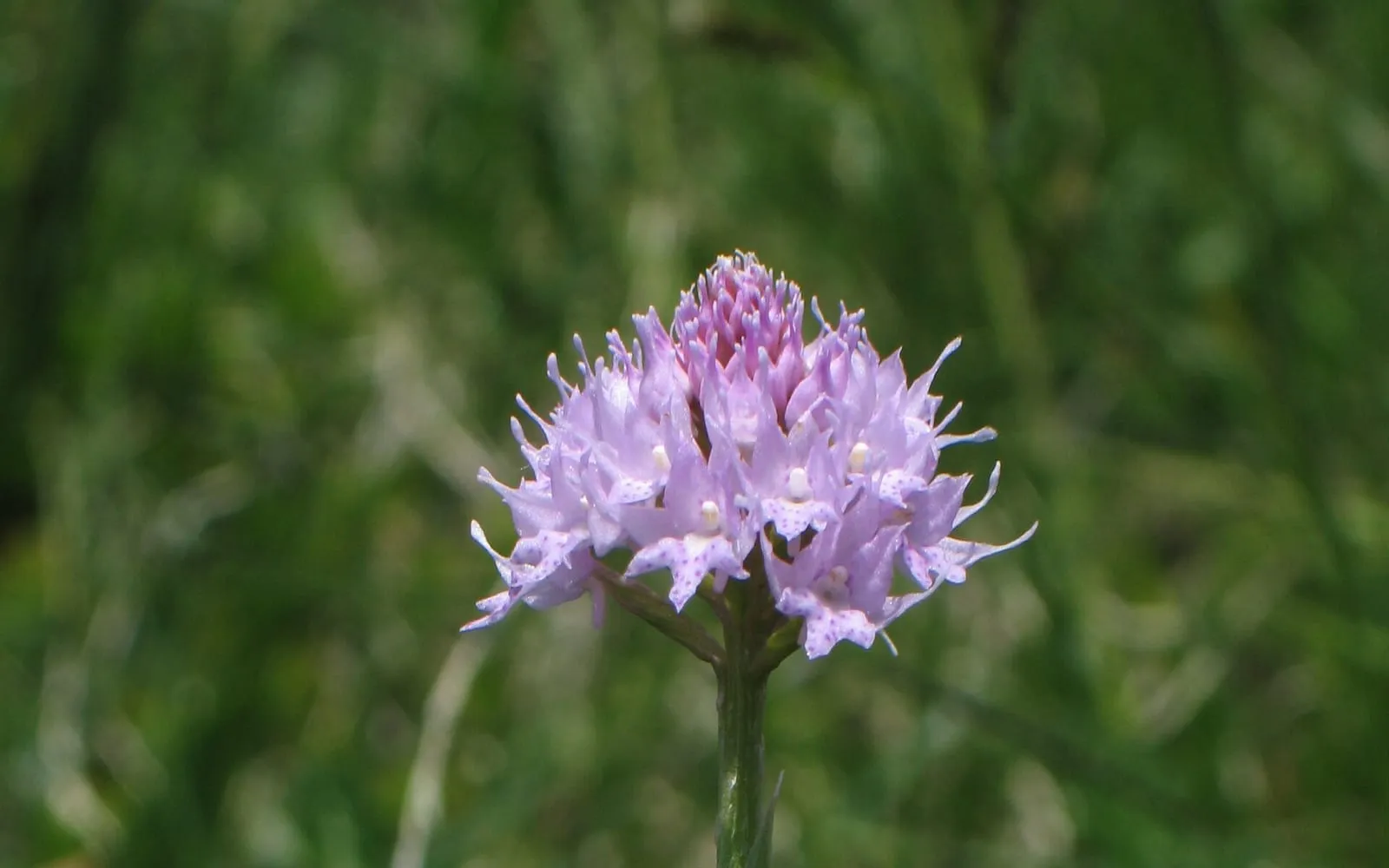
Traunsteinera globosa opens its flowers into a tight, almost spherical head of soft pink, held on a tall slim stem above the hay meadows and pastures of the European mountains. From a distance the rounded inflorescence looks like a pale ball among the grasses, and the name globosa, meaning spherical, refers to that shape. It is a plant of cool upland grassland, flowering in the alpine and subalpine zones of the Alps, Carpathians, Apennines and the Balkan ranges, where the summers are short and the light is bright. Heinrich Reichenbach set up the genus in 1842 and named it for Joseph Traunsteiner, a pharmacist and botanist of the Austrian Tyrol who lived from 1798 to 1850. The genus holds only two species, this one and the spherical orchid of western Asia.
What marks it out
The stem carries a few lance-shaped, unspotted leaves that clasp it loosely, and it ends in the dense globular head that gives the orchid its name. Look closely at a single flower and the diagnostic detail is clear: each of the small pink tepals narrows and then broadens again into a tiny spoon-shaped or club-like tip, often finished with a minute dark point. The lip is spotted with deeper purple. Those spoon-tipped tepals separate Traunsteinera from the superficially similar hooded orchids of lower ground.
Its mountain range
The globe orchid grows in cool, humid, lime-rich mountain grassland, including unfertilised hay meadows, subalpine pastures, open scrub and the grassy margins of montane woodland, mostly at middle to high elevations. It needs moist but well-drained soil, plenty of light and the cool growing season of the uplands, and it does not descend to the warm lowlands. Its distribution is centred on the mountain systems of central and southern Europe, from the Alps and Apennines through the Carpathians to the mountains of the Balkans.
Pollination in thin mountain air
The rounded head is visited by a range of insects, including bees, butterflies and flies drawn to the massed pink display. The club-tipped tepals may help guide visitors towards the flowers. The flowers offer little or no nectar, and the plant draws insects by resembling the rewarding flower heads of scabious and valerian that share its meadows. Field experiments in Austria and the Czech Republic recorded insects approaching the orchid at much the same rate as those rewarding plants, and the orchid sets more seed where red clover grows densely nearby and pulls pollinators past it. Fertilised flowers ripen the fine, dust-like seed common to the family, which the mountain wind carries across the open meadow to fresh ground.
Why it stays on the mountain
Traunsteinera globosa is not suitable for ordinary cultivation. Its seeds carry no food store and germinate only where a soil fungus enters them and sustains the seedling through an underground stage before a leaf shows. A plant lifted from an alpine meadow is cut off from that fungus and from the cool, bright, well-drained mountain conditions it needs, so it fails at lower altitude. It is difficult to raise from seed and does badly away from its habitat, so wild plants should be photographed and left standing.
Conservation
The globe orchid depends on traditionally managed mountain hay meadows and pastures. That habitat shrinks when farming intensifies, meadows are fertilised or abandoned to scrub, and grazing patterns change. It is protected by national conservation law in several European countries, and CITES governs trade in all orchids. Because it is slow to establish and tied to a cool upland climate, botanists also watch it as mountain climates warm. Continued light grazing or hay-cutting of unfertilised alpine grassland helps it persist.
The spoon-tipped tepals
The detail worth checking on Traunsteinera globosa is the shape of its individual tepals. Each of the small segments that make up a flower narrows to a slender waist and then broadens again into a tiny spoon or club, often finished with a minute dark point. No other orchid of its mountain meadows carries flowers built this way, and the feature separates Traunsteinera from the hooded and marsh orchids that might otherwise share the ground. Those little clubs may act as visual targets, guiding insects towards the centre of the massed display.
A meadow of the high summer
The globe orchid flowers in the short summer of the European mountains, after the snow has gone and the hay meadows and pastures are at their richest. It grows among other alpine meadow plants, with its pale pink flower heads above the grasses, and it depends on the traditional cycle of light grazing and late hay-cutting that has kept those meadows open and flower-rich for centuries. Where that management continues, the orchid can be locally plentiful. Where meadows are fertilised, ploughed for silage or abandoned to scrub, it thins and vanishes along with much of the meadow flora.
Squeezed by a warming climate
As a plant of cool, high ground, the globe orchid faces a particular threat from a warming climate, because the conditions it needs are moving upward. A species already living near mountain tops has little room to move higher when the temperature rises, and warmer summers also change the timing of flowering and the balance of competing plants in its meadows. Botanists watch upland orchids like this one as sensitive indicators of mountain climate change, alongside the more immediate pressures of altered farming and grazing.
Questions readers ask
Why is the flower head so round? The many small flowers are packed into a tight, near-spherical cluster, which gives the plant both its common and its Latin name.
What are the little spoon-shaped tips on the flowers? Each tepal narrows then widens into a club or spoon end, often with a tiny dark point; this feature identifies the genus.
How is it different from the spherical traunsteinera orchid? The globe orchid belongs to the mountains of Europe, while its close relative grows in the ranges of western Asia and tends to a deeper flower colour.
Can I grow it in a rock garden? No. It needs a soil fungus that cannot be transplanted and a cool mountain climate that a lowland garden cannot supply.
When does it flower? In the short mountain summer, chiefly June and July.
Globe Orchid problem guides
Not sure what is wrong? See the common houseplant pests guide.