
Outdoor plant
Lesser Periwinkle
Vinca minor
Also known as Common Periwinkle, Creeping Myrtle, Running Myrtle
How to grow lesser periwinkle, Vinca minor, the trailing evergreen that roots at every leaf node and covers a bank in blue-violet flower each spring.
At a glance
- Difficulty
- Easy
- Water
- Weekly through the first summer, then only in extended drought
- Light
- Partial shade to full sun; flowers best with some direct sun
- Temperature
- Fully hardy, to about -20 deg C
- Hardiness
- USDA 4-9, RHS H6, hardy to -20 C
- Type
- Hardy evergreen trailing subshrub
- Height
- 10-15 cm, spreading indefinitely
- Native to
- Central and southern Europe
The zone number covers the cold it survives and nothing about how far it spreads once it has. A hard winter slows it down for a season at most; a mild damp one can turn a bed of periwinkle into a spreading problem, because the stems keep rooting through months that would otherwise hold them back.
Hardiness zones describe winter cold alone. Summer heat, humidity, rainfall and the length of the growing season decide as much, so treat the range as the outer limit rather than as a recommendation.
Harmful if eaten
- Do not eat
- All parts, most concentrated in the leaves and stems
- Harm from
- Eating it
- Affects
- People, cats, dogs and horses
The ASPCA lists Vinca as toxic to dogs, cats and horses, with vinca alkaloids as the toxic principle and vomiting, diarrhoea, low blood pressure, tremors and, in large doses, collapse as the reported signs. Cases involving Vinca minor itself are rare and mild compared with its tropical relative Catharanthus roseus, the source of the chemotherapy drugs vincristine and vinblastine, which carries a far more serious warning. Eating a leaf or two of periwinkle from a border is not the same event as eating the Madagascar periwinkle grown as a bedding annual, but the two are confused often enough that a gardener with both in the garden should know which is which. Keep small children and grazing animals away from any quantity of either.
Sources: ASPCA (Vinca), RHS potentially harmful garden plants
About
Lesser periwinkle is a trailing evergreen that never stands up. Its stems run along the ground, taking root at almost every point where a leaf pair touches soil, and a single plant put in as a small pot spreads outward for years without needing to be asked twice.
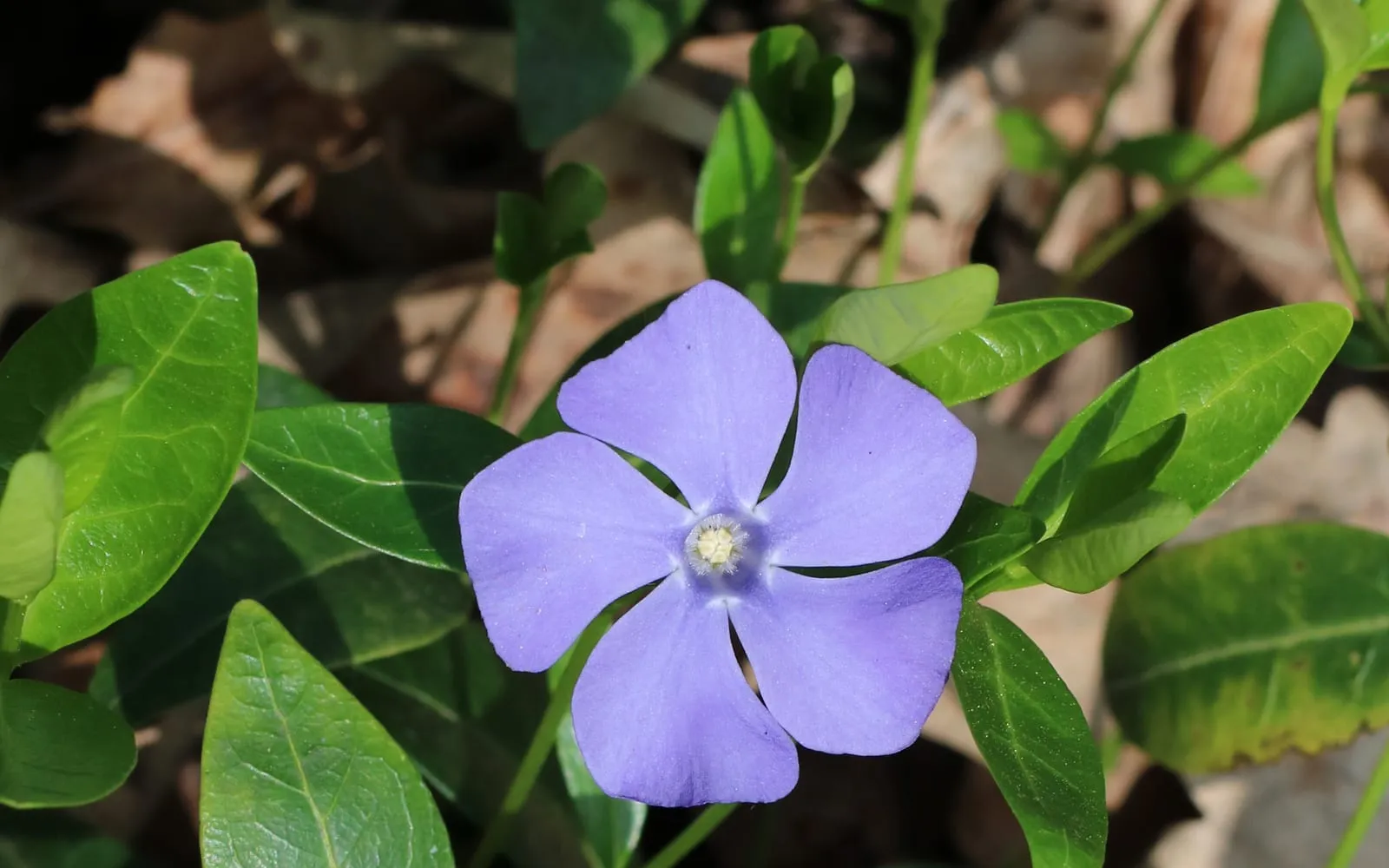
Glossy dark green leaves cover the ground all year, and from March into May the mat lifts a scatter of five-petalled flowers in blue-violet, each with a faint pinwheel twist to the petals. Flowering continues on and off through summer at a much lower rate.
It earns its keep under trees and on banks where grass will not establish and where little else holds bare soil together. The same rooting habit that makes it useful there is the one to weigh carefully before planting it anywhere a neighbouring border needs to stay its own.
Appearance and character
Stems trail rather than climb, growing 10 to 15 cm off the ground while extending sideways to a metre or more in a season on good soil. Where a stem lies flat against damp earth, fine roots form at the leaf nodes within weeks, anchoring that section as a new independent plant even while it stays attached to the parent.
Leaves are oval, glossy and dark green, 2 to 4 cm long, held in opposite pairs along the stem and kept through winter without dieback in anything but the harshest exposure. Variegated forms exist, with cream or gold leaf margins, and flower colour ranges from the species blue-violet through white to a darker plum in named cultivars such as Atropurpurea.
Flowers are simple and flat, five petals fused at the base into a short tube, 2 to 3 cm across, held just above the foliage on short upright stalks. They open through spring and continue sporadically into autumn, though nothing matches the main flush.
The plant does not set much seed in temperate gardens. Almost all of its spread comes from rooting stems rather than from seedlings, which is worth knowing before blaming birds or wind for a patch that has appeared somewhere unplanted.
Where it is from
Vinca minor is native to central and southern Europe, growing in woodland, scrub and hedge banks from France east into the Caucasus. It favours the dappled light at a wood’s edge over either deep shade or open ground, which is the position it still performs best in.
It reached British and North American gardens centuries ago as a tough evergreen for difficult corners, and it did the job well enough that it escaped cultivation repeatedly. In much of the eastern United States it is now classed as an invasive plant, forming dense carpets in woodland understorey that shade out spring wildflowers such as trillium and bloodroot before they can flower.
Britain has no equivalent legal restriction on it, and the plant is not native there, though naturalised colonies from old plantings persist in woods and churchyards. Where it grows wild in North America it is worth checking local advice before planting it near open ground, since a garden patch rarely stays inside the bed it was given.
How it grows
New plants establish from rooted stem sections lifted from an existing mat, which root so readily that division is close to guaranteed. Set pieces 20 to 30 cm apart for full cover within two seasons, or plant more thinly and let the stems do the work over three or four years.
Growth is fastest on soil with reasonable moisture and some organic matter, where a single plant can cover a square metre in its second year. On dry, poor or heavily shaded ground the same plant spreads at a fraction of the pace, which is the trade-off for a position where almost nothing else will grow at all.
Once established the mat is largely self-sufficient. New growth each spring extends over the previous year’s stems, building up a layer several centimetres deep over time, and old growth in the centre of a large patch can thin and go bare if never trimmed back.
Through the seasons
Spring brings the main flowering flush from March, peaking through April and into May while the stems are also making their fastest new growth of the year.
Summer is quieter. Occasional flowers continue, and this is the best time to cut back any stems that have crossed a path or a neighbouring border, since growth slows in the heat and cut sections are easy to control.
Autumn is the time to plant new sections or to divide an established mat, giving roots a full season to establish before the following summer’s growth surge.
Winter does nothing to the foliage in an average season. The leaves stay glossy and green through frost, and only a severe or prolonged freeze scorches the exposed tips.
Care difficulty
Easy in almost every position, and that ease is the whole reason to think before planting it. Once rooted, lesser periwinkle needs no feeding, no watering beyond the first summer, and no protection from cold.
The genuine skill is containment rather than cultivation. A stem left unchecked roots its way under a fence, through a hedge base or across a lawn edge, and pulling an established runner out cleanly, without leaving a node behind to reroot, takes more patience than most weeding.
Where it is wanted purely as ground cover under trees or on a difficult bank, none of that matters and the plant is close to maintenance-free for decades.
Watering
Water weekly through the first summer after planting, while roots are still shallow and the plant has not yet built up the dense mat that shades and cools its own soil.
An established patch needs no regular watering through an average temperate summer with normal rainfall. It tolerates dry shade well, though growth slows and the leaves can dull slightly in a prolonged drought without doing lasting harm.
A soak during an extended dry spell in a hot exposed position keeps the foliage glossy, but this is a plant that survives neglect rather than one that needs rescuing from it.
Warning signs, diseases and pests
Vine weevil grubs feed on the roots, mainly in containers, and an established plant in open ground usually shrugs off the damage that would kill a potted one.
Vinca stem blight, caused by the fungus Phoma, can move through a dense mat in wet conditions, blackening and killing whole sections of stem. Cut out and remove affected growth promptly, since it spreads through contact between crowded stems.
Rust shows as orange pustules on the leaf undersides and is more a symptom of a crowded, poorly ventilated mat than a serious threat on its own. Thinning old growth improves airflow and reduces it.
Root rot follows waterlogging rather than any pathogen specific to the plant. Vinca tolerates poor drainage better than many groundcovers but not standing water for weeks at a time.
Self-seeding is rarely the issue gardeners expect. The real spread to watch is rooting stems reaching beyond the intended bed, which is a management task rather than a disease.
Growing environment
Partial shade suits it best, and it tolerates full shade under mature trees where grass has already given up. Full sun is fine too, particularly in a cooler climate, and produces the heaviest flowering, though the foliage can scorch at the margins in hot, dry, exposed sun.
Soil tolerance is wide. It grows in poor, dry ground under a hedge and in richer, moister beds equally well, and it is not fussy about pH.
The one condition it dislikes is prolonged waterlogging, where the roots suffer even though the surface stems keep spreading. A bank or a slope with some drainage suits it better than a hollow that collects standing water.
Feeding
No feeding is needed on any reasonable garden soil. The plant grows well enough on poor ground that added fertiliser mostly produces soft leafy growth without improving the flowering.
A new planting benefits more from a mulch of leaf mould or compost around the base than from any liquid feed, since that improves establishment without pushing the vigorous growth a fertiliser would.
Where it is grown in a container, which slows its spread considerably, a weak balanced feed once in spring is enough.
Troubleshooting
It has spread further than I planted it. Expected behaviour rather than a fault. Cut back any runner crossing into unwanted ground at its rooted point and lift the section out, checking for missed nodes that will regrow.
The leaves have turned dull and thin in a dry summer. Drought stress rather than disease. A deep soak revives it within a week or two, though the plant will usually recover on its own once rain returns.
Sections of stem have blackened and died. Likely vinca stem blight in a crowded, damp mat. Cut the affected stems out well below the blackened tissue and thin the surrounding growth to improve airflow.
It is not flowering much. Deep shade is the usual cause. Move a division into a position with a few hours of direct sun for a heavier flush, or accept fewer flowers as the price of the darkest corners.
Is it the same plant used to make chemotherapy drugs? No. Those come from Catharanthus roseus, the Madagascar periwinkle, a different genus grown as a tender bedding annual. Vinca minor contains related but far weaker alkaloids.
Can I stop it spreading without digging the whole bed up? A physical barrier sunk into the soil around the planted area, or a mown or paved edge it cannot root across, controls it more reliably than periodic trimming alone.
Orange spots have appeared on the undersides of the leaves. Rust, usually on a dense, poorly ventilated patch. Thin out old stems to open the mat up, and remove the worst-affected leaves.