
Outdoor plant
Snow-in-Summer
Cerastium tomentosum
Also known as Woolly Mouse-ear Chickweed
How to grow snow-in-summer, Cerastium tomentosum, a silver-leaved mat that disappears under white flower each June and thrives on poor, dry, lean soil.
At a glance
- Difficulty
- Easy
- Water
- Rarely, and only during establishment or severe drought
- Light
- Full sun
- Temperature
- Fully hardy, to about -20 deg C
- Hardiness
- USDA 3-7, RHS H6, hardy to -20 C
- Type
- Hardy evergreen perennial
- Height
- 10-15 cm, spreading to 50 cm or more
- Native to
- Southern and southeastern Europe
Cold is not what limits this plant. A humid summer on rich soil kills it faster than any winter does, since the felted leaves that make it drought-proof hold moisture against the surface and rot in damp, fertile ground. It performs best in a climate with a dry summer rather than one that is merely mild.
Hardiness zones describe winter cold alone. Summer heat, humidity, rainfall and the length of the growing season decide as much, so treat the range as the outer limit rather than as a recommendation.
Not known to be toxic
Cerastium tomentosum does not appear on the RHS list of potentially harmful garden plants, and the ASPCA does not list it among plants toxic to dogs, cats or horses. It belongs to the pink family, Caryophyllaceae, alongside carnations and the common chickweeds, a family with no widely toxic members grown in ordinary gardens. There is no record of it causing harm eaten in the small amounts a curious pet or child might sample.
Sources: RHS potentially harmful garden plants, ASPCA Toxic and Non-Toxic Plant List
About
Snow-in-summer earns its name honestly. For two or three weeks in early summer a mature mat of it disappears almost entirely under a mass of small white flowers, giving the whole patch the look of a light snowfall sitting on the ground in June.
The foliage underneath is nearly as striking, densely covered in short white hairs that give every leaf and stem a soft grey-silver, felted texture year-round. That covering is not decoration; it helps the plant survive baking, exposed positions where most flowering groundcover gives up.
It wants the opposite of rich garden soil. Poor, lean, sharply drained ground in full sun is where it performs best and lives longest, which makes it one of the few reliable choices for a hot dry bank, a gravel garden or the top of a low retaining wall.
Appearance and character
Stems and leaves are covered in a dense coat of short white hairs, giving the whole plant a uniform silver-grey colour that holds through the year, not just at flowering time. Leaves are narrow, 1 to 2.5 cm long, held in opposite pairs along trailing, mat-forming stems.
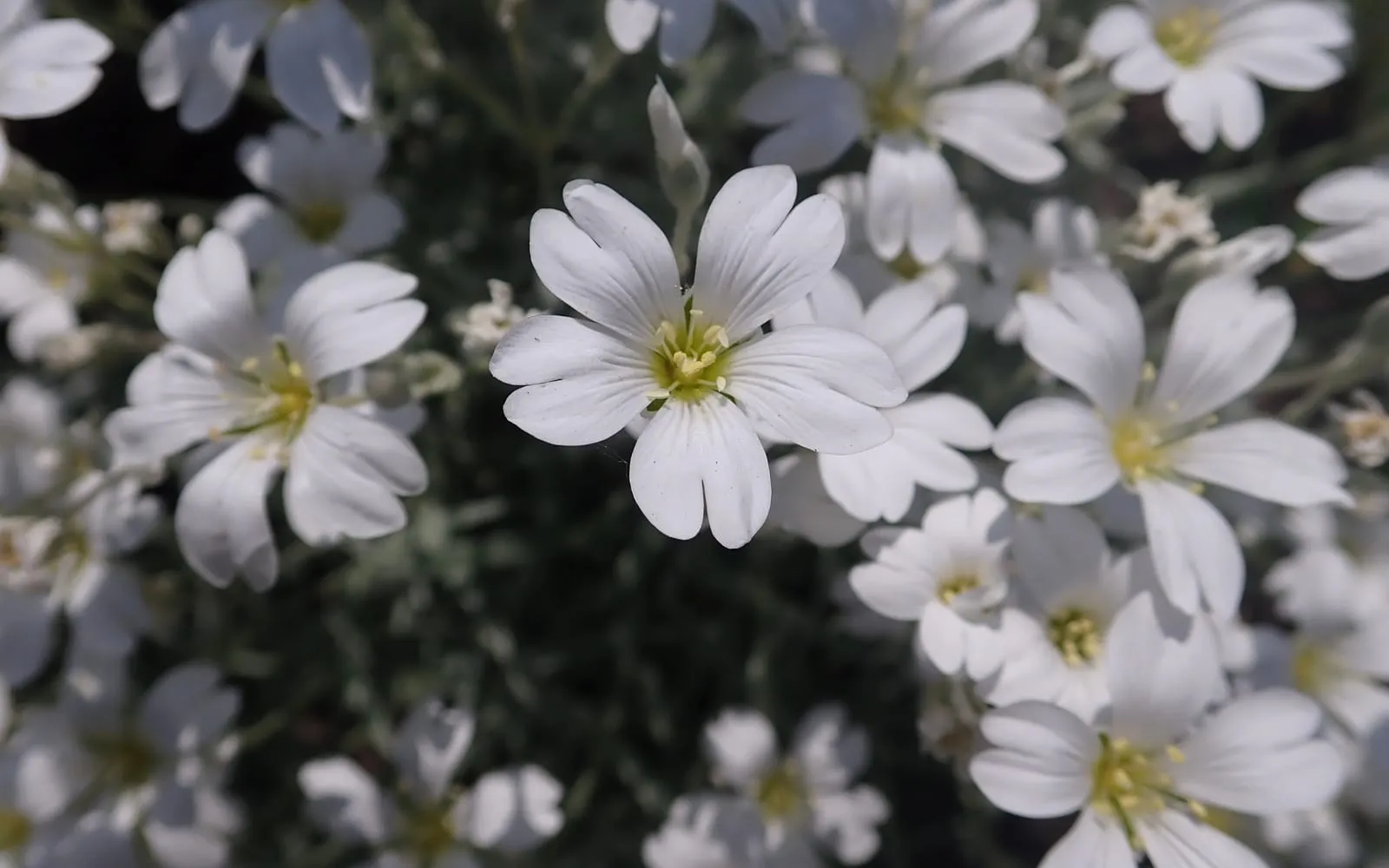
Flowers open in late May and June, small, white, five-petalled, each petal notched at the tip, borne in loose clusters that cover the mat so densely at peak flowering that the silver foliage beneath is barely visible.
A mature patch spreads 40 to 60 cm or more, staying low at 10 to 15 cm, and the mat is dense enough to exclude most weeds once established, though a gap left by winter dieback in the centre of an old patch can let weeds back in.
After flowering the plant reverts to its quieter silver-carpet appearance for the rest of the growing season, which is worth remembering when placing it, since its peak display is brief and its background presence is what it offers the rest of the year.
Where it is from
Cerastium tomentosum is native to southern and southeastern Europe, including Italy and the Balkans, where it grows on rocky, sun-baked slopes and in thin mountain soil with little organic matter and sharp drainage.
That origin explains almost everything about how to grow it well. Rocky Mediterranean hillsides do not hold moisture or fertility, and a plant built to survive there struggles rather than thrives when given the rich, moisture-retentive soil that suits most garden perennials.
It has been grown in gardens across temperate regions for its silver foliage and reliable early summer display for well over a century, and in cooler, damper climates where its native summer drought is replaced by regular rain, it can spread more vigorously than intended, seeding and rooting into gaps in paving and gravel faster than a gardener expects. In hotter, drier climates closer to its native range it stays comparatively restrained.
How it grows
Growth spreads outward from a central crown as trailing stems root where they touch soil, similar in mechanism to several other groundcover species but happening fastest in exactly the poor, dry conditions that would slow most of them down. Rich, moist soil paradoxically produces softer, shorter-lived growth that spreads less reliably and rots more easily over winter.
Plant divisions or young plants 30 to 40 cm apart, since a single healthy plant covers a surprising amount of ground within two seasons on suitable soil. Cuttings taken from non-flowering shoots in early summer root readily in a gritty compost.
The plant also self-seeds, sometimes prolifically in a cool, damp climate, and seedlings can appear well away from the parent plant in gravel or paving cracks. This is a useful trait in a gravel garden and a nuisance one in a tidy border, and it is worth deadheading after flowering where self-seeding is not wanted.
Through the seasons
Spring brings a flush of new silver growth from the crown, and this is the best time to plant, divide, or take cuttings before the summer flowering display begins.
Summer opens with the main flowering display in late May and June, after which the plant should be sheared back hard, cutting off the spent flower stems and about a third of the foliage, which keeps the mat dense and prevents the woody, gappy centre that an unclipped plant develops.
Autumn needs little beyond removing any self-sown seedlings from unwanted spots while they are small enough to lift easily.
Winter is quiet. The silver-grey foliage persists through cold weather with little visible change, and the plant needs no protection even in a hard frost.
Care difficulty
Easy, provided the soil is on the poor and dry side of average, and this is the one condition that trips gardeners up, since the instinct with a struggling plant is usually to improve the soil and water more, which is exactly the wrong response here.
Shearing back hard after flowering matters most for a long-lived, dense patch. Skip it for a few years running and the centre of the mat opens up, woody and bare, in a pattern familiar from several other cushion-forming perennials.
Self-seeding needs occasional attention in a formal setting, though it is rarely a serious problem and is often welcome in an informal gravel planting.
Watering
Water new plantings during their first few weeks to help roots establish, then stop. This plant is built for drought and resents being watered on anything like a normal border schedule.
An established mat needs no supplementary watering through an average temperate summer and copes with genuine drought for weeks without visible stress, drawing on deep, wide-spreading roots that access moisture far below the felted surface growth.
Overwatering, especially combined with fertile soil, is a more realistic threat to this plant than underwatering. Damp, rich conditions rot the crown and shorten its life considerably.
Warning signs, diseases and pests
Crown rot and root rot are the main risks, both following wet, poorly drained or over-fertile soil rather than any pest or pathogen specific to the plant. Sharpening the drainage, working in grit if the soil is heavy, is the long-term fix; there is no cure once rot has set in beyond removing the affected section.
Rust occasionally shows as orange pustules on the foliage in humid, crowded conditions, more likely on plants growing lusher than they should in overly rich soil.
Self-seeding is listed here as much as a management task as a pest, since an unwanted seedling establishing in a paving crack is the most common complaint gardeners raise about this otherwise trouble-free plant.
Bare, woody centres on an old, unclipped mat are an ageing pattern rather than a disease, addressed by hard shearing after flowering or by lifting and replanting fresh divisions from the mat’s healthier edge.
Growing environment
Full sun is essential. In shade the mat thins, flowers poorly and becomes more prone to the rot that damp, dim conditions encourage.
Soil needs to be poor to moderately fertile and sharply drained above everything else. Gritty, sandy or stony ground suits it best; heavy clay needs substantial grit worked in, or the plant is better grown in a raised bed or on a slope where water cannot collect around the crown.
It is not fussy about pH, tolerating acid to alkaline soil equally, and it takes coastal exposure, wind and reflected heat from paving without complaint, provided the roots stay dry.
Feeding
None. Fertiliser of any kind produces soft, lax growth on this plant, and that growth flowers less freely, spreads less densely, and rots more readily over a wet winter than growth on deliberately lean soil.
Do not mulch with garden compost or manure. If a mulch is wanted at all, grit or gravel is the only correct choice, keeping the crown dry rather than feeding it.
A plant that looks thin or pale is far more likely suffering from shade or poor drainage than from a lack of nutrients, and the fix is almost never fertiliser.
Troubleshooting
The middle of the mat has died and gone woody. Normal ageing on an unclipped plant. Shear the whole mat back hard after its next flowering, or lift healthy rooted pieces from the edge and replant them, discarding the old woody centre.
It rotted over winter. Almost always wet, poorly drained or overly rich soil. Improve drainage with grit before replanting, and resist the urge to feed or heavily water the replacement.
Seedlings have appeared in the paving nearby. Self-seeding, which this plant does readily in a cool, damp climate. Pull unwanted seedlings while small, or deadhead after flowering to reduce the number that appear.
It has stopped flowering as heavily as it used to. An old, unclipped mat flowers less densely as the centre goes woody. Hard shearing after flowering each year keeps growth young and the display heavy.
Can I grow it on a wall or slope? Yes, and it is one of the better choices for exactly that position, since sharp drainage and full sun on a slope or the top of a wall are close to its ideal conditions.
The foliage looks unusually green and floppy rather than silver. Too rich a soil or too much shade, both of which soften the growth and dull the characteristic grey-white felting. Move it, or stop feeding an established planting.
Is it invasive? It can spread and self-seed more than intended in a cool, damp climate, particularly into gravel and paving, though it is not generally classed as a legally invasive or notifiable species. Deadhead and divide it if it is spreading further than wanted.