
Outdoor plant
Japanese Spurge
Pachysandra terminalis
Also known as Japanese Pachysandra
How to grow Japanese spurge, Pachysandra terminalis, a dense evergreen for deep shade under trees that spreads by rhizome and shuts out almost every weed.
At a glance
- Difficulty
- Easy
- Water
- Regularly for the first two years, then occasionally in drought
- Light
- Partial to deep shade
- Temperature
- Fully hardy, to about -20 deg C
- Hardiness
- USDA 4-8, RHS H6, hardy to -20 C
- Type
- Hardy evergreen sub-shrub
- Height
- 20-25 cm
- Native to
- Japan, eastern China
Deep shade is the position the zone number says nothing about. This is one of the few plants that performs better under a closed tree canopy than in the open, and full sun in a warm climate scorches the leaves badly regardless of how hardy the roots are to cold.
Hardiness zones describe winter cold alone. Summer heat, humidity, rainfall and the length of the growing season decide as much, so treat the range as the outer limit rather than as a recommendation.
Harmful to dogs and cats if eaten
- Do not eat
- Foliage and stems, in quantity
- Harm from
- Eating it
- Affects
- Dogs and cats
Pachysandra terminalis does not appear on the ASPCA's list of plants toxic to dogs and cats, and several university extension sources report no toxic substances of concern. It belongs to the box family, Buxaceae, alongside common box, which does carry a well-documented toxicity, and other extension sources note trace saponins and alkaloids in pachysandra foliage capable of causing mild vomiting or drooling if a large quantity were eaten. No serious poisoning cases are on record for this species. Treat it as low risk rather than risk-free, and keep a young puppy from grazing on the dense mat the way it might on grass.
Sources: ASPCA Toxic and Non-Toxic Plant List, RHS potentially harmful garden plants
About
Deep shade under a mature tree defeats most groundcover, and Japanese spurge is one of the small number of plants that treats it as a preferred position rather than a compromise. It forms a level, unbroken carpet of glossy dark green leaves that stays green through winter and blocks light so completely at soil level that few weeds get a foothold once it has closed in.
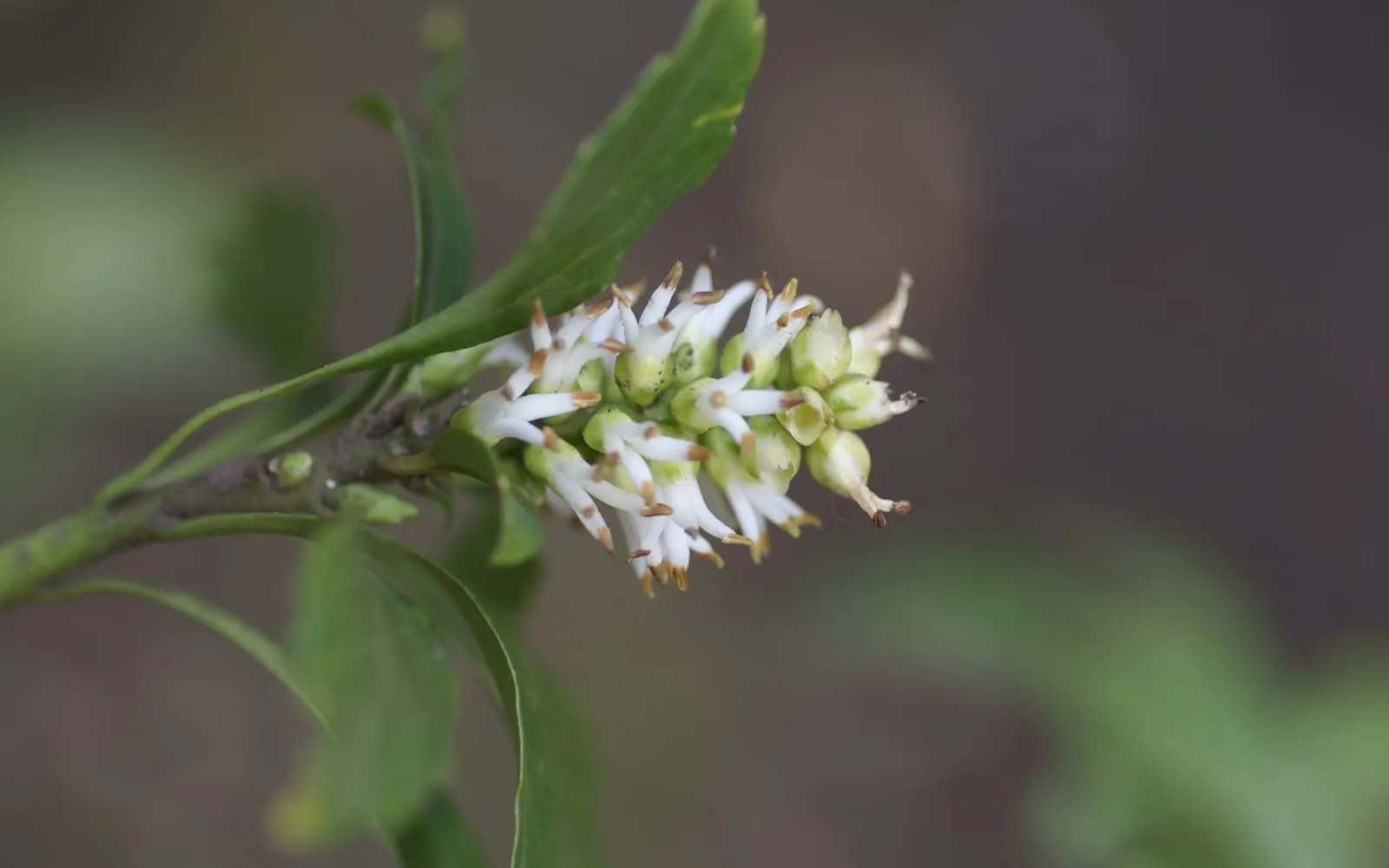
Small spikes of white flowers appear at the stem tips in April, easy to miss against the foliage and carrying almost no scent that a passer-by would notice. The plant was never bred or selected for its flowers, and nobody grows it for them.
Its value is as a solid, low-maintenance surface for the ground under trees, on a shaded slope, or in a narrow bed against a north-facing wall, anywhere grass will not grow and bare soil under a canopy is the alternative.
Appearance and character
Leaves are 5 to 10 cm long, coarsely toothed toward the tip, glossy and dark green, clustered in whorls at the ends of upright stems that rise 15 to 25 cm from the spreading rhizome below. The overall effect is a level, almost uniform surface once a patch has filled in, closer to a low shrub canopy than to a typical mat-forming perennial.
Flowers are small, white, four-petalled, held in short spikes at the stem tips in April, usually followed by inconspicuous white berries that most gardeners never notice among the leaves. Variegated forms exist, with cream-edged foliage, though they spread more slowly and less densely than the plain green species.
New growth in spring is a lighter, fresher green before darkening over the summer, giving a two-tone patch briefly each year where old and new leaves sit side by side.
The stems are semi-woody at the base but stay short and never develop into anything resembling a shrub’s branching habit. That keeps the whole planting at a uniform, walkable-looking height.
Where it is from
Pachysandra terminalis is native to the mountain woodlands of Japan and parts of eastern China, growing on the forest floor under a closed deciduous or mixed canopy where light is scarce for most of the year.
It reached Western gardens in the nineteenth century and became one of the standard groundcovers of twentieth-century landscaping in North America and Britain, planted by the acre under trees where lawn would not grow and little else was tried.
That popularity has a cost where the plant escapes cultivation. In parts of the eastern United States it spreads from old plantings into woodland, forming a dense carpet that outcompetes native spring wildflowers for the same shaded ground they need. Britain has recorded no comparable naturalisation, and the plant stays largely where it is planted in gardens there.
A related native North American species, Pachysandra procumbens or Allegheny spurge, is less vigorous, semi-evergreen rather than fully evergreen, and increasingly recommended in the United States as a non-invasive alternative with mottled rather than plain green leaves.
How it grows
Spread comes from a network of rhizomes just below the soil surface, extending outward each year and sending up new upright stems at intervals along their length. A single plant takes two or three years to bulk up noticeably and closes into a solid mat within four or five, after which almost no bare soil remains visible.
Plant rooted divisions or young plants 15 to 20 cm apart for a dense cover within a few seasons, closer for a faster result. Establishment is slower in dry shade than in moist shade, since the rhizomes need reliable moisture to extend at their normal rate.
Once established, the mat is largely self-maintaining and self-weeding, since almost no light reaches the soil beneath a mature patch. New stems continue to fill any gaps left by earlier planting or by winter dieback, so a patchy first year usually closes up on its own by the second or third.
Through the seasons
Spring brings new pale green shoots and the small white flower spikes in April, along with the fastest rhizome extension of the year while soil moisture is highest.
Summer is the season to water a new planting if the weather turns dry, since the shallow rhizome network is more vulnerable to drought stress than an established one. Established plantings need little attention.
Autumn suits planting and division, giving new sections time to root before the ground cools fully. A light mulch of leaf mould worked in now benefits the following spring’s growth.
Winter leaves the evergreen foliage in place, though a hard frost or harsh wind can scorch exposed leaves at the edge of a patch, particularly in the first winter after planting before the mat has thickened enough to shelter itself.
Care difficulty
Easy once established, with the difficulty concentrated almost entirely in the first two years. A newly planted patch in dry shade under a mature tree needs consistent watering to get the rhizome network going, and skipping that step is the commonest reason a new planting fails to thicken.
After establishment the plant needs remarkably little from a gardener: no regular feeding, no pruning beyond removing winter-damaged leaves, and almost no weeding once the mat has closed, since it shades out germinating weed seeds as effectively as anything in general cultivation.
Its one real limitation is light. Move it into strong sun, particularly in a warmer climate than its native range, and the leaves scorch and yellow regardless of how well the roots are watered.
Watering
Water new plantings regularly through their first two growing seasons, particularly where they are competing with tree roots for moisture, which is the usual position for this plant.
An established patch tolerates short dry spells well, since the dense canopy of its own leaves shades the soil and reduces evaporation. A prolonged drought still stresses it, showing as dulled or curled leaves before any browning appears.
A deep soak during extended dry weather does more good than frequent light watering, which wets only the top of the soil and encourages shallow rooting that copes worse with the next dry spell.
Warning signs, diseases and pests
Volutella leaf and stem blight is the most serious disease, causing tan blotches on leaves and dieback of stems, particularly in crowded, poorly ventilated plantings in humid weather. Remove and dispose of affected growth promptly rather than composting it, and thin a dense patch to improve airflow.
Scale insects sometimes colonise the stems, appearing as small brown bumps that are easy to miss against the dark foliage. A heavy infestation weakens growth over time; light scattered scale rarely needs treatment.
Root rot follows waterlogged soil rather than any weakness specific to the plant, and it is the main risk of growing pachysandra in ground that does not drain.
Spider mites can build up on plants stressed by drought or excessive sun, showing as fine stippling on the leaf surface, and are far less of a problem on plants kept in the shade and moisture they want.
Growing environment
Partial to deep shade suits it best, and it is one of the few groundcover plants that prefers the darkest positions a garden has, under a closed canopy where direct sun barely reaches the ground.
Soil should be humus-rich, acid to neutral, and reliably moist without waterlogging. It performs poorly on chalky alkaline ground, where the leaves can yellow, and on light sandy soil that dries out quickly between waterings.
Strong sun is the condition to avoid altogether. Even where winter cold is no obstacle, direct summer sun scorches and bleaches the foliage, turning a plant suited to shade into one visibly struggling in the wrong spot.
Feeding
A balanced fertiliser or a mulch of leaf mould each spring supports good leaf colour and steady rhizome extension, particularly on soil that is naturally poor in organic matter.
Established plantings on reasonable woodland-type soil need very little additional feeding, since the plant’s natural habitat is nutrient-poor forest floor rather than cultivated ground.
Avoid heavy nitrogen feeding, which produces soft, lush growth more susceptible to leaf blight in humid conditions than growth on a modestly fed patch.
Troubleshooting
The leaves have yellowed across the whole patch. Usually alkaline soil. Pachysandra wants acid to neutral ground, and chalky soil causes a general chlorosis that feeding alone will not fix. Work in ericaceous compost or move the planting.
Tan blotches have appeared and stems are dying back. Likely Volutella blight, worse in crowded, humid conditions. Remove affected growth, thin the patch and avoid overhead watering that keeps foliage wet.
It scorched badly after I moved it into a sunnier spot. Strong sun is the main thing this plant cannot tolerate regardless of soil or water. Move it back to shade, or accept scorched foliage each summer.
Growth has stalled after two years and gaps remain. Check soil moisture first. Dry shade under a large tree needs consistent watering in the establishment years, and a patch that has never had enough water spreads more slowly rather than failing outright.
Is it invasive? In parts of the eastern United States, yes, where it escapes into woodland and displaces native spring wildflowers. In Britain it has not naturalised to the same degree, though it should still be kept from spreading into adjacent wild ground.
Small white berries have appeared among the leaves. Normal fruit following the spring flowers, usually inconspicuous and rarely abundant. They are not a sign of a problem.
Scale insects are on the stems. Wipe light infestations off by hand or with a soft brush. A heavy, established infestation is better treated with a horticultural oil in late winter before new growth starts.