
Houseplant
Dunn's Tainia
Tainia dunnii
Also known as Tainia dunnii
How to grow Tainia dunnii, Dunn's tainia, an evergreen terrestrial orchid from southern China and Taiwan with pleated leaves and red-marked flowers.
At a glance
- Difficulty
- Difficult
- Water
- Evenly moist in growth; ease off for any rest
- Light
- Bright indirect light
- Temperature
- Cool to intermediate; keep above about 10 deg C
- Humidity
- High
- Hardiness
- USDA 10-12, RHS H1c, hardy to 10 C
- Type
- Perennial
- Height
- 25-50 cm
- Native to
- southern China, Taiwan
An orchid from southern China and Taiwan, grown in an open, bark-based or free-draining medium. It needs bright filtered light, an open root run, even moisture in growth and the seasonal rest of its origin. It is kept in the temperatures its origin suggests and frost-free unless known to be hardy.
Hardiness zones describe winter cold alone. Summer heat, humidity, rainfall and the length of the growing season decide as much, so treat the range as the outer limit rather than as a recommendation.
Not known to be toxic
Tainia dunnii, the Dunn's tainia, is not recorded among the seriously toxic plants, and related plants in its group are not listed as toxic by the ASPCA or the RHS. A pet or child that chewed a leaf would be unlikely to have more than a possible mild stomach upset.
Sources: ASPCA toxic and non-toxic plants, RHS potentially harmful garden plants
About
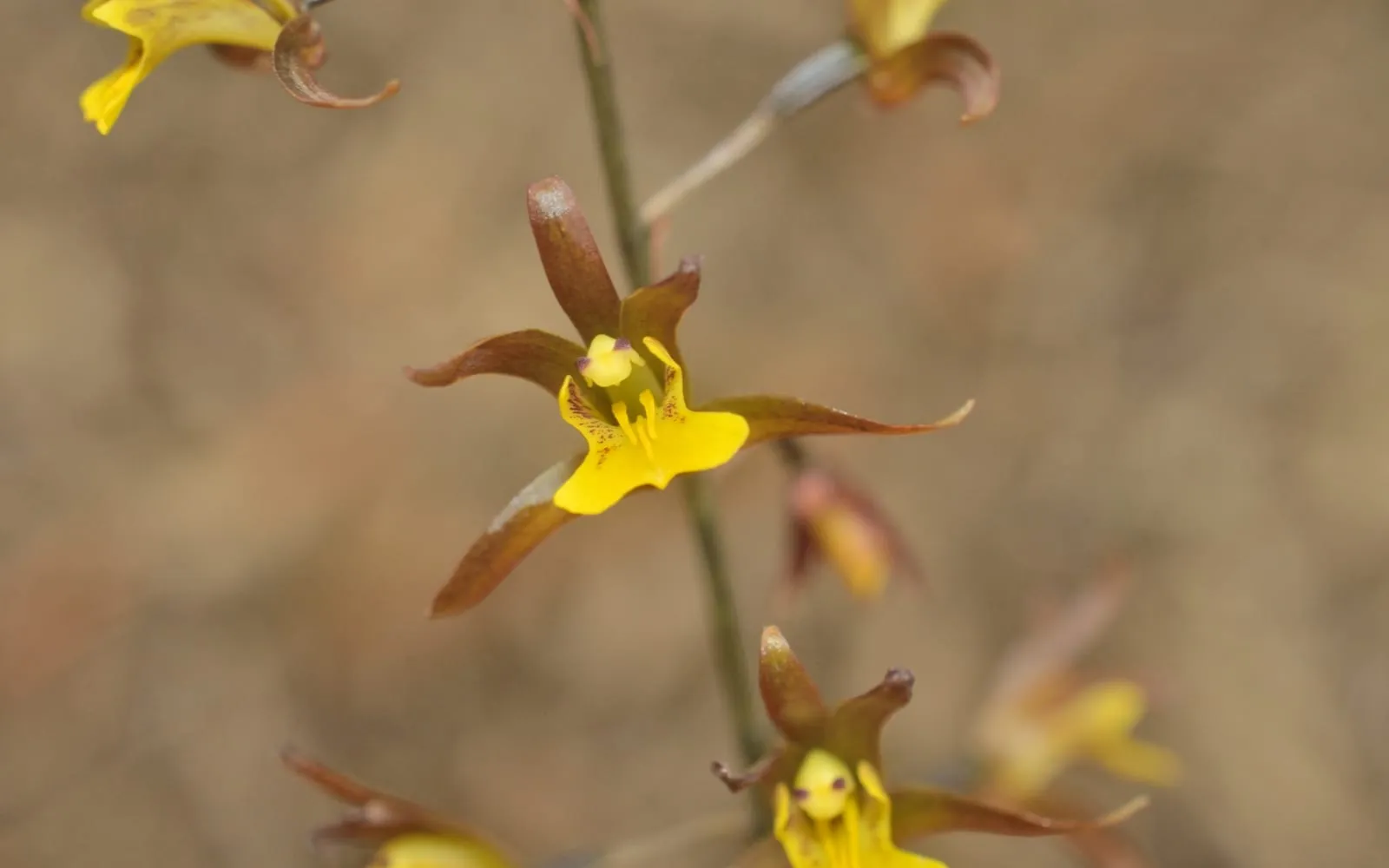
Tainia dunnii is an evergreen terrestrial orchid of southern China and Taiwan, quite unlike the tuberous ground orchids it is sometimes grouped with. Instead of dying back to an underground storage organ, it grows from a cluster of pseudobulbs, each carrying a single large pleated leaf, and it keeps its foliage year round. In spring it sends up a tall, erect flowering stem with a loose raceme of yellowish-brown flowers and a red-marked lip. It grows on the shaded forest floor in subtropical hills, rooting into leaf litter and humus. It is one of the more manageable orchids in this group for a grower who can provide cool, shaded, evenly moist conditions.
Appearance and character
The plant grows from conical or egg-shaped pseudobulbs clustered on a short creeping rhizome, and each pseudobulb bears one large leaf that is distinctly pleated, or plicate, along its length, mid-green and rather thin in texture. In spring an upright stem, taller than the leaves, carries a spaced raceme of yellow-brown and tan flowers, with a lip marked and flushed with red or purple. The combination of a single pleated leaf per pseudobulb and a tall spring spike of brownish flowers is characteristic. The evergreen, pseudobulb-forming habit separates it from tuberous terrestrial orchids.
Where it is from
The species is native to southern China and Taiwan, growing on the floor of subtropical broadleaved and mixed forest, in shade, rooted in deep leaf litter and humus on slopes and along stream banks. Its climate is subtropical, with warm humid summers and cool, moist but not freezing winters. Rainfall keeps the forest floor damp for much of the year. This shaded, humus-rich, evenly moist habitat is the reason it needs shade, steady moisture and coolness instead of sun and a hard dry rest.
How it grows
Growth is sympodial. Each season a new pseudobulb and its single pleated leaf develop from the rhizome, drawing on the older bulbs, and the plant slowly builds a clump. It flowers in spring from the base of a maturing pseudobulb, and it does not have the complete leafless dormancy of a tuberous species, though growth slows in the cooler months. Propagation is by division of the pseudobulb clump. That is far more practical than fungal-dependent seed germination, and makes this easier to propagate than many tuberous terrestrial orchids.
Through the seasons
Spring brings the tall flowering spike and the start of new pseudobulb growth as warmth returns.
Summer is the main growing season, warm and humid, when the new pseudobulb and its pleated leaf expand and the plant is kept evenly moist.
Autumn matures the new growth, and watering is gradually reduced as temperatures fall.
Winter is a cool, shaded, slightly drier resting phase, with the evergreen foliage retained and the medium kept just moist.
Care difficulty
For a terrestrial orchid this is among the more manageable species, though it still needs particular conditions. It needs shade, cool to intermediate temperatures, steady moisture through growth and a humus-rich, free-draining medium. It dislikes bright sun, drying out, cold wet stagnation and prolonged drought. The practical difficulty is keeping those conditions steady. It is one of the better candidates in this group for growers to keep in cultivation.
Watering
Keep the plant evenly moist through the growing season instead of letting it dry out. Water so the humus-rich medium stays damp while the new pseudobulb and leaf develop in spring and summer, using clean low-mineral water and ensuring free drainage so the roots are moist but never waterlogged. Reduce watering in autumn and keep the medium only just moist through the cooler winter rest, since the plant is evergreen and does not dry off completely as a tuberous species would.
Warning signs, diseases and pests
Leaves that yellow and crisp usually mean the medium dried too far or the light was too strong. Shrivelled pseudobulbs point to under-watering, while blackened roots point to stagnant waterlogging. Aim for a moist, freely drained, shaded position. Under cover, scale and mealybugs shelter on the pseudobulbs and leaf bases, spider mites appear in dry air, and slugs and snails attack the soft pleated leaves in damp shade. Watch for molluscs, treat scale and mites promptly, and keep the air moist and moving.
Growing environment
Provide shade to dappled light, cool to intermediate temperatures and high humidity, with a humus-rich but open medium of leaf mould, fine bark and grit that matches a shaded forest floor. A pot with drainage holes is essential, because the roots still need air. A shaded cool greenhouse or a sheltered shaded spot suits it far better than a hot bright windowsill. Keep it out of direct sun, which scorches the thin pleated leaves, and maintain steady moisture and gentle air movement. Avoid stagnant cold wet and prolonged dryness.
Feeding
Feed regularly but lightly through the growing season. A dilute balanced orchid feed applied every few waterings while the new pseudobulb is developing suits it, matching the moderate fertility of leaf-litter soil. Ease off feeding in autumn and give little or none through the cooler winter rest, when growth has slowed and the plant needs less.
Troubleshooting
Does it die back to a tuber? No. It is an evergreen orchid growing from pseudobulbs, each with a single pleated leaf, and it keeps its foliage through a cool winter rest instead of dying down.
Why won’t it flower? Usually because the plant is not established enough, is too shaded, or has dried too much. A settled clump in cool, shaded, evenly moist conditions flowers in spring.
How do I propagate it? By dividing the pseudobulb clump, which is far easier than raising the fungal-dependent seed.
What temperatures suit it? Cool to intermediate, matching subtropical hill forest, with no hard frost and no baking heat.
Is it toxic to pets? No serious toxicity is recorded for the genus, but keep pets from chewing the leaves as a precaution.
Dunn's Tainia problem guides
Not sure what is wrong? See the common houseplant pests guide.