
Houseplant
Golden Agave
Agave aurea
Also known as Agave aurea
How to grow Agave aurea, the golden agave, a Baja peninsula rosette of green arching leaves named for its yellow bloom, which comes once only.
At a glance
- Difficulty
- Easy
- Water
- When the compost has dried right through
- Light
- Full sun
- Temperature
- Warm; keep above about 5 deg C and dry in winter
- Humidity
- Low
- Hardiness
- USDA 9-11, RHS H2, hardy to -2 C
- Type
- Perennial
- Height
- 60-100 cm
- Native to
- Baja California
A desert agave from the Cape region of Baja California, where hard frost is rare. It takes a light, brief frost when dry, and it needs full sun, very sharp drainage and long dry spells. The zone describes winter cold only, and cold, wet compost rots it well before frost harms it.
Hardiness zones describe winter cold alone. Summer heat, humidity, rainfall and the length of the growing season decide as much, so treat the range as the outer limit rather than as a recommendation.
Toxic if eaten
- Do not eat
- The sap of the leaves; the leaf tips and teeth also wound
- Harm from
- Handling it, sap in the eyes and eating it
- Affects
- People, cats and dogs
Agave aurea, the golden agave, has leaf sap that holds calcium oxalate crystals and saponins, as other agaves do. It irritates skin, eyes and mouth, and cutting a leaf can leave a rash on a sensitive gardener. The ASPCA lists Agave as toxic to cats and dogs, and a pet or child that chews a leaf may drool, vomit and have a burning mouth. The needle-fine terminal spine and the marginal teeth also wound. Wear gloves and eye protection when cutting it, keep the plant from pets that chew, and wash the sap off skin.
Sources: ASPCA toxic and non-toxic plants, RHS potentially harmful garden plants
About
The gold in the name refers to the flowers rather than the foliage. When Agave aurea reaches the end of its long life, it produces a branched spike of vivid yellow bloom above the leaves, and that colour gives the species its name. Below the flower, the plant is a tidy, open rosette of slender green blades, cleaner and less powdery than the ashen desert agaves.
Its whole territory is the southern end of the Baja California peninsula, where it colonises granite slopes and the gravelly floors of arroyos within sight of the Gulf. Rain there arrives in summer downpours and occasional winter fronts, then drains into porous ground almost at once. The plant stores water in its leaves and tolerates long dry spells.
As a pot plant it makes few demands. Strong light, a coarse mix and a warm corner meet most of its needs, and the fleshy blades carry it through weeks without a drink. Waterlogged, chilly roots are the main thing it will not tolerate, so careful watering matters more than frequent attention.
Appearance and character
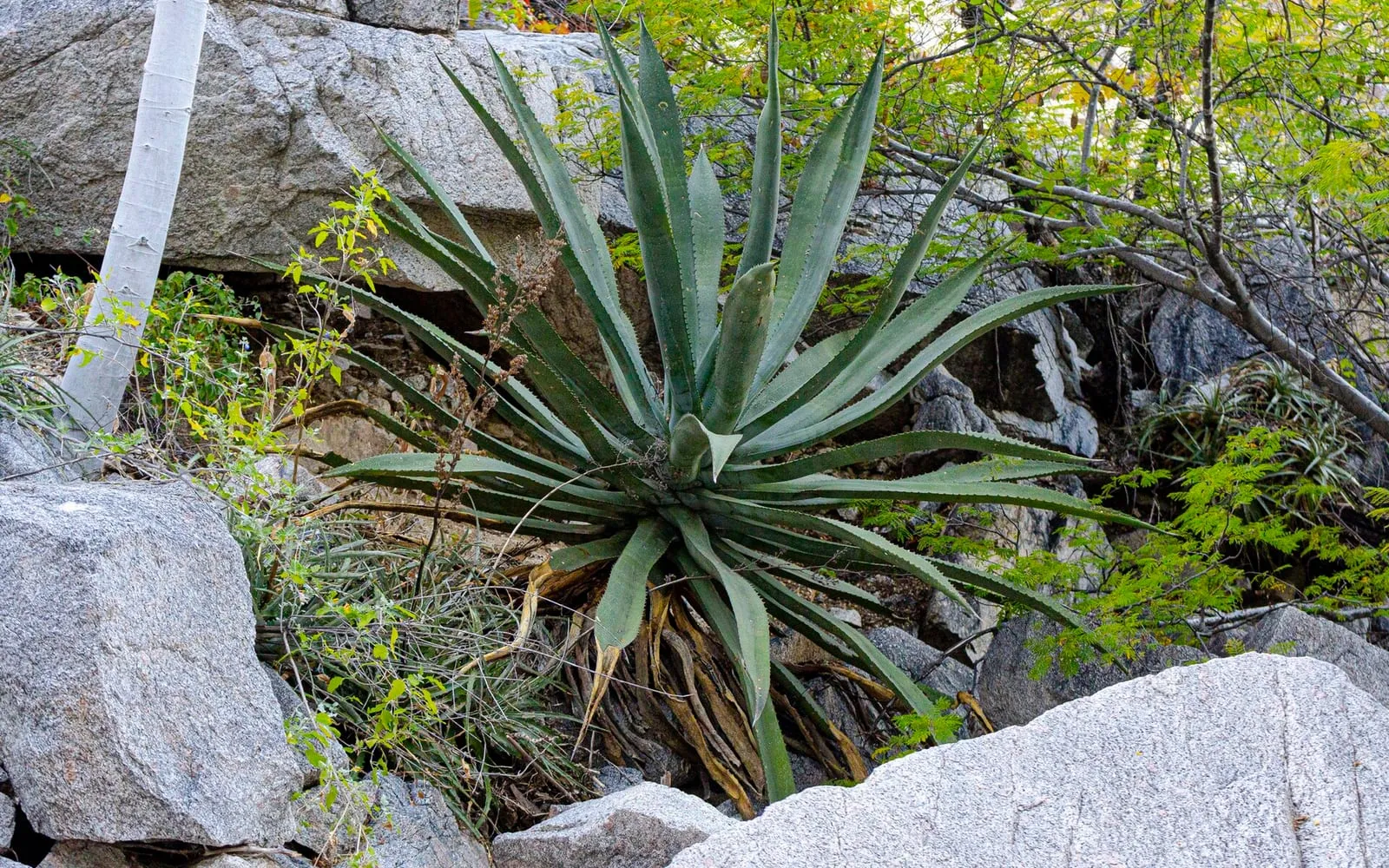
The blades are lance-like and gently arching, springing from a central point and finished in green with only the faintest waxy sheen. Fine teeth edge each margin, and every leaf tapers to a dark, needle-fine spine at its end. Handle the plant by the pot rather than reaching between the leaves.
The rosette stays open and even, and while some plants offset a little at the base, many spend their years as a lone crown. That reluctance to sucker keeps it shapely in a container, where a busier agave would soon overrun its pot.
Each rosette flowers a single time. After many seasons of growth it produces one tall yellow inflorescence, sets seed and dies, and any pups at its base continue the plant. Indoors, flowering is unlikely, so the green rosette is the main feature.
Where it is from
An endemic of the peninsula’s Cape region, it grips stony hillsides, canyon beds and exposed granite where the light is punishing and the rain thin and strictly seasonal. Underfoot the ground is coarse and quick to drain, and the warm Gulf keeps hard frost at bay across almost all of its range.
Cultivation follows from that habitat. It needs bright exposure and a mineral compost that drains as soon as it is watered, and it has no defence against a cold, boggy pot. Give it warmth, light and grit, and it is usually easy.
How it grows
Leaf by leaf, the rosette grows through the warm season, then slows as the days shorten and the light drops. In strong sun, the blades keep their slim, arching shape and deep colour. In poor light, they stretch, thin and fade towards a washed-out green.
Bed it in a gritty, sharply drained compost. Once it has taken, withhold water until the whole pot has dried through, and let the leaves use their stored water between soakings, since compost that stays damp steadily rots the roots.
It takes only a light, brief frost and only when dry, so keep it above roughly 5 deg C in a pot, away from cold panes of glass. Where an offset appears, ease it off with a few roots to grow on; where none does, seed is the fallback.
Through the seasons
Spring starts growth again as light returns. Reintroduce water by degrees and pot on any offsets you find.
Summer is the main growth period. Let the compost dry through, then water, and give the plant the strongest light on offer.
Autumn slows growth. Widen the dry intervals and taper the feed as the season closes.
Winter is a warm, dry pause. Water at long intervals and shelter the plant from cold.
Care difficulty
Easy, and neat in a pot thanks to its shy suckering. It stockpiles its own water, takes little feed and asks mainly for light and free drainage. Its main risk is a chilled, wet root zone, so keep it dry across winter, and place the plant where no one brushes against the marginal teeth or end-spine.
Watering
Let the gritty compost dry down through the entire pot, then flood it thoroughly and empty whatever the saucer collects. The water stored in the leaves lets the rosette cope with a dry spell. Standing moisture around the roots causes the harm.
Through winter give barely a trickle, since a cold, saturated mix will rot a plant that was otherwise settled. If a watering feels early, wait, because this agave copes with thirst far better than wet roots.
Warning signs, diseases and pests
The main danger is a cold, waterlogged root zone, shown by a soft, discoloured base or a rosette loose in its compost. Improve the drainage, reduce watering sharply, above all in the cold months, and keep the plant in strong light.
Dry indoor air can bring spider mites, and mealybugs hide in the leaf folds. Check the creases of the rosette and treat any early colony before it establishes.
Scorched, brown leaf tips usually trace to arid air or heat trapped behind glass. Even out the watering, add a little ventilation, and new growth should come through cleanly.
Growing environment
Offer it the strongest light you have. Full sun holds the rosette open and the blades firm and green; shade makes the rosette looser and fades the colour to a flat grey-green.
Frost-tender beyond a light, brief touch, it needs a spot above roughly 5 deg C, clear of draughts. A sunny sill or a bright glasshouse suits it, and it can spend a warm summer outdoors.
Grow it in a light, sharp, gritty compost in a pot that drains at speed, and turn it now and then to keep the rosette even. Handle it by the pot to keep clear of the fine end-spine.
Feeding
One or two weak, balanced feeds across the growing season are enough. Feed it richly and the leaves soften and stretch, blurring the clean rosette, so keep every dose slight.
Give nothing over winter. A repot into fresh grit supplies it for a long stretch, so fresh compost matters more than bottled feed.
Troubleshooting
Why is my golden agave going soft? A chilled, wet root run is usually behind it. Improve the drainage, water much less, and keep it warm and bright.
How much light does it need? All the direct light you can give. In shade the leaves lengthen and the green fades.
How often should I water it? Once the compost has dried right through, and only sparingly in winter, going by the state of the mix.
How do I propagate it? Lift a rooted offset where one forms, or raise fresh plants from seed.
Is it safe around pets? No. The sap is an irritant and the ASPCA lists Agave as toxic to cats and dogs, so keep chewing pets away from it and mind the end-spine.
Golden Agave problem guides
Not sure what is wrong? See the common houseplant pests guide.