
Houseplant
Fly Orchid
Ophrys insectifera
Also known as Ophrys insectifera
How to grow Ophrys insectifera, the fly orchid, a European orchid whose dark flowers mimic an insect to lure male wasps.
At a glance
- Difficulty
- Difficult
- Water
- Rainfall is enough outdoors; never let the soil dry out completely
- Light
- Dappled shade to part shade
- Temperature
- Cool temperate; hardy, and needs a cold winter rest
- Humidity
- Average
- Hardiness
- USDA 5-8, RHS H6, hardy to -20 C
- Type
- Perennial
- Height
- 15-40 cm
- Native to
- Europe
A hardy terrestrial orchid of European chalk and limestone soils, ranging from Scandinavia to the Mediterranean. It needs a cold winter rest and lime-rich, free-draining ground in dappled shade, and it depends on a soil fungus and one group of wasps that a pot cannot supply. Summer heat with damp, acid compost is what defeats it.
Hardiness zones describe winter cold alone. Summer heat, humidity, rainfall and the length of the growing season decide as much, so treat the range as the outer limit rather than as a recommendation.
Not known to be toxic
Ophrys insectifera, the fly orchid, is not recorded among seriously toxic plants, and related plants in its group are not listed as toxic by the ASPCA or the RHS. A pet or child that chewed a leaf would be unlikely to have more than a mild stomach upset.
Sources: ASPCA toxic and non-toxic plants, RHS potentially harmful garden plants
An orchid that mimics an insect
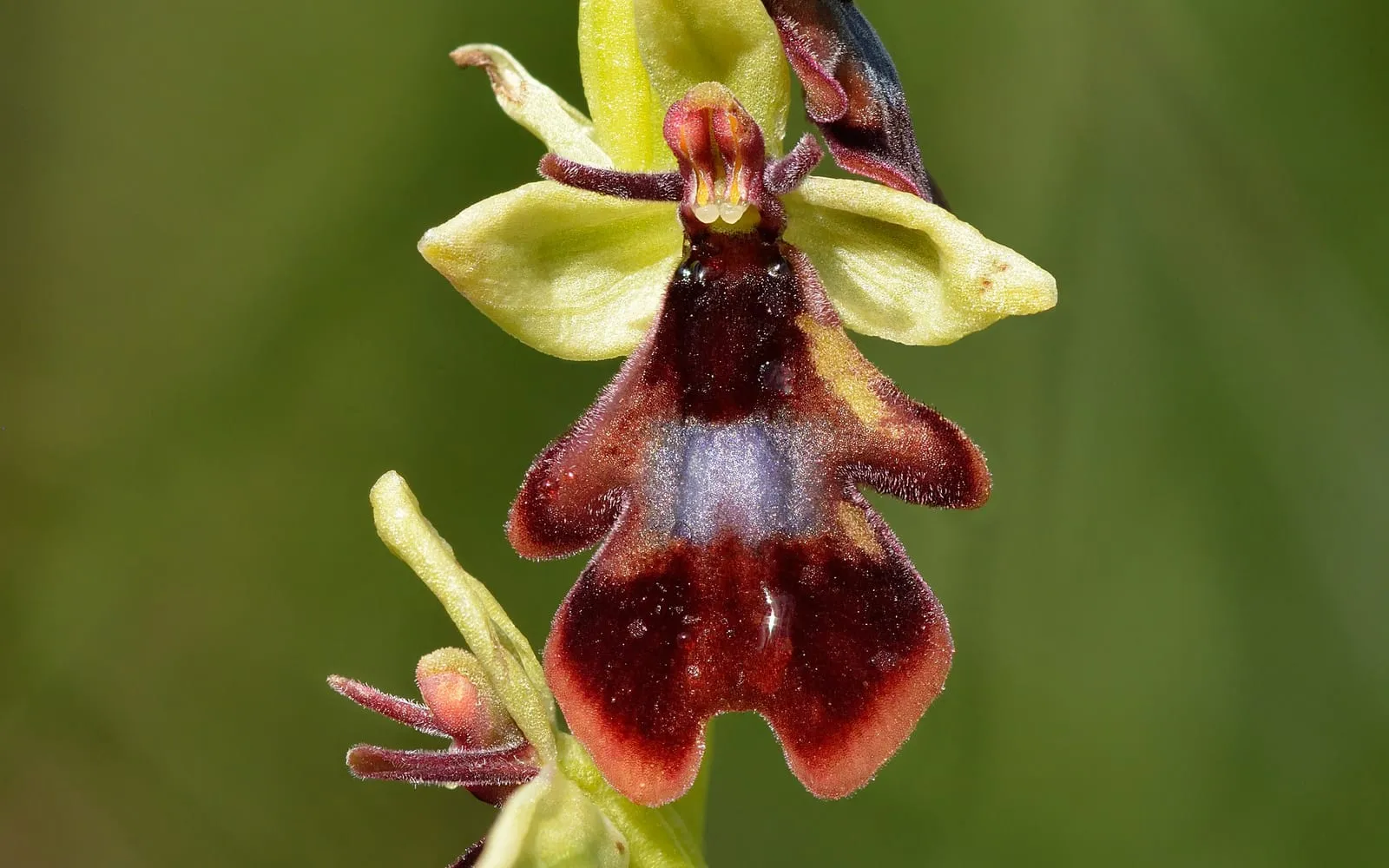
Ophrys insectifera has one of the most distinctive flowers in the European flora. Each bloom mimics a small insect clinging to a green tab: the velvety maroon lip forms the body, a shining blue-grey bar across it resembles a folded wing, and two tiny raised bumps at the top stand in for antennae, while the narrow yellow-green sepals splay out behind. The resemblance matters because it attracts a particular kind of male wasp. The plant is slender and easily overlooked, but its pollination depends on that relationship.
Spotting it
The fly orchid is thin and wiry, with a few narrow shining leaves near the base and a loose stem that can reach knee height but rarely draws the eye. The flowers sit well apart up the stem, each small and dark, so that a plant looks like a scatter of little insects along a green thread. There is no bright colour and no scent a human nose registers strongly, so the species is often more common than casual observers suppose. It is easy to miss at the edge of a wood or in the long grass of a chalk bank.
Its ground
This orchid keeps to lime-rich ground, growing on chalk and limestone in open woodland, scrub margins, fen edges and old grassland across Europe. It needs a cool, partly shaded position with a soil that never dries out completely, and it tolerates more shade than most of its relatives, often flowering along the shady side of a woodland ride. It ranges widely from Scandinavia to the Mediterranean, though it is nowhere abundant and has declined with the loss of chalk grassland and coppiced woodland.
Pollination
The pollination of the fly orchid is a textbook case of sexual deception. The flower releases a scent that copies the pheromone of a female digger wasp of the genus Argogorytes, and its shape and hairy texture reinforce the signal. Male wasps, emerging before the females, are drawn in and attempt to mate with the lip, a behaviour called pseudocopulation. During that attempt the pollen masses stick to the wasp’s head, and he carries them to the next flower. The orchid offers no nectar, and because only one wasp species is deceived, seed set is often sparse.
Cultivation is very difficult
Like the other hardy terrestrial orchids, the fly orchid begins life as a dust seed with no food store, and it germinates only where a compatible soil fungus infects the seed and feeds the seedling through years underground. Neither the fungus nor the delicate root system survives being dug up, so a wild plant moved to a garden dies. The species is also difficult in expert hands, since flask-raised seedlings are slow and sensitive, and it is seldom offered for sale. Anyone set on growing a hardy orchid does better with an easier, nursery-propagated kind and should leave the fly orchid on its bank.
Safeguarding it
Britain protects all wild plants from uprooting without the owner’s consent under the Wildlife and Countryside Act 1981, and the fly orchid’s reliance on a single pollinator makes its colonies fragile. Where the wasp is absent, the plant cannot set seed, so conserving the insect matters as much as conserving the flower. National protection applies across its European range, and CITES covers trade in all orchids. Maintaining light coppice and grazed chalk grassland supports both the orchid and its wasp.
Its wasp pollinator
The fly orchid’s dependence on a single group of digger wasps makes it one of the most specialised plants of its habitat. The male wasps of the genus Argogorytes hatch a little before the females, and the orchid flowers during that short gap. Its lip produces the scent and texture of a mate. When the females emerge, the trick stops working, so the orchid’s flowering is closely timed to the wasps’ emergence. Where the wasp is scarce, the orchid may flower well yet set almost no seed, so the plant’s seed production depends on the insect.
Years underground
From seed, the fly orchid spends years underground. The dust-fine seed germinates only when the right soil fungus enters it, and the young plant then lives as a small underground body, fed by the fungus, for several seasons before it produces a first leaf at the surface. Even as an adult it may skip a year, staying below ground without flowering if conditions are poor, so counts of flowering spikes can underestimate a colony. This slow, intermittent life is another reason the plant cannot be rushed into a pot or moved successfully.
Hiding in plain sight
Surveys repeatedly find the fly orchid to be more frequent than casual walkers suppose, because it is so hard to see. Its small dark flowers, spaced up a thin green stem with no bright colour to catch the eye, blend into the dappled shade of a woodland ride or the tall grass of a chalk bank. Botanists learn to look along the shaded edges of paths in early summer, at knee height, where the little insect-like flowers show against a plain background. Once the eye is trained to the shape, plants often turn up in numbers where none seemed to grow.
Questions worth answering
Does it really fool a wasp into mating with it? Yes. The flower copies the scent and feel of a female wasp, and males try to copulate with the lip, picking up pollen as they do.
Why is it hard to find? It is small, dark and scentless to us, so it blends into grass and woodland edge even where it is frequent.
Can I grow it from a plant found in a wood? No. Uprooting is unlawful without permission and the plant cannot live apart from its soil fungus.
Does it smell of anything? To a human, barely; to a male digger wasp, it smells convincingly like a mate.
When does it flower? From May into July, with the male wasps’ emergence setting the timing.
Fly Orchid problem guides
Not sure what is wrong? See the common houseplant pests guide.