
Houseplant
Fragrant Orchid
Gymnadenia conopsea
Also known as Gymnadenia conopsea
How to grow Gymnadenia conopsea, the fragrant orchid, a slender orchid whose clove and carnation scent strengthens after dusk to draw moths.
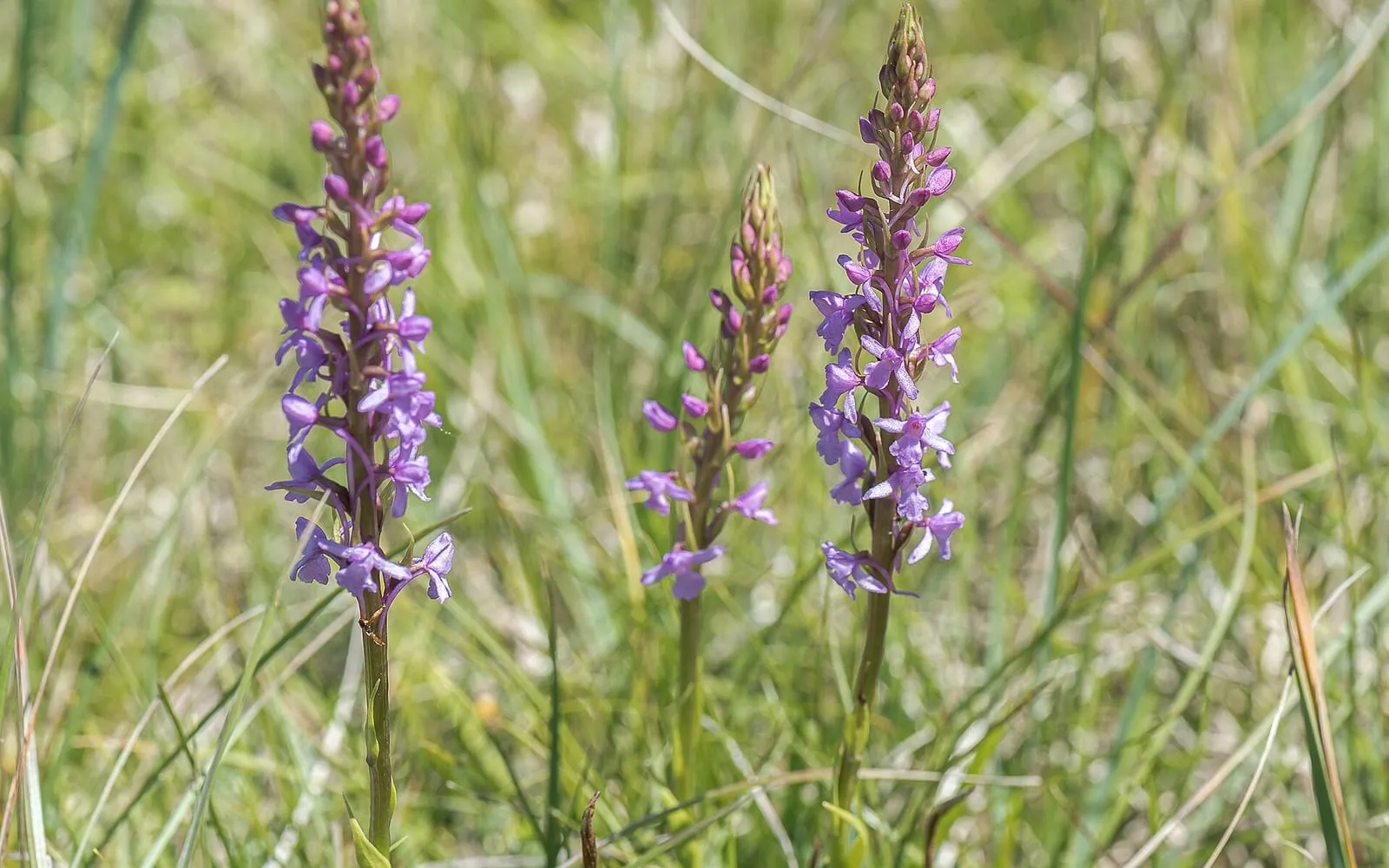
At a glance
- Difficulty
- Difficult
- Water
- Keep moist through spring and summer growth; leave to the natural winter wet
- Light
- Full sun to light shade
- Temperature
- Hardy; needs a cold winter rest
- Humidity
- Average
- Hardiness
- USDA 4-8, RHS H7, hardy to -25 C
- Type
- Perennial
- Height
- 20-50 cm
- Native to
- Europe and temperate Asia
A fully hardy terrestrial orchid of cool temperate grassland across Europe and temperate Asia. It needs a cold winter rest, a cool summer and lime-rich, unfertilised ground, and it fails in the mild winters and hot summers that suit tropical orchids. The zone describes winter cold only, and the soil fungus it depends on is the main limit on growing it.
Hardiness zones describe winter cold alone. Summer heat, humidity, rainfall and the length of the growing season decide as much, so treat the range as the outer limit rather than as a recommendation.
Not known to be toxic
Gymnadenia conopsea, the fragrant orchid, is not recorded as poisonous to people or pets, and orchids are not listed as toxic by the ASPCA or the RHS. A pet or child that chewed a leaf would be unlikely to have more than a mild stomach upset. The tubers were once dried and ground for salep, a food and drink.
Sources: ASPCA toxic and non-toxic plants, RHS potentially harmful garden plants
Scent before sight
Gymnadenia conopsea is noticeable by smell. On a warm summer evening a colony can scent the surrounding air with a sweet, spicy clove-and-carnation smell that carries several paces downwind, and the fragrance strengthens after dusk to attract the moths that pollinate it. The plant is a slender orchid of Europe and temperate Asia, common on lime-rich grassland, with dense, tapering spikes of small rose-pink flowers in June and July.
Recognising the plant
A fragrant orchid is tall and narrow, with a few keeled grey-green leaves clasping the lower stem and a long, cylindrical, closely packed flower spike above. The individual blooms are small and lilac-pink, occasionally deeper red or white, each with a broad three-lobed lip and, behind it, a long slender spur, often twice the length of the flower itself. That thread-thin spur is important for both its identity and its pollination, and it distinguishes the plant from the shorter-spurred marsh and spotted orchids of the same turf.
Where it grows
The species favours short, unimproved grassland over chalk and limestone, along with base-rich fen meadows and damp calcareous flushes, depending on the subspecies. It needs full sun, a soil rich in lime and low in fertiliser, and a sward kept open by grazing or cutting. Its range spans Europe from Britain and Scandinavia across to Siberia, and while it remains locally frequent on good grassland, it has vanished from land that has been ploughed, drained or heavily fertilised.
The leaves appear in spring before the flower spike rises. After flowering and seed set, the top growth yellows and dies back to the underground tuber. That seasonal die-back is normal, and it is why a marked planting position matters in a meadow garden.
Moths and the long spur
That long spur holds nectar at its tip, and reaching it needs a correspondingly long tongue. Night-flying moths, especially hawk-moths and other long-tongued species, hover at the spikes after dark, uncoil their proboscis into the spur and press their heads against the pollen masses, which stick and travel to the next flower. Some day-flying butterflies and moths also visit. Because the flower offers nectar, unlike the deceptive spider and fly orchids, it sets seed more freely, and a well-pollinated spike can ripen a good crop of capsules.
Why it stays wild
The fragrant orchid follows the same rule as the other hardy terrestrials: its seeds are dust-fine, carry no food, and germinate only when a soil fungus infects them and feeds the seedling through an underground stage before the first leaf shows. Lifting a plant severs it from that fungus and from the fine chalk turf it grows in, so transplanted plants dwindle and die. It is occasionally raised from flask-sown seed by specialists and can sometimes be settled into a lime-rich meadow garden, but wild plants must be left alone, both to protect the colony and because uprooting them without consent is unlawful.
Care of the species
While not among the scarcest orchids, the fragrant orchid depends on the survival of species-rich calcareous grassland, a habitat that has shrunk drastically across its range. In Britain the Wildlife and Countryside Act 1981 prohibits digging up any wild plant without the landowner’s agreement, and its downland and fen-meadow sites need continued grazing or hay-cutting to stay open. National protection applies elsewhere in Europe and CITES covers orchid trade. Maintaining unfertilised, well-grazed lime grassland supports both the orchid and its moth pollinators.
Avoid lawn fertiliser, weedkiller and mosskiller around it, since those change the thin turf it needs.
Three orchids under one name
What used to be treated as a single fragrant orchid is now split into three closely related species, sorted mainly by habitat and flowering time. The chalk fragrant orchid grows on dry lime grassland; the marsh fragrant orchid grows in wet base-rich fens and flushes; and the heath fragrant orchid grows on damper, more acid ground and blooms later. They share the slender spike, the clove scent and the long spur, and they differ in fine points of lip shape and spur length that need a close look with a hand lens. Between them they cover a wide spread of habitats for such similar-looking plants.
Scent and pollination
The fragrant orchid’s perfume attracts the moths that carry its pollen, and its chemistry shifts through the day. By afternoon and into the evening the sweet, spicy, carnation-like scent strengthens, attracting night-flying moths whose long tongues can reach the nectar in the slender spur. Different members of the fragrant orchid group are said to smell subtly different, and the strength of the scent can vary from plant to plant.
Why the long spur matters
The thread-like spur, often longer than the flower itself, controls which insects can pollinate the plant. Only an insect with a matching tongue can reach the nectar pooled at its tip, which narrows the visitors to long-tongued moths and a few butterflies. As they feed, their heads press against the pollen masses. The length of the spur and the length of the pollinator’s tongue are closely linked, which is why a fragrant orchid without long-tongued moths sets little seed even if it flowers well.
Questions people ask
Why does it smell stronger at night? Its main pollinators are night-flying moths, so the scent builds after dusk to draw them to the flowers.
What is the long tail behind each flower? A slender nectar-filled spur; only long-tongued moths and butterflies can reach the reward at its tip.
Does it set seed well? Better than the deceptive orchids, because it offers nectar to its visitors.
Can I grow it on my lawn? Only from responsibly raised stock in unfertilised, lime-rich turf; a wild plant should never be moved and rarely survives it.
When is it in flower? From June into July, sometimes later on cool upland grassland.
Fragrant Orchid problem guides
Not sure what is wrong? See the common houseplant pests guide.