
Houseplant
Gibbous Cynorkis Orchid
Cynorkis gibbosa
Also known as Cynorkis gibbosa
How to grow Cynorkis gibbosa, the gibbous cynorkis orchid, a small tuberous orchid of Madagascar with a purple-spotted leaf and coral-pink spurred flowers.
At a glance
- Difficulty
- Difficult
- Water
- Evenly moist in growth; nearly dry while the tubers rest
- Light
- Bright indirect light to partial shade
- Temperature
- Warm to cool; keep above about 5 deg C
- Humidity
- High
- Hardiness
- USDA 10-12, RHS H1c, hardy to 5 C
- Type
- Perennial
- Height
- 20-40 cm
- Native to
- Madagascar
An orchid of Madagascar that grows from coastal-hill forest margins to cool mountain slopes. It takes warm to cool conditions but has no frost tolerance, and it needs a dry rest in winter when its tubers are dormant. The zone describes winter cold only, and steady moisture in growth and a dry rest matter more than the minimum temperature.
Hardiness zones describe winter cold alone. Summer heat, humidity, rainfall and the length of the growing season decide as much, so treat the range as the outer limit rather than as a recommendation.
Not known to be toxic
The gibbous cynorkis orchid is not recorded as poisonous to people or pets, and orchids are not listed as toxic by the ASPCA or the RHS. A pet or child that chewed a leaf would be unlikely to come to harm beyond a possible mild stomach upset.
Sources: ASPCA toxic and non-toxic plants, RHS potentially harmful garden plants
About
Cynorkis gibbosa is a small terrestrial orchid found only in Madagascar, where the genus is especially diverse. Its species name refers to a rounded swelling, or gibbosity, associated with the flower. It grows from slender, hairy tubers at the edges of humid and montane forest, on damp rocks and banks, and on shaded granite, and it is rarely seen in cultivation. Its single leaf is dark green with purple or black spots, and its flower spike carries many coral to salmon pink flowers.
Appearance and character
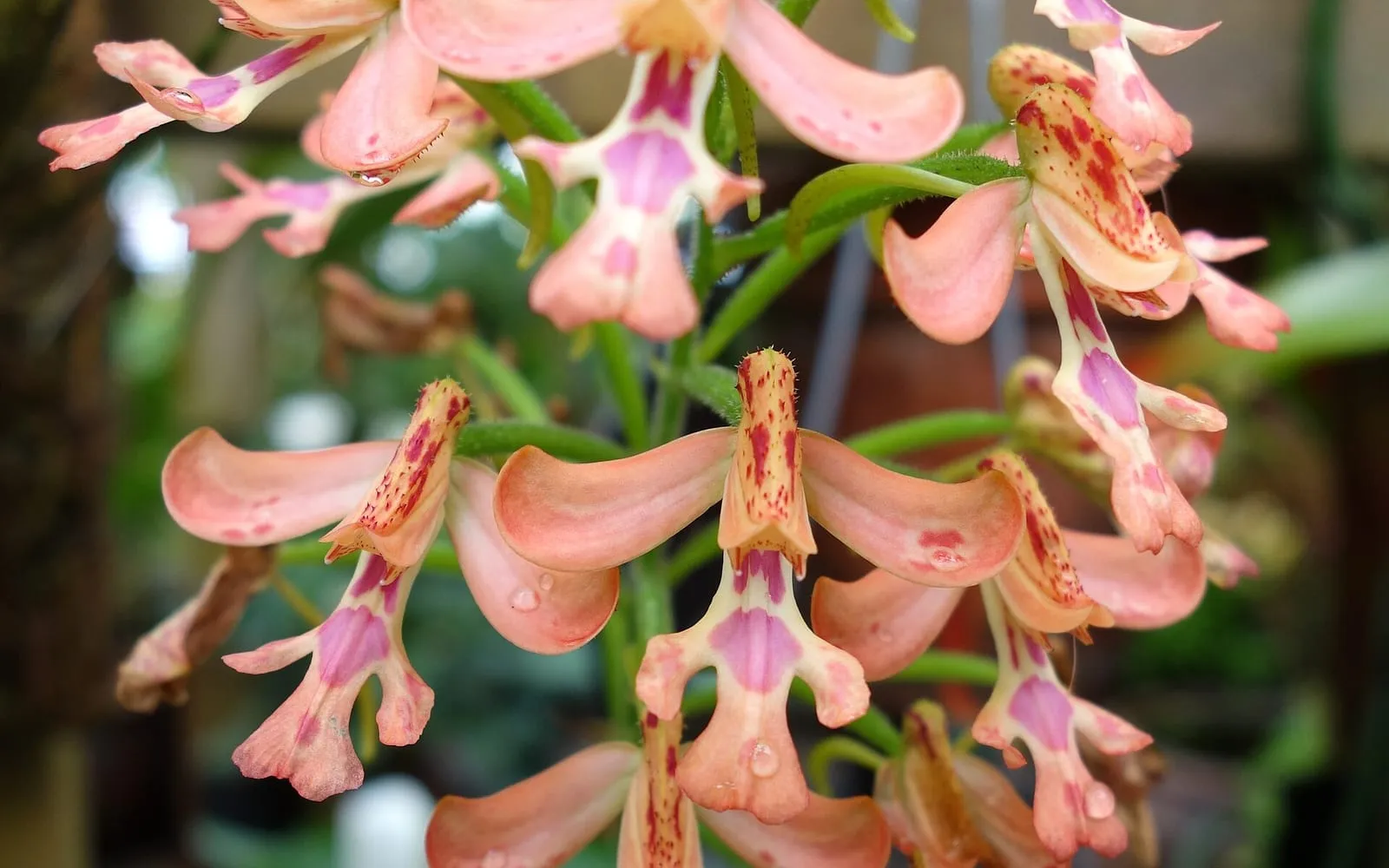
The plant is small and slender, with a single oblong leaf near the base, 10 to 30 cm long and spotted with purple. An upright stem carries a dense head of 10 to 40 flowers, each about 2.5 cm across. The petals are coral to salmon pink, and the lip is white towards the base with a mauve blotch at the centre and a three-lobed tip. A slender green spur hangs behind each flower. The elongated tubers are covered in fine hairs and store water and food between growing seasons.
Where it is from
The gibbous cynorkis is endemic to Madagascar. It grows at the edges of humid, subhumid and montane forest, on seepage banks, along streams, and as a lithophyte on damp, shaded granite, at roughly 500 to 2,000 metres. It flowers in the southern summer, mainly in January and February and sometimes into March, and is reported to rest through the drier months from about April to October. The climate there is mild to warm with a wet season and a dry one. It is very different from the cool winter-growth cycle of the Cape disas, and it is not a plant of African grassland.
How it grows
Growth comes each year from the tubers. With the wet season, the leaf and flower stem develop, the plant sets seed, a new tuber forms and the leaf dies back as the dry season sets in. The dust-fine seed relies on soil fungi to germinate in the wild, and natural increase is otherwise by the slow production of new tubers. Some growers report that it keeps its leaf through the year under steady warmth, so watch the plant itself rather than relying only on the calendar when deciding whether it is resting.
Through the seasons
Start of the wet season starts growth from the tuber, and the leaf and flower stem emerge as warmth and moisture return.
Height of the wet season is the main growth and flowering period, warm and humid.
End of the rains prompts the leaf to yellow and die back.
Dry season is a rest, with the tuber kept almost dry and above about 5 deg C until the next growing season.
Care difficulty
Difficult. It needs steady warmth and moisture in growth, a nearly dry rest, sharp drainage and low-mineral water, and a tuber left cold and wet rots. Little horticultural experience exists for the species, so the notes here describe its likely needs from its habitat instead of a proven method. Wild collection is unreliable and damaging, and a plant should come from a specialist nursery that raises its own stock.
Watering
Water follows the growing season closely. While the plant is in active growth, keep the open medium evenly damp with low-mineral water and let it drain freely, so the tuber never sits in stagnant wet. Reduce watering as the leaf ages. Through the rest, keep the tuber almost dry, since a cold, wet rest rots the small storage organ. The plant’s own growth is a more reliable guide than a fixed calendar.
Warning signs, diseases and pests
A tuber gone soft, or roots darkening and rotting, usually points to a rest left wet or cold. If the tuber is kept too dry for too long, it may shrivel and fail to regrow. Indoors, aphids gather on the soft flower stem, mealybugs and scale hide at the leaf bases, and fungus gnats breed in sodden compost. Pick them off by hand or use a gentle control, and keep the plant airy throughout.
Growing environment
Give it warm to cool, humid, bright conditions during growth, in an intermediate greenhouse or a plant case, in a free-draining, humus-rich medium of fine bark, peat-free compost and grit. Its natural habitat is partial shade at forest edges and on shaded rock, so filter strong direct sun through glass. Keep the rest dry and above about 5 deg C.
Potting and propagation
Plant the tubers just below the surface in a shallow pot, with the growing points upward and the medium pressed lightly around them. Repot every two or three years, just before growth restarts, into fresh medium, because old peaty mixes sour and collapse around the tubers. Increase is by dividing the tubers at repotting when a clump has produced several. Seed needs sterile flask culture, so it is a job for a specialist laboratory. The species is listed in CITES Appendix II as an orchid, so buy only plants that come with a legal trade record.
Feeding
Feed sparingly during growth, using a very dilute balanced orchid feed occasionally while the plant is active. The soils it grows in are poor and heavy feeding leaves harmful salt residues, so use a light dose. Give no feed during the rest, when the tuber takes nothing up from the medium.
Troubleshooting
What does the name gibbosa mean? It refers to a rounded swelling on the flower, a feature that helps distinguish this species from its many close relatives.
Is it from Africa? It is from Madagascar, where the genus is most diverse, and it is not a plant of the African mainland.
Why is it hard to grow? Little is documented about cultivating this species, so any attempt is partly experimental. It needs a moist growing season, a nearly dry rest and, for seed, the soil fungi it partners with in the wild.
How is it propagated? Chiefly through the slow yearly increase of its tubers. The dust-fine seed needs its fungal partner and rarely germinates in an ordinary pot.
Is it toxic to pets? Nothing in the genus is recorded as seriously toxic, though it is sensible to keep a chewing pet away from it.
Gibbous Cynorkis Orchid problem guides
Not sure what is wrong? See the common houseplant pests guide.