
Houseplant
Eyelash Begonia
Begonia bowerae
Also known as Begonia bowerae
How to grow Begonia bowerae, the eyelash begonia, a small creeping Mexican begonia whose leaves are fringed with fine white hairs, and how to water it.
At a glance
- Difficulty
- Easy
- Water
- When the top few centimetres of mix have dried
- Light
- Bright indirect light to light shade
- Temperature
- Warm; keep above about 13 deg C
- Humidity
- Average to high
- Hardiness
- USDA 10-12, RHS H1b, hardy to 13 C
- Type
- Perennial
- Height
- 15-25 cm
- Native to
- Mexico
A tender tropical foliage plant from Mexico, growing in warm, humid, shaded to filtered light. It needs warmth, humidity and bright indirect light, and it cannot take frost or chill. It is safest above about 13 deg C, and cold, wet compost or dry air causes problems.
Hardiness zones describe winter cold alone. Summer heat, humidity, rainfall and the length of the growing season decide as much, so treat the range as the outer limit rather than as a recommendation.
Harmful if eaten
- Harm from
- Eating it and handling it
- Affects
- People, cats, dogs and horses
The ASPCA lists begonias as toxic to cats, dogs and horses because of soluble calcium oxalate crystals, which are most concentrated in tubers and are also present in the rhizomes, stems and leaves. Chewing the plant can irritate the mouth and cause drooling and vomiting, and a child that chews it may be affected in the same way. The sap can irritate skin, so wear gloves when cutting stems. Keep it out of reach of pets and small children.
Sources: ASPCA toxic and non-toxic plants, RHS potentially harmful garden plants
First look
Begonia bowerae is a small, creeping begonia from the cloud forests of southern Mexico, named for the row of fine white hairs that fringe every leaf like a set of lashes. It belongs to the rhizomatous group, spreading by a knobbly, horizontal stem that creeps over the compost surface and sends up leaves and roots as it goes. That habit makes it a low, dense carpet instead of an upright plant, and a well-grown specimen can trail over the rim of a shallow pot. Compact and undemanding, it has become one of the most collected small foliage begonias.
The leaves close up
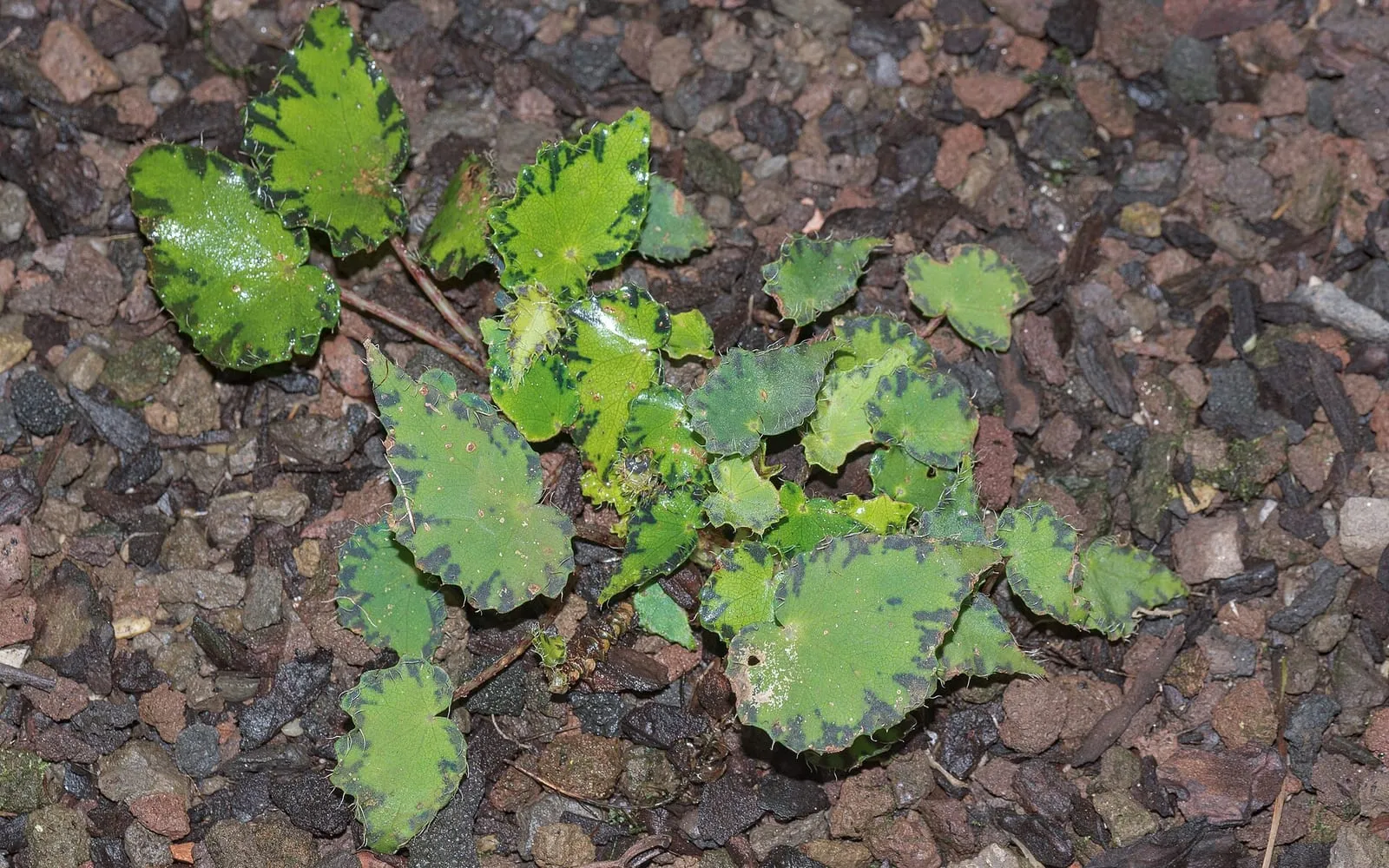
Each leaf is small, roughly heart-shaped and lopsided, its bright green surface bordered by a bold band of chocolate or near-black along the scalloped edge. Stiff pale hairs stand out all around the margin, and shorter ones dot the leaf stalks, catching the light and giving the plant its name. The leaves are held only a few centimetres above the rhizome, so the whole plant stays low and layered. Many named forms and hybrids exist, some with darker leaves and some with a silvery overlay, but all share the fringing hairs. Sprays of small pink-flushed white flowers rise on slender stalks in late winter and spring, the male and female blooms separate as they are throughout the genus.
Where it comes from
In the wild this begonia grows on shaded, humid rock ledges and forest floors in Mexico, where the rhizome creeps through moss and leaf litter. It is used to cool, moist, still air and light that never falls directly on it. Indoors, give it shade, moisture, warmth and no direct sun; hot sun or dry heat makes it shrivel.
Light for a rhizomatous begonia
Bright but wholly indirect light gives the richest leaf colour and the tightest, most compact growth. A north or east window is close to ideal, as is a position set back from a brighter one. In too little light the leaves pale and the rhizome stretches, spacing the leaves thinly; in direct sun the delicate blades scorch. It grows well under a grow light or in the middle of a room lit from the side, well away from direct south-window sun.
Watering the surface rhizome
Water when the top of the compost has dried, wetting the mix from below or around the edge and keeping the creeping rhizome itself dry. Because the rhizome sits on the surface, it rots quickly if it is kept constantly wet or buried, so let the surface dry between drinks and never leave the pot standing in water. Growth is strongest from spring to autumn, when it uses more water; in winter it slows and needs far less. A shallow pan suits it, since a deep pot of cold, soggy compost below the shallow roots encourages rot.
Warmth and a moist atmosphere
Steady warmth suits it, with about 13 deg C the sensible lower limit. This begonia needs more humidity than many, as the thin leaves brown at the edges in the dry air of a heated room. A pebble tray, a grouping of plants, or a spot in a naturally humid room such as a bright bathroom can help. Take care that the still, damp air does not become stagnant, though, since trapped moisture on the crowded leaves encourages mould.
Feeding
Feed lightly and often through the growing season, using a balanced liquid fertiliser at a quarter to half strength every few weeks. A rhizomatous begonia builds a modest root system and is quickly scorched by strong feed, so keep it dilute. Give none from late autumn until spring growth resumes.
Propagation
This is one of the easiest begonias to propagate. Cut a length of rhizome bearing a leaf or two, lay it on damp compost and pin it down so its underside makes contact, and new roots and shoots emerge within weeks. A single healthy leaf, its main veins nicked and pinned flat to moist compost in a covered tray, will also raise plantlets from the cuts. Keep the tray warm, bright and lightly humid until the young plants are large enough to lift, then pot them on singly. Divide a crowded plant at repotting in spring, potting each rhizome piece into fresh, open mix.
Keeping it well
Given moist air and shade, the plant has few problems. Powdery patches on the leaves are mildew, brought on by damp, stagnant conditions; thin the plant, improve air movement and remove affected leaves. Mealybugs may hide among the crowded leaf bases as white specks and can be picked off with an alcohol-tipped bud. Botrytis can rot leaves left wet and cold. A rhizome that turns soft and brown has been overwatered, and the cure is a drier regime and a more open compost.
The growing year
Spring brings fresh leaves and the flower spikes; divide, take cuttings and start feeding again.
Summer is steady leafy growth; keep the compost lightly moist, the air humid and the light indirect.
Autumn slows the plant; reduce watering and let feeding stop as the light weakens.
Winter is a cool rest; keep it above chilling temperatures, water sparingly and guard against sodden compost.
Common questions
Why are the leaf edges going brown? The air is too dry for it. Stand it on a moist pebble tray or move it to a more humid room.
What light does it need? Bright, indirect light only; direct sun burns the thin leaves, and deep shade draws the rhizome out.
How often should I water? When the surface has dried, keeping the creeping rhizome itself dry and watering much less in winter.
How do I propagate it? Pin a leafy piece of rhizome onto damp compost, or root a whole leaf with its veins nicked; both root readily.
Is it safe with pets? No. The ASPCA lists begonias as toxic to cats, dogs and horses because of soluble calcium oxalates, so keep it away from pets that chew.
Eyelash Begonia problem guides
Not sure what is wrong? See the common houseplant pests guide.