
Houseplant
Crested Coelogyne
Coelogyne cristata
Also known as Necklace orchid
How to grow crested coelogyne as a houseplant. Its cascading white flower spikes, cool winter rest, and why it resents being repotted too often.
At a glance
- Difficulty
- Moderate
- Water
- Regular watering in the growing season, a clear dry rest in winter
- Light
- Bright indirect light, some gentle direct sun
- Temperature
- 5-25 deg C; needs a cool, dry winter rest
- Humidity
- Moderate to high, 50 percent or more
- Hardiness
- USDA 9-10, RHS H2, hardy to 2 C
- Type
- Evergreen epiphytic perennial orchid
- Height
- 20-30 cm, spikes trail further
- Native to
- Himalayas
Cooler-growing than most popular houseplant orchids, reflecting its origin at real elevation in the Himalayas, and it tolerates a light winter chill well above frost that would trouble many tropical lowland orchids. A distinctly cool, dry winter rest is not optional for this species; it is the trigger that produces the following spring's cascading flower spikes.
Hardiness zones describe winter cold alone. Summer heat, humidity, rainfall and the length of the growing season decide as much, so treat the range as the outer limit rather than as a recommendation.
Not known to be toxic
Crested coelogyne has no toxicity listing from the RHS or the ASPCA and is considered safe around pets and children. There is no documented history of poisoning associated with this species.
Source: RHS
About
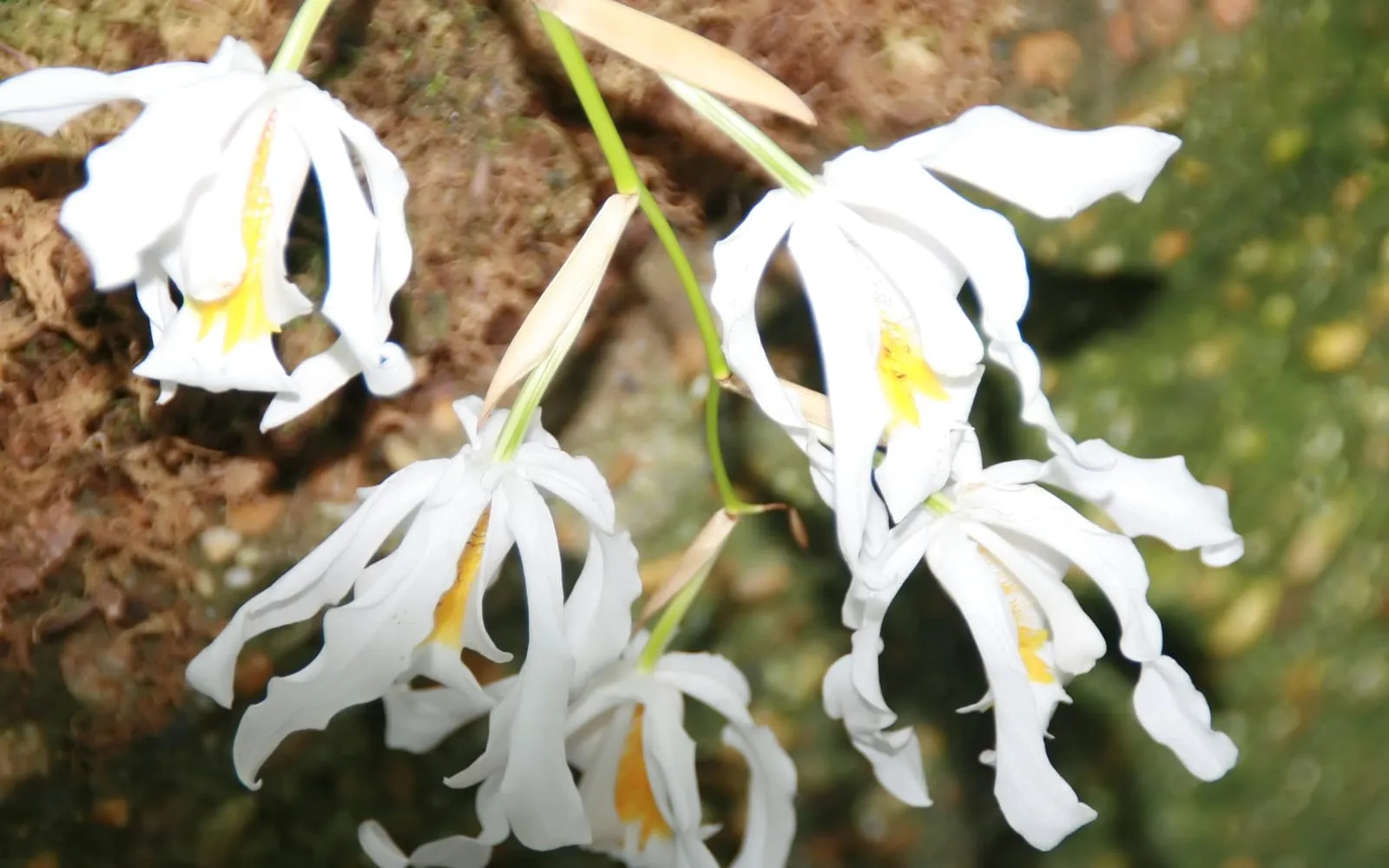
The crested coelogyne is one of the most reliably spectacular of the cooler-growing orchids in general cultivation, producing cascading spikes of pure white flowers, each with a distinctive frilled, crested yellow mark on the lip, in early spring on a well-grown, mature plant. Coming from real elevation in the Himalayas rather than tropical lowland forest, it needs noticeably cooler conditions than a typical Phalaenopsis or Dendrobium, and it is often grown successfully in an unheated conservatory or cool room that would be too cold for many other popular orchids.
Large, well-established specimens, grown undisturbed for years in the same container, are especially prized among orchid growers, since this species flowers most prolifically once it has built up a substantial, mature clump of pseudobulbs, and a plant repotted or divided too often rarely reaches that full potential.
Appearance and character
Rounded to oval pseudobulbs cluster tightly together, each one topped with a pair of narrow, pleated, dark green leaves. As the plant matures and pseudobulbs accumulate over successive years, the clump broadens into a dense mass that eventually fills and often overflows its pot.
Flower spikes emerge from the base of new growth in late winter and trail downward or outward, holding several large, pure white flowers each with a crest of yellow ridges on the lip, opening in a fairly compact flush rather than the extended, trickling bloom of some other orchids, which makes a well-timed flowering display particularly striking on a mature plant.
Where it is from
Forest at real elevation across the Himalayas, from northern India through Nepal and into parts of China, where cool temperatures, a distinct dry season and, at least locally, some exposure to cooler winter conditions are all part of the normal yearly rhythm.
That mountain forest origin, much cooler than the lowland tropical forest many popular orchids come from, is the reason this species both tolerates and needs a proper cool season to perform well, unlike orchids bred and selected primarily for constant warm indoor conditions.
How it grows
New pseudobulbs form each year at the leading edge of the expanding clump, gradually building up the plant’s overall size and, in turn, its flowering potential, since more mature pseudobulbs generally means more flower spikes the following spring. Because the species flowers best from an undisturbed, well-established clump, growers typically avoid dividing or repotting more often than strictly necessary, often leaving a plant in the same pot for several years even as it becomes visibly crowded.
The cool, dry winter rest plays a direct role in this growth cycle, signalling to the plant that the time has come to initiate flower buds rather than continue vegetative growth, a distinction this species draws more sharply than many other orchids.
Through the seasons
Spring is the main flowering period, with cascading white spikes opening from the base of new growth, typically before or alongside the season’s new leaf growth.
Summer is the main growing season, with new pseudobulbs developing. Water regularly and feed every second watering.
Autumn growth slows as temperatures drop; begin easing off watering in preparation for the winter rest.
Winter provide a distinctly cool, fairly dry rest, well above frost but noticeably cooler than summer, which is what triggers strong flowering the following spring.
Care difficulty
Moderate. The main adjustment for growers used to warmer, tropical orchids is providing a cool winter, which some homes struggle to offer without a dedicated cool spot such as an unheated porch or conservatory. Beyond that seasonal requirement, routine care is straightforward.
Watering
Water thoroughly during the growing season, allowing the compost to approach dryness between waterings. Reduce watering substantially over the winter rest, keeping the compost only lightly moist rather than constantly wet, since this dry period alongside the cool temperatures is what most reliably brings on a strong spring flowering display.
Warning signs, diseases and pests
Scale insects and mealybug can colonise the pseudobulbs or leaves, particularly in a dense, mature clump where they are harder to spot, and are treated with careful manual removal or a horticultural soap for persistent infestations. Spider mites occasionally appear in warm, dry air, showing as fine speckling on the leaves.
A plant that produces healthy pseudobulbs but flowers poorly or not at all is the most common frustration with this species, and almost always traces back to a winter that was not sufficiently cool or dry, or to the plant having been divided or repotted too recently to have built up enough mature growth to flower well.
Growing environment
Bright, indirect light with a little gentle direct sun suits it well. Cooler conditions than many other houseplant orchids are appropriate year round, and a reliably cool spot for winter, whether an unheated room, porch or conservatory, is close to essential for reliable flowering.
Feeding
A balanced orchid fertiliser at quarter strength, applied every second watering during active growth, supports steady pseudobulb development. Stop feeding entirely during the winter rest, when the plant is not taking up nutrients in any meaningful quantity.
Troubleshooting
The plant grows well but rarely flowers. Check that it received a cool, sufficiently dry winter rest, since this is the most common cause of poor flowering in an otherwise healthy plant.
A recently divided or repotted plant has stopped flowering. This species flowers best from an undisturbed, well-established clump, so a recently disturbed plant may need a couple of seasons to rebuild enough mature pseudobulbs before flowering resumes at its previous level.
The clump has become very congested and is spilling out of its pot. This is tolerated well by this species and does not need immediate correction; move to a slightly larger pot only when strictly necessary, since disturbance can set back flowering for a season or more.
Small clusters are visible tucked among the crowded pseudobulbs. Check for scale insects or mealybug, which can hide within a dense clump more easily than on a more open-growing orchid, and treat promptly with manual removal or a horticultural soap.
Crested Coelogyne problem guides
Not sure what is wrong? See the common houseplant pests guide.