
Outdoor plant
Rain Lily
Zephyranthes candida
Also known as Autumn zephyr lily, Fairy lily, Peruvian swamp lily
How to grow rain lily, Zephyranthes candida. Planting a true bulb whose crocus-like white flowers open within days of rain, and its evergreen grassy foliage in a mild climate.
At a glance
- Difficulty
- Easy
- Water
- Regularly in summer, sparingly in winter where grown as deciduous
- Light
- Full sun
- Temperature
- Needs winter protection below zone 8
- Hardiness
- USDA 7-10, RHS H3, hardy to -10 C
- Type
- Bulbous evergreen perennial in mild climates
- Height
- 15-30 cm
- Native to
- The Rio de la Plata region of Argentina, Uruguay and Paraguay
Zone 7 is the cold edge of what this bulb tolerates, and even there it generally needs a dry mulch and a sheltered spot to come through winter reliably. From zone 9 upward it grows outdoors year round as an evergreen. What the zone number does not capture is how much summer moisture it needs, since unlike most of the bulbs, corms and tubers in this collection it comes from ground that floods seasonally and tolerates boggy, even briefly waterlogged soil in summer far better than it tolerates cold, wet soil in winter.
Hardiness zones describe winter cold alone. Summer heat, humidity, rainfall and the length of the growing season decide as much, so treat the range as the outer limit rather than as a recommendation.
Toxic if eaten
- Do not eat
- Every part, and the bulb most of all
- Harm from
- Eating it and handling it
- Affects
- People, cats and dogs
Rain lily contains lycorine and related alkaloids, the same class of compound found across the Amaryllidaceae family, including daffodils, snowdrops and amaryllis, concentrated most heavily in the bulb. Eating any part causes salivation, vomiting, abdominal pain and diarrhoea, and a larger ingestion of bulb material can bring on lethargy and tremors. The grassy foliage is easily mistaken for ordinary lawn grass or chives by a child or a grazing pet, which is the main practical risk with a plant this low-growing and this widely used as an edging or lawn substitute in warm climates. Handling the sap causes mild skin irritation in some people. For a person, eating a piece of leaf or bulb causes an unpleasant stomach upset instead of anything life-threatening, and a child who has chewed on the foliage is worth a call to a doctor.
Sources: RHS potentially harmful garden plants, ASPCA toxic and non-toxic plants
About
The name describes what the plant does. After weeks of dry weather, a rain lily clump that has shown nothing but grassy leaves can be covered in crocus-like white flowers within two or three days of a good soaking rain, the whole clump responding to the same trigger at once instead of flowering on an ordinary fixed schedule. The mechanism is a response to the sudden change in soil moisture and temperature that follows a heavy rain after drought, and gardeners in its native range and in warm gardens worldwide grow it for that sudden, weather-triggered display.
Individual flowers last only a few days, so a rain lily display is a burst instead of a steady show, repeating each time a dry spell breaks over the summer and into autumn.
Unlike most of the bulbs, corms and tubers covered in this collection, which die back completely for part of the year, rain lily keeps its narrow, grass-like foliage right through the year in a mild, frost-free climate, functioning almost as a low evergreen groundcover between flushes of flower.
Appearance and character
Narrow, dark green, rush-like leaves grow in dense clumps directly from clustered bulbs, staying low and grassy enough that an unflowering patch is easily mistaken for ordinary turf at a glance.
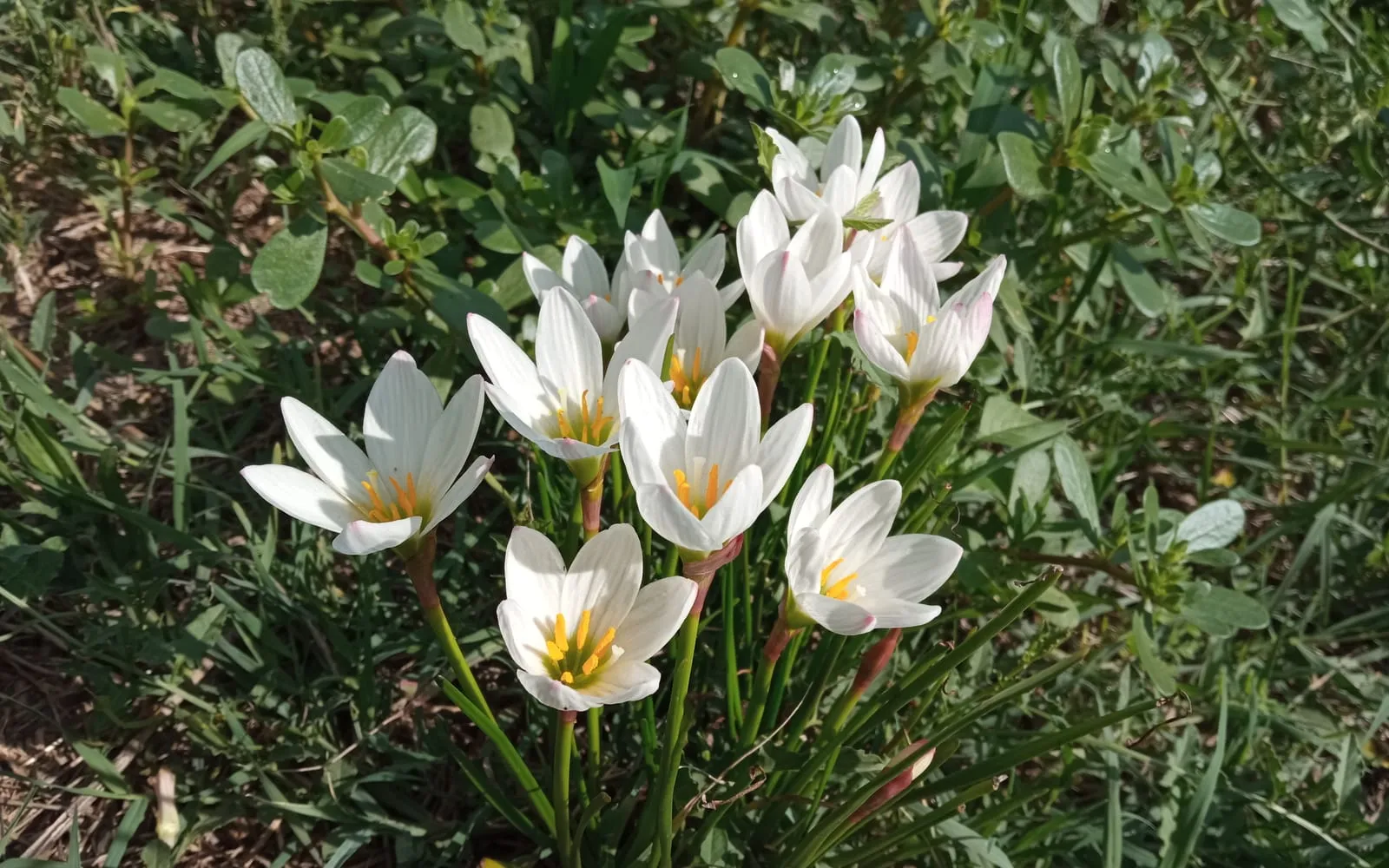
Flowers rise on slender stems just above the foliage, each a simple six-petalled goblet, pure white and faintly flushed pink on the outside of the petals in bud, opening flat in bright sun and closing again at night or in dull weather. A single stem carries one flower instead of a cluster, though a well-established clump in full response to rain can produce dozens of stems simultaneously.
The bulbs themselves are small, narrow and elongated instead of rounded, clustering tightly together and multiplying steadily by offset to form increasingly dense mats over a few seasons.
Flowering follows rain after dryness rather than a fixed calendar window, typically running from midsummer into autumn wherever rainfall breaks a dry spell, which sets it apart from almost every other plant in this collection, most of which flower in a defined spring or autumn window regardless of rainfall.
Where it is from
The Rio de la Plata region of southern South America, spanning parts of Argentina, Uruguay and Paraguay, where it grows in damp grassland, along riverbanks and in seasonally flooded ground.
That habitat, wet for part of the year and prone to drying out between rains, is exactly what shapes the plant’s flowering trigger. A sudden heavy rain after a dry spell in its native grassland signals a burst of favourable growing conditions, and flowering fast in response is a way of making the most of a window that will not last. The same habitat also explains its unusual tolerance of wet, even boggy summer soil, which most true bulbs from drier climates cannot tolerate.
The genus name comes from the Greek for west wind, a nod to the flower’s origin in the western hemisphere from a European perspective, and the species name candida means white, describing the flower colour directly.
How it grows
A bulbous perennial, evergreen where winters stay frost-free, spreading steadily by offset bulbs that cluster tightly around the parent, building into a dense mat instead of staying as scattered individual plants.
Plant bulbs with the neck at or just below soil level, about 2 to 3 cm deep, considerably shallower than most true bulbs in this collection, and space them 8 to 10 cm apart to allow for the clustering growth habit. Spring planting suits most climates, though in a mild, frost-free area bulbs can go in at almost any time of year.
Once established, the clump needs very little intervention. It flowers in response to rainfall instead of to any particular care given by the gardener, and the most useful thing to do in a dry summer, where a display is wanted, is to give the clump a thorough soak and watch for flowers within a few days.
In a marginal climate at the cold edge of its range, treat the foliage as deciduous even if it would otherwise stay evergreen further south, and protect the dormant bulbs with a dry winter mulch.
Through the seasons
Spring brings renewed growth and the strongest flush of foliage, particularly where the plant has died back over a cold winter, along with the first possible flowering if a wet spell follows a dry early spring.
Summer is the main flowering season, with fresh flushes of flowers appearing every time a period of dry weather is broken by rain or a deliberate deep watering.
Autumn often brings the last strong flush of flowers as summer storms or the first autumn rains arrive, continuing into early autumn in a mild climate before growth slows for the year.
Winter is either continued evergreen growth in a frost-free climate, or full dormancy under a protective mulch where winters bring occasional frost at the cold edge of the plant’s range.
Care difficulty
Easy, particularly in a climate mild enough to grow it as an evergreen perennial. It needs little beyond reasonably fertile soil and a willingness to accept its unpredictable, rain-triggered flowering instead of a fixed schedule.
The main limitation is cold. Below about zone 7, the plant does not reliably survive outdoors, and gardeners in colder areas either grow it in a container that can be moved under cover for winter, or accept it as a summer bedding plant grown fresh from bulbs each year.
Watering
Water regularly and generously through the growing season, since this is one of the few bulbs in this collection that benefits from moist to wet soil in summer instead of needing sharp drainage.
Where a flush of flowers is wanted during a dry summer spell, a deep, thorough soak reliably triggers a response within a few days, which is the most direct way to control when the display happens instead of waiting for natural rainfall.
In a climate where the plant goes dormant over a cold winter, reduce watering substantially and keep the resting bulbs on the drier side until growth resumes in spring. In a marginal climate, cold wet soil kills the bulbs more often than cold alone.
Warning signs, diseases and pests
Very few pests trouble this plant in most gardens. Slugs occasionally graze soft young growth, though established clumps of tough, grassy foliage are rarely bothered.
Bulb rot appears almost exclusively where cold and wet combine over winter, at the cold edge of the plant’s hardiness range, showing as clumps that fail to return with the same vigour the following spring or that rot completely. A dry winter mulch in a marginal climate reduces this risk considerably.
Frost damage, showing as blackened, collapsed foliage after an unprotected hard freeze, is common at the cold end of the plant’s range but rarely kills the bulb itself, which usually resprouts from below ground once warmer weather returns.
A clump that has stopped flowering despite reasonable summer rain is usually either too shaded, since it needs full sun to flower well, or has not yet experienced the sharp dry-then-wet trigger it responds to, particularly in a climate with consistently even rainfall instead of distinct dry spells.
Growing environment
Full sun gives the strongest flowering. In shade the plant survives and spreads as foliage but rarely flowers well, since the trigger response depends partly on soil warming quickly after rain, which a shaded position does more slowly.
Moderately fertile soil that holds moisture through summer suits it best, and unlike most bulbs in this collection it tolerates wet, occasionally boggy conditions during the growing season without rotting, reflecting its native riverside and seasonally flooded habitat.
It works particularly well as a low edging plant, massed at the front of a border, or as an unconventional lawn substitute in a warm, frost-free climate, where the grassy evergreen foliage doubles as groundcover between flushes of flower.
Protect the crown with a dry mulch through winter at the cold edge of its range, since winter wet combined with cold causes losses more often than cold alone.
Feeding
Feed monthly through the main growing season, from late spring until flowering tails off in autumn, with a balanced liquid feed to support the repeated flushes of flower the plant produces in response to rain.
Reduce feeding through any period of winter dormancy in a marginal climate, and stop entirely once the foliage has died back or growth has clearly slowed for the season.
In mild climates where the plant grows year round, light feeding can continue through most of the year, tapering off only during the coolest months when growth naturally slows.
Troubleshooting
Why did it suddenly flower after weeks of nothing? That is the plant’s normal behaviour instead of anything unusual. A heavy rain, or a deliberate deep watering, after a dry spell reliably triggers a flush of flowers within a few days.
How deep should I plant the bulbs? About 2 to 3 cm, shallow, with the neck of the bulb at or just below soil level, spaced 8 to 10 cm apart to allow for the clustering growth.
It has stayed green all winter instead of dying back. That is normal in a mild, frost-free climate, where the foliage is evergreen rather than deciduous.
Will it survive my cold winters? Reliably only from about zone 7 upward, and even there it usually needs a dry protective mulch. Colder gardens can grow it as a container plant moved under cover, or as annual summer bedding.
It is not flowering despite regular summer rain. Check how much sun it gets. It needs full sun to flower well, and a shaded position produces foliage but few or no flowers.
Can I grow it in consistently wet ground? Yes, better than most bulbs in this collection. It comes from seasonally flooded grassland and tolerates summer wet far better than winter wet combined with cold.
Is it dangerous to pets or children? It contains lycorine, the same alkaloid found in daffodils, and is moderately toxic if eaten, with the bulb carrying the highest concentration. The grassy foliage can be mistaken for lawn grass, so it is worth keeping an eye on a pet or child that grazes low planting.