
Outdoor plant
Common Liverwort
Marchantia polymorpha
Also known as Umbrella liverwort
What common liverwort, Marchantia polymorpha, needs to spread across damp pots and paths, and how to stop it colonising a greenhouse or nursery bed.
At a glance
- Difficulty
- Easy
- Water
- Thrives on permanently damp surfaces; drying out checks its spread
- Light
- Partial shade to full shade
- Hardiness
- USDA 3-10, RHS H7, hardy to -30 C
- Type
- Perennial thalloid liverwort
- Height
- A few millimetres tall; the thallus spreads indefinitely
- Native to
- Cosmopolitan across temperate regions worldwide
Extremely hardy and found across most of the temperate world on every inhabited continent, tolerating cold far better than it tolerates drying out. It survives hard frost with no visible damage and resumes growth as soon as the surface it grows on is damp again, which is why it appears and disappears from the same greenhouse bench or plant pot depending on the season's rainfall rather than the temperature.
Hardiness zones describe winter cold alone. Summer heat, humidity, rainfall and the length of the growing season decide as much, so treat the range as the outer limit rather than as a recommendation.
Not known to be toxic
Common liverwort has no toxicity listing from the RHS or the ASPCA and poses no known hazard to pets, children or garden wildlife. Its presence is a horticultural nuisance in pots and seed trays rather than a safety concern of any kind.
Source: RHS
About
Common liverwort is the flat, ribbon-like green growth that colonises the compacted, permanently damp surface of overwatered plant pots, greenhouse staging and shaded paving almost everywhere in the temperate world. Most gardeners meet it as an unwelcome coloniser of a favourite houseplant’s pot rather than as a plant deliberately grown, and this entry exists mainly to explain what it is and how to discourage it, alongside a note on the small number of gardeners who do cultivate it deliberately for a naturalistic bog garden or terrarium.
It is one of the most ancient lineages of land plant still living, part of a group that diverged from the rest of the plant kingdom hundreds of millions of years before flowering plants existed, and its simple, undifferentiated body plan reflects that early branch on the tree of life rather than any lack of evolutionary success; liverworts of this kind have persisted essentially unchanged in basic form for an extraordinarily long time.
Appearance and character
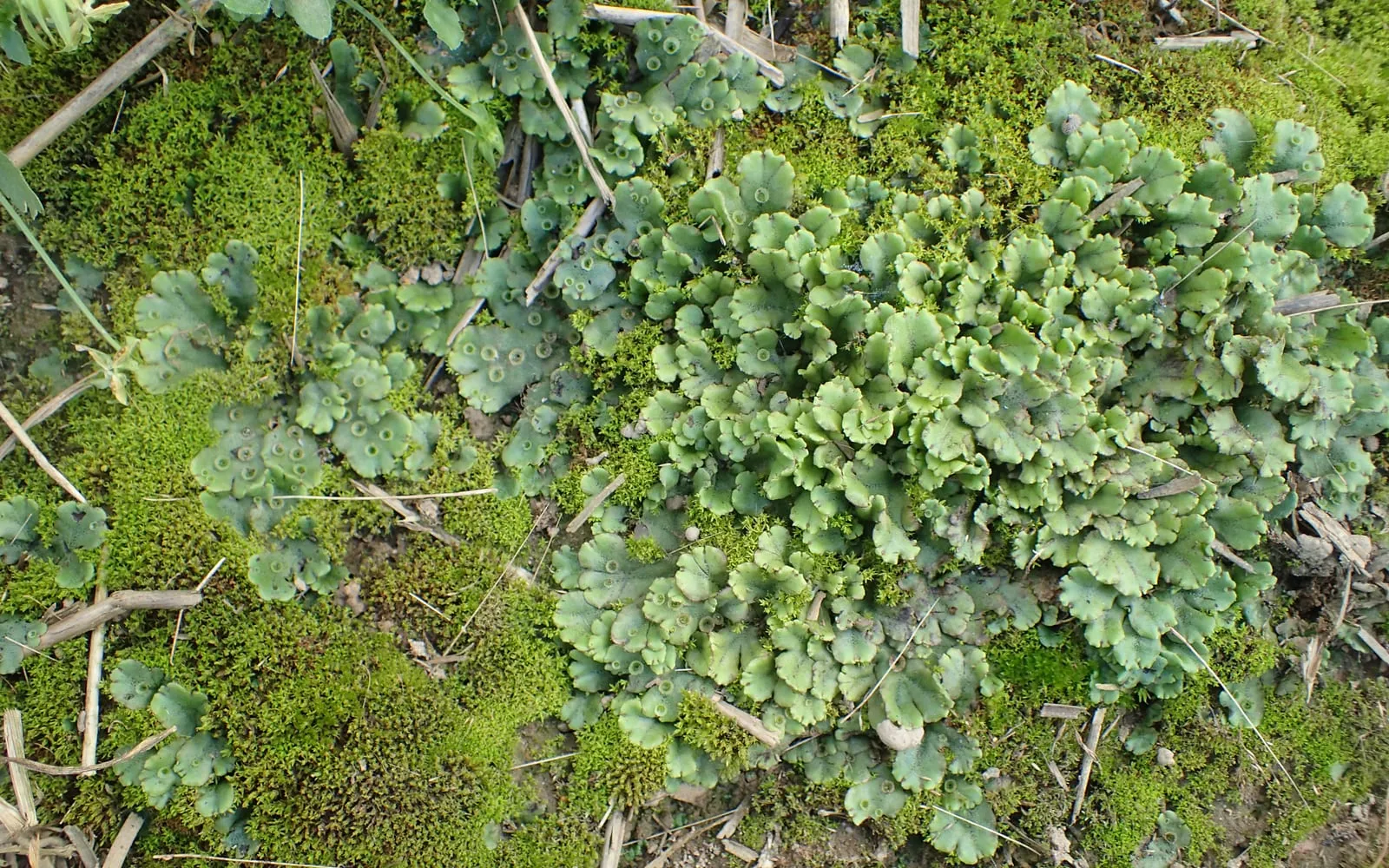
The plant body, called a thallus rather than a leaf, is a flat, branching, ribbon-like green structure that lies pressed against the surface it grows on, with a distinctive pattern of small diamond-shaped segments visible under magnification and tiny pores for gas exchange dotted across the upper surface.
Two reproductive structures are its most recognisable features: small, cup-shaped structures called gemma cups scattered across the thallus, which hold tiny packets of tissue splashed out by falling rain to start new plants nearby, and taller, umbrella-shaped stalks that appear in favourable conditions, bearing the plant’s true sexual reproductive structures beneath their canopy.
Where it is from
Damp, compacted, disturbed ground worldwide, wherever soil has been packed down and stays consistently wet: greenhouse floors, plant pots, damp paths, recently disturbed nursery beds and the edges of streams and ponds. It is considered cosmopolitan, found on every continent with a temperate or suitable climate, aided by its extremely light, wind-dispersed spores and splash-dispersed gemmae.
Disturbed, compacted, poorly drained ground is its preferred habitat rather than an accident of cultivation, which is why it appears so readily on the compacted surface of an overwatered pot or a well-trodden greenhouse floor.
How it grows
A perennial that spreads by branching outward across a surface from its growing edges, while also reproducing rapidly by the small gemmae splashed out of its cup-shaped structures during rain or watering, each one capable of growing into an entirely new plant wherever it lands on suitably damp ground.
This combination of vegetative spread and prolific asexual reproduction lets a single colonising fragment cover a considerable area within a single growing season under favourable, permanently damp conditions, which is the main reason it can seem to appear from nowhere across a whole greenhouse bench.
Through the seasons
Spring and summer are the periods of fastest growth and reproduction, particularly in a wet season or on regularly watered pots and staging.
Autumn growth continues so long as surfaces remain damp, slowing only as conditions cool and dry.
Winter the thallus persists through frost with little visible change, resuming active growth as soon as temperatures and moisture allow.
Care difficulty
Easy, in the sense that this plant needs nothing and grows given the smallest opportunity; the practical challenge for most gardeners is control rather than cultivation. Anyone who wants a naturalistic patch for a bog garden or terrarium needs only to keep a fragment permanently damp on a suitable surface, which it colonises without further encouragement.
Watering
For deliberate cultivation, keep the surface it grows on permanently damp; drying out even briefly checks growth noticeably, though the plant generally resumes once moisture returns rather than dying outright.
For control in an unwanted spot, the single most effective step is the opposite: reducing watering frequency and improving surface drainage, since this plant cannot maintain a foothold on ground that is allowed to dry between waterings.
Warning signs, diseases and pests
Common liverwort has no significant pests or diseases of its own; if anything, it is itself regarded as the problem in most garden and nursery settings, since a thick mat across the surface of a pot can reduce oxygen reaching plant roots below and compete with seedlings for light and space in a seed tray.
A pot developing a green, flattened crust on its compost surface, with small cup-like structures visible on close inspection, is the clearest identifying sign, and is best addressed by scraping off the growth, improving surface drainage with grit, and reducing how often the pot is watered from above.
Growing environment
Shade to partial shade and permanently damp, compacted, poorly aerated surfaces are what this plant favours, which is the reverse of what most cultivated plants want from their growing medium. Improving drainage, increasing light and surface aeration, and allowing the surface to dry between waterings all work against it directly.
Feeding
No feeding is relevant. This plant favours nutrient-rich but poorly aerated, compacted conditions, and fertilising a surface already colonised by it does nothing to discourage its spread and may encourage it further.
Troubleshooting
A houseplant’s pot has developed a green, crusty surface. This is almost certainly common liverwort, encouraged by frequent overhead watering and compacted compost. Scrape it off, top-dress with grit to improve surface drainage, and water from below where practical.
It keeps returning after being scraped away. Any surviving fragments or gemmae readily regrow. Combine repeated removal with reduced overhead watering and improved compost aeration for a lasting fix.
It has spread across greenhouse staging or a nursery bed. Improve drainage and airflow across the affected area, and consider whether irrigation is being applied more often or more heavily than the plants need.
You want to establish it deliberately in a bog garden or terrarium. Transplant a healthy fragment onto a permanently damp, shaded surface and leave it undisturbed; given consistent moisture it typically establishes and spreads without further intervention.
Seedlings in a tray have stopped growing since the liverwort appeared. A dense thallus across the compost surface can restrict oxygen reaching germinating seeds and compete directly with young seedlings for light and space. Scrape away as much of the liverwort as possible without disturbing the seedlings’ roots, and consider re-sowing in fresh, better-drained compost if the tray is heavily affected.