
Outdoor plant
Giant hogweed
Heracleum mantegazzianum
Also known as Cartwheel flower, Giant cow parsley, Hogsbane
How to recognise Heracleum mantegazzianum, tell it from common hogweed and cow parsley, remove it safely, and what to do if the sap gets on your skin.
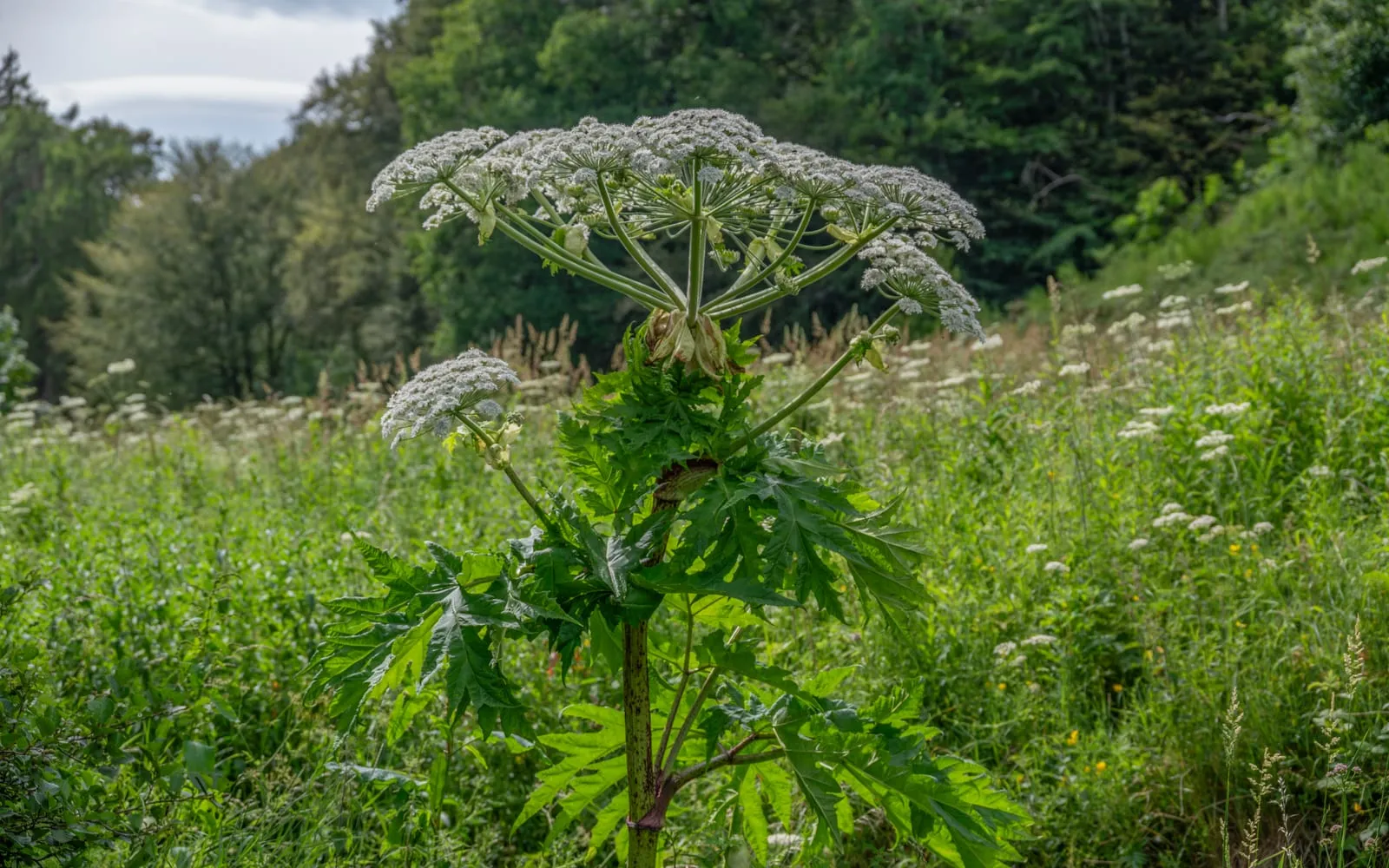
At a glance
- Difficulty
- Difficult
- Water
- Never water it. This is a plant to remove rather than grow
- Light
- Full sun to partial shade
- Temperature
- Fully hardy, and it spreads fastest along cool damp watercourses
- Hardiness
- USDA 3-8, RHS H7, hardy to -30 C
- Type
- Monocarpic perennial, flowering once after two to five years and dying
- Height
- 3-5 m in flower
- Native to
- The western Caucasus, in Georgia and southern Russia
- Best month
- June in the Northern Hemisphere, December in the Southern Hemisphere
The legal duty is the thing that changes at a border, and it is stronger outside Britain than in it. In the United States giant hogweed is a federal noxious weed, illegal to import or move between states, and New York, Washington, Michigan, Vermont and Maine all require landowners to control it. Canada regulates it provincially. In Britain it is listed on Schedule 9 of the Wildlife and Countryside Act 1981, which makes planting it or causing it to grow in the wild an offence but does not require you to remove it.
Hardiness zones describe winter cold alone. Summer heat, humidity, rainfall and the length of the growing season decide as much, so treat the range as the outer limit rather than as a recommendation.
Every month named in this guide is for the temperate Northern Hemisphere. If you garden in the Southern Hemisphere, shift each one by six months, so June becomes December. Closer to the equator the wet and dry seasons matter more than the calendar, and the shift stops being a useful guide.
Poisonous if eaten
- Do not eat
- The sap in every part, and the hollow stems and leaves most of all
- Harm from
- Handling it, sap in the eyes and eating it
- Affects
- People, cats, dogs and horses
Giant hogweed causes chemical burns and it is the most dangerous plant to touch in Britain. The sap contains furanocoumarins, which are harmless in the dark and become intensely reactive under ultraviolet light. Sap on skin that is then exposed to daylight destroys the skin's ability to protect itself, producing redness within a day, then large fluid-filled blisters and deep painful burns over the following two to three days. The scarring lasts months, and the affected skin can stay hypersensitive to sunlight for years, reblistering each summer. Sap in the eye causes severe damage and sometimes permanent blindness. Children are hurt most often, usually after cutting the hollow stems to make telescopes or pea-shooters. If sap touches you, get out of the sunlight straight away, wash the area with soap and cold water, cover it completely, and keep it covered and out of daylight for at least 48 hours. Seek medical advice for anything beyond a small patch, and treat any contact with the eyes as an emergency. Dogs and horses are affected on the muzzle and any thinly haired skin. In the United States it is a federal noxious weed, illegal to import or move between states, and several states require landowners to control it. In Britain it is listed on Schedule 9 of the Wildlife and Countryside Act 1981, which makes it an offence to plant it or cause it to grow in the wild, and cut material and contaminated soil are controlled waste under the Environmental Protection Act 1990 and must go to a licensed facility rather than into a compost heap or a green bin.
Sources: RHS potentially harmful garden plants, ASPCA toxic and non-toxic plants
About
This is the one plant in the collection that nobody should be growing. Giant hogweed is here so that you can recognise it, understand why it matters, and know what to do if you find it or if its sap gets on your skin.
The danger is not poisoning in the ordinary sense. The sap contains compounds that are inert in the dark and become violently reactive in sunlight, so a smear on a forearm produces nothing at all for a day and then a deep blistering burn that scars for months and leaves the skin sun-sensitive for years afterwards.
It reached Britain in the nineteenth century as an ornamental for large gardens, which is exactly how something 5 m tall with a metre-wide flower head gets planted in the first place. It escaped along rivers, and it is now established across most of the country.
Appearance and character
An enormous plant. In flower it stands 3 to 5 m tall, which is taller than a first-floor window, and nothing else in a British hedgerow approaches it.
Stems are hollow, ridged, 5 to 10 cm thick, and covered in coarse bristly hairs. The critical feature is the colouring, since the stems carry distinct blotches and streaks of purple-red, and the bristles sit on raised spots.
Leaves are huge, up to 1.5 m long and 1 m across, deeply and sharply divided into jagged irregular lobes with pointed teeth. The outline is spiky and untidy rather than lacy.
Flowers open in June and July as a flat-topped umbel up to 80 cm across, made of many smaller umbels, in white or faintly pink, and the whole head looks like a cartwheel.
Seeds are produced in enormous numbers, commonly 20,000 and sometimes 50,000 per plant, flat, oval and about 1 cm long. They float, which is how the plant travels down a river system.
The plant is monocarpic. It grows as a leaf rosette for two to five years, flowers once, sets seed and dies.
Telling it from the harmless lookalikes is the most useful skill here. Common hogweed, Heracleum sphondylium, is a native plant reaching about 2 m with leaves that are lobed but rounded rather than jagged, green stems that are ridged and hairy but not purple-blotched, and umbels up to 20 cm across. Cow parsley reaches 1.5 m, has fine feathery fern-like leaves and smooth stems, and flowers in April and May, well before giant hogweed. Hogweed sap in general can cause a mild reaction, so gloves are sensible for all of them, and only giant hogweed causes serious burns.
Where it is from
The western Caucasus, in Georgia and southern Russia, where it grows in damp subalpine meadows and along mountain streams as one plant among many.
It was introduced to Britain in 1817 as an ornamental curiosity, appeared in Kew’s seed lists, and was planted in Victorian gardens for its scale. Seeds were distributed enthusiastically for decades.
The escape route was water. Seeds float, so a single plant beside a river seeds the whole catchment downstream, which is why infestations follow watercourses so faithfully.
It has no significant natural enemies in Britain, and its size lets it shade out native vegetation completely, leaving bare eroded soil on riverbanks over winter after it dies back.
Britain added it to Schedule 9 of the Wildlife and Countryside Act 1981, making it an offence to plant it or otherwise cause it to grow in the wild. The United States went further and listed it as a federal noxious weed, and New York, Washington, Michigan, Vermont and Maine oblige landowners to control it outright.
How it grows
Understanding the life cycle is what makes control possible.
Seed germinates in late winter and early spring, usually February and March, earlier than most competing vegetation, which gives it a head start.
The plant then spends two to five years as a rosette, building a thick taproot up to 60 cm deep, and it can be cut back repeatedly during this stage without dying.
It flowers once, in June and July, sets seed in August and September, and then dies. Killing the plant before it flowers is therefore the whole objective.
Seed remains viable in the soil for up to fifteen years, which is why a cleared site needs monitoring for at least that long.
To remove it safely, work on a still, dry, overcast day, and never strim or mow it, since that aerosolises the sap over a wide area and has injured people several metres away.
Wear full waterproof protection. Non-absorbent overalls, waterproof gloves taped at the wrist, a face shield or goggles, and boots. Cotton and other absorbent fabrics soak up sap and hold it against the skin.
Dig out individual plants in spring by severing the taproot at least 15 cm below the crown with a spade. Anything shallower regrows.
For a large stand, herbicide is the practical route. Glyphosate applied to the foliage in spring while the plants are actively growing is standard, usually needing repeat treatment over three to five seasons as the seed bank empties. Anything within 2 m of a watercourse requires an approved aquatic formulation and Environment Agency consent.
Cut off any flower heads that do form, before the seed ripens, and bag them.
Dispose of everything as controlled waste through a licensed facility. Cut material must not go into a compost heap, a garden bonfire, a green waste collection or fly-tipped ground.
Through the seasons
Late winter and early spring is when seedlings appear, from February. This is the best time to dig out young plants, while they are small and the taproot is short.
Spring is the treatment window. Plants are growing actively, herbicide works best, and nothing has flowered yet.
Summer brings the flowering in June and July and the highest risk of injury, since the plants are large, the sap is flowing and the sun is strong. Remove flower heads before seed sets in August.
Autumn is die-back. The stems collapse leaving bare soil, and the seed bank is already in the ground waiting for spring.
Care difficulty
Difficult, and the difficulty is in the eradication rather than in any aspect of cultivation.
The seed bank is the reason it takes so long. Fifteen years of viability means a site cleared in one season regrows from seed for many more.
The personal protective equipment is not optional, and the commonest injuries happen to people who thought a quick pull would be fine.
Watercourses complicate everything, since seed arrives from upstream regardless of what you do on your own land, and herbicide use near water is regulated.
Professional contractors are worth the cost for anything beyond a handful of plants, and are the sensible answer where the stand is large or near a river.
Watering
There is nothing to water. This plant needs removing rather than growing, and every section of this guide is about getting rid of it.
Damp ground is what it favours, particularly river banks, ditches, damp waste ground and the edges of ponds.
Drying out a site is not a control method, since the plant tolerates a wide range of conditions.
Warning signs, diseases and pests
Skin contact is the emergency to know about. Redness appears within 24 hours, blisters within 48, and the burns can be deep. Get out of the sun immediately, wash with soap and cold water, cover the skin completely, and keep it covered and out of daylight for at least 48 hours. Get medical attention for anything more than a small patch, for any blistering, and immediately for any contact with the eyes. Tell the doctor which plant it was, since the treatment differs from an ordinary burn.
Long-term sensitivity is the part people are not warned about. Affected skin can reblister on sun exposure for several years afterwards, so keep the area covered or protected with high-factor sunscreen through subsequent summers.
Regrowth after digging means the taproot was not cut deeply enough. Go back and sever it at least 15 cm below the crown.
New seedlings appearing every spring on a cleared site are the seed bank germinating. Expect this for up to fifteen years and treat them while small.
Plants appearing along a stream or ditch usually mean an untreated source upstream. Report it to the landowner or to the local authority.
Legal duties fall on the landowner rather than the plant, and what they require depends on where you are. In Britain, allowing it to spread onto neighbouring land can lead to a community protection notice under the Anti-social Behaviour, Crime and Policing Act 2014, and planting it or causing it to grow in the wild is an offence. Several American states and Canadian provinces require removal instead, so check the listing for your state or province.
Growing environment
Check the positions where it establishes so you can look in the right places.
River banks, stream sides and ditches are the classic habitat, and most British infestations follow water.
Damp waste ground, railway embankments, roadside verges and the edges of parks also support it.
It tolerates sun and partial shade and grows on any fertile damp soil.
It does not usually establish in closed woodland or in regularly mown grassland, since both suppress the seedlings.
Check any watercourse running through or beside your land in June, when the plant is unmistakable, and again in early spring for rosettes.
Feeding
Nothing here needs feeding. The relevant point is the reverse, which is that nutrient-rich damp soil beside water is what suits it best.
Restoring a dense cover of grass or native vegetation after clearance suppresses seedlings, and bare soil invites them back.
Reseeding a cleared riverbank with grass serves two purposes, competing with the seedlings and holding the soil that would otherwise erode over winter.
Troubleshooting
I think I have found some. How do I be sure? Look for height above 3 m, hollow bristly stems with distinct purple blotches, jagged deeply cut leaves up to 1.5 m long, and a flower head up to 80 cm across. Common hogweed is half the height with rounded lobed leaves and green unblotched stems.
Sap has got on my skin. What do I do? Get out of the sunlight at once, wash with soap and cold water, cover the area completely, and keep it covered and out of daylight for at least 48 hours. Seek medical advice for anything beyond a small patch, and treat eye contact as an emergency.
Can I just strim it down? No. Strimming aerosolises the sap and has injured people standing several metres away. Dig it out or use herbicide.
Is it illegal to have it on my land? That depends where you are. In Britain, having it is not an offence, though planting it or causing it to grow in the wild is, under Schedule 9 of the Wildlife and Countryside Act 1981, and letting it spread to neighbouring land can bring enforcement action. Several American states and Canadian provinces require you to remove it.
How do I get rid of the cuttings? They are controlled waste. Bag them and take them to a licensed facility. Never compost them, never burn them in the garden, and never put them in a green bin.
How long will it take to clear? Three to five years of treatment, and up to fifteen years of monitoring, because the seed stays viable in the soil that long.
Should I do it myself? For one or two plants, yes, with full waterproof protection on a still overcast day. For a stand, or anything near a watercourse, use a professional contractor.
Are my dog and my children at risk? Yes. Children are the most frequently injured, usually after cutting the hollow stems to play with. Dogs and horses burn on the muzzle and any thinly haired skin.