
Outdoor plant
American Arborvitae
Thuja occidentalis
Also known as Eastern arborvitae, Eastern white cedar, Northern white cedar
How to grow American arborvitae, Thuja occidentalis. Choosing the right cultivar for hedging, why the foliage carries a genuine toxin, and avoiding winter bronzing.
At a glance
- Difficulty
- Easy
- Water
- Regular watering while establishing; appreciates consistent moisture through summer once mature
- Light
- Full sun to part shade; best density and colour in full sun
- Temperature
- Extremely cold-hardy; less tolerant of prolonged summer heat and drought
- Humidity
- Adaptable; prefers reliable moisture over dry air
- Hardiness
- USDA 2-7, RHS H7, hardy to -40 C
- Type
- Hardy evergreen conifer
- Height
- 12-20 m for the species in the wild, exceptionally over 30 m for old trees on cliff sites. The narrow columnar and dwarf cultivars sold for hedging and screening, which is most of what is planted, typically reach 3-6 m
- Native to
- Eastern and central North America, from the Canadian Maritimes and southeastern Canada south into the Appalachians and Great Lakes
Among the most cold-hardy conifers grown ornamentally anywhere, taking winters that would kill most other hedging evergreens outright. The zone number says nothing about its other real limit, which is a hot, dry summer: it wants consistent soil moisture and struggles with prolonged drought or extended heat above roughly 32 deg C, conditions common well within its nominal hardiness range in continental summers.
Hardiness zones describe winter cold alone. Summer heat, humidity, rainfall and the length of the growing season decide as much, so treat the range as the outer limit rather than as a recommendation.
Toxic if eaten
- Do not eat
- All parts, with thujone concentrated in the foliage tips and seed cones
- Harm from
- Eating it and handling it
- Affects
- People, cats, dogs and horses
American arborvitae's foliage and essential oil contain thujone, a compound that acts on the central nervous system and is well documented as toxic in overdose, historically from herbal preparations and tinctures made from the related Thuja species used in folk medicine. Chewing a small amount of foliage typically causes drooling and mild stomach upset in a cat or dog. Eating a substantial quantity, or ingesting concentrated oil, can cause vomiting, tremors, seizures and, in severe documented human cases involving essential oil misuse, organ injury. Sap and foliage can also irritate skin on contact during hedge trimming for some people. This is a genuine toxicity risk rather than a mild irritant one, and it is worth keeping in mind for a species so commonly planted as a boundary hedge within reach of grazing livestock, small children and pets that chew on garden foliage.
Sources: RHS potentially harmful garden plants, Toxic essential oils, Part V: thujone and thujone-containing essential oils including Thuja occidentalis (PubMed)
About
American arborvitae is the hedge behind a huge share of North American property boundaries, valued for holding dense green foliage from ground level to tip without the bare lower legs that develop on many other evergreens. Its scale-like leaves come in flattened, fan-shaped sprays rather than individual needles, giving even a young hedge a solid, uninterrupted wall of foliage within a few seasons.
The species is also cold-hardiness in a category of its own among common garden conifers. Wild trees survive winters in the Canadian Maritimes and around Hudson Bay that few other ornamental evergreens would take, and that extreme hardiness is most of the reason it became the default hedging conifer across a large part of the continent it comes from.
Appearance and character
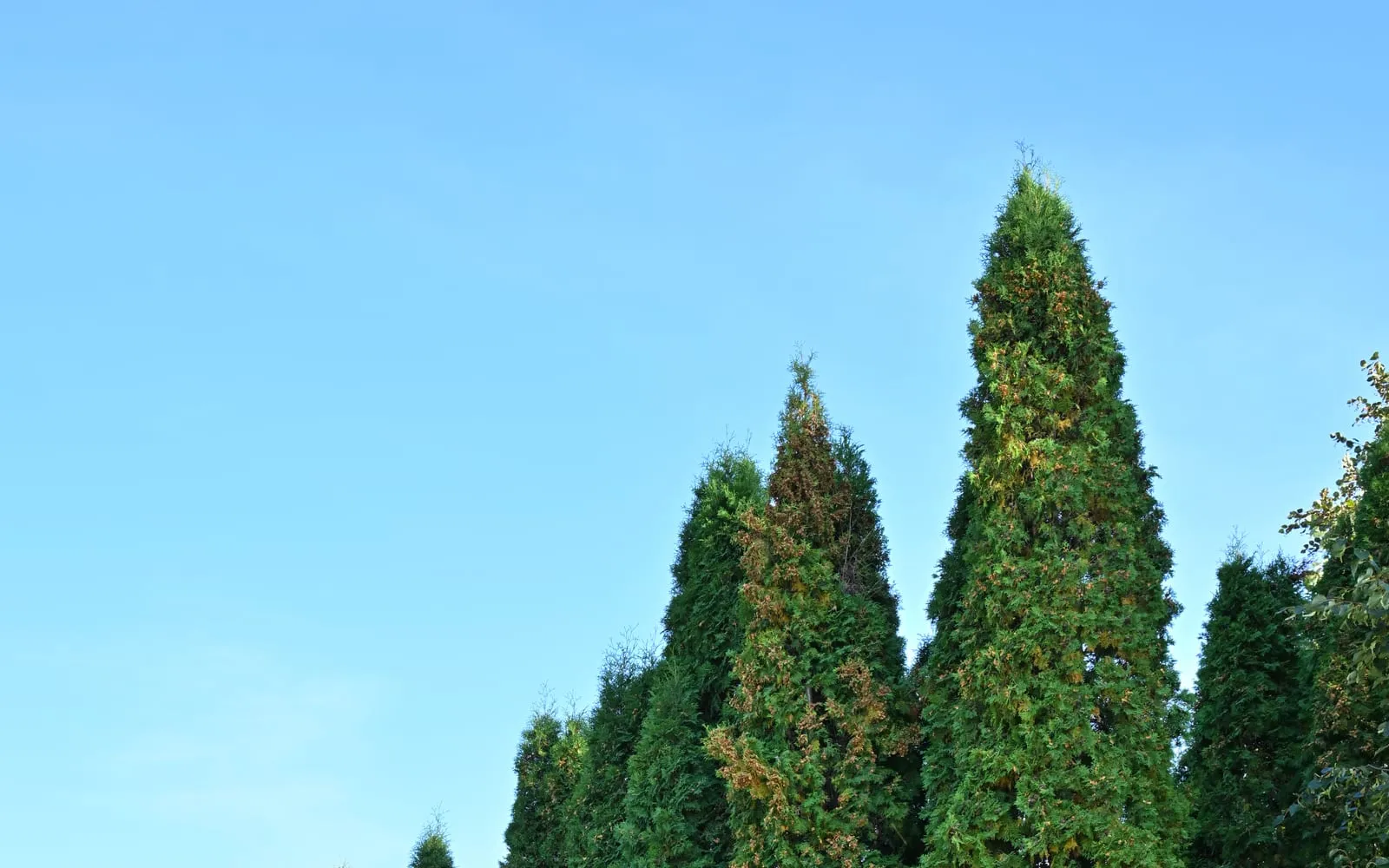
Foliage is arranged in flat, fan-like sprays of tiny overlapping scale leaves, aromatic when crushed with a scent some people find pleasant and others describe as closer to shoe polish. Colour is a rich, glossy green through the growing season on most forms, though many trees turn a duller yellow-brown, sometimes called winter bronzing, in cold weather before greening up again in spring.
The natural habit is densely pyramidal to narrowly columnar, branching from low on the trunk and holding its foliage to ground level far better than most conifers of similar height, which is exactly the trait that makes it so useful as a screen.
Bark is reddish-brown, thin, and peels in narrow vertical strips on mature trunks, visible mainly on older specimen trees rather than closely clipped hedges. Small oval cones, only about a centimetre long, appear scattered through the foliage and turn from green to brown as they ripen.
Cultivated selection has produced an enormous range of forms from the wild species: narrow columns bred specifically for hedging such as ‘Smaragd’ (sold as Emerald Green), dense low globes for foundation planting, and golden or blue-tinged foliage forms grown as accent plants rather than screens.
Where it is from
Thuja occidentalis is native to eastern and central North America, from the Canadian Maritimes and southeastern Canada south through the Great Lakes region and along the Appalachians. It grows naturally on limestone cliffs, in cold wet swamps and along cool, rocky lakeshores, a combination of very different habitats that explains why the species tolerates both alkaline soil and periodic waterlogging better than most conifers.
Trees growing wild on exposed cliff faces in places like the Niagara Escarpment are among the oldest documented in eastern North America, with some individuals verified by core sampling at well over eight hundred years old despite looking stunted and gnarled rather than large, a reminder that this is a long-lived species growing slowly in poor conditions rather than a short-lived hedging plant.
The common name arborvitae, Latin for tree of life, dates to the sixteenth century, when French explorers were reportedly shown its foliage as a scurvy remedy by Indigenous people in eastern Canada, since the needles carry a useful amount of vitamin C.
How it grows
Plant in spring or autumn into any reasonably drained soil; this species is markedly more tolerant of clay, chalk and occasional wet ground than most conifers sold for hedging, which is a large part of its practical appeal for a difficult site.
Space hedging cultivars according to their expected width at maturity rather than planting tightly for instant effect, since overcrowded plants shade each other’s lower growth and never fill in properly. A typical columnar hedging form wants 45 to 90 cm between plants depending on the cultivar and how quickly a solid screen is wanted.
Trim a hedge once or twice during the growing season, cutting into the current season’s soft growth rather than old wood, since like most conifers in this list it does not reliably resprout from bare, leafless wood inside the plant. Establishing the final width and shape early, before the hedge fills out, avoids ever needing to cut back that hard.
Water new plants through their first two summers until established, after which the species tolerates a fair amount of neglect on reasonable soil, though a prolonged drought still shows in browning foliage faster than on a more drought-adapted conifer.
Through the seasons
Spring brings a flush of soft, bright green new growth at the shoot tips, and any winter bronzing on the older foliage fades back to green over several weeks as temperatures rise.
Summer is the main growing season, and it is also when drought stress shows fastest, as browning or thinning foliage on a hedge that has gone too long without water in a dry spell.
Autumn is a good planting and hedge-establishment window in most climates, with cooler air reducing transplant stress while the soil is still warm enough for root growth to continue.
Winter brings the bronzing that alarms many first-time growers, a yellow-brown cast across some or all of the foliage that is a normal cold-weather pigment change in many cultivars rather than a sign of dieback, and it reverses in spring. Heavy wet snow can splay a multi-stemmed specimen open, which loose ties around the crown before a snowy winter helps prevent.
Care difficulty
Easy. American arborvitae tolerates a wide range of soils, survives winters that would kill many other evergreens, and needs only routine trimming to keep a hedge in shape. The main risk to an established planting is prolonged summer drought rather than any pest or disease, and even that usually causes cosmetic browning rather than death if corrected promptly.
Deer are a genuine, non-horticultural difficulty in much of its native range, where arborvitae is a preferred winter browse and an unprotected young hedge can be stripped bare in a single hard winter.
Watering
Water new plants deeply and regularly through their first two growing seasons, since a shallow, poorly established root system is the main reason a young hedge fails.
Established plants tolerate short dry spells but show stress in a prolonged drought faster than a more drought-adapted species such as juniper or Italian cypress, with browning foliage that does not always recover even once watering resumes.
Reliable moisture through summer, rather than a fixed schedule, produces the densest, greenest hedge. Waterlogged ground is tolerated for periods far longer than most conifers manage, reflecting the wet, swampy sites the species occupies naturally, but it is not preferred over well-drained soil with regular watering.
Warning signs, diseases and pests
Bagworms build spindle-shaped bags of silk and foliage that hang from the branches like small pine cones, and a heavy infestation can defoliate and kill sections of a hedge if the bags are not removed by hand or treated while the caterpillars are still small in early summer.
Spider mites cause fine yellow speckling and, in a bad case, faint webbing, usually worse in hot, dry, dusty conditions along a driveway or wall. A strong hose spray through the growing season is often enough to keep them in check.
Leaf-miner larvae tunnel inside the scale leaves, causing small brown patches scattered through the foliage that are mostly cosmetic on an established hedge.
Winter bronzing, the seasonal colour change described above, is frequently mistaken for disease by first-time growers and needs no treatment at all.
Deer browsing strips foliage within reach over a single winter in many parts of the species’ native range, and repeated browsing over several years can permanently disfigure or kill a young hedge; fencing or a repellent through the dormant season is the practical response where deer pressure is high.
Root-rot appears on poorly drained sites despite the species’ general tolerance of wet ground, usually where drainage is properly blocked rather than merely damp, showing as browning from the base upward.
Growing environment
Full sun produces the densest foliage and best colour on most cultivars, though the species tolerates a fair amount of shade better than many conifers, at some cost to density on the shaded side.
Almost any reasonably drained soil suits it, including chalk, clay and soil that floods occasionally, which is unusual tolerance among the conifers on this list and reflects the range of wild habitats the species occupies.
Shelter from strong, drying wind and heavy salt spray helps in an exposed site, since both cause browning at the foliage tips, though a well-sited hedge is otherwise a useful windbreak for whatever is planted behind it.
Space to reach the mature width of the chosen cultivar avoids the crowding and thin patches that come from planting too close for a quick screen.
Feeding
A young hedge benefits from a balanced, slow-release fertiliser once in spring for its first several years while establishing a full root system and canopy.
Established hedges on reasonable soil generally need little supplemental feeding, particularly where clippings are left to break down at the base rather than removed every time.
A hedge showing pale, thin growth despite adequate water is more often sited in deep shade or competing with tree roots than short of nutrients, and checking light and root competition first saves an unnecessary feeding programme.
Troubleshooting
My hedge has turned yellow-brown for winter. Is it dying? Almost certainly not. Many arborvitae cultivars bronze in cold weather and green up again in spring; this is a pigment change rather than dieback. Persistent brown, dry patches that do not green up by early summer are the sign to investigate further.
Deer have stripped the lower branches. Arborvitae is a preferred winter browse for deer across much of its native range, and repeated browsing can permanently disfigure a young hedge. Fence young plants or use a repellent through the dormant season if deer pressure is significant locally.
There are small bag-shaped cocoons hanging in the foliage. This is bagworm. Remove the bags by hand while numbers are low, ideally before the larvae inside mature and disperse in late summer, since a heavy infestation can kill sections of a hedge.
How close together should I plant a new hedge? Space plants according to the mature width of the specific cultivar, typically 45 to 90 cm apart for a narrow columnar hedging form, rather than planting tightly for instant cover, which produces thin lower growth once the hedge matures.
Sections of the hedge are browning from the base up. Check drainage first. Despite tolerating occasional wet ground well, properly waterlogged or compacted soil causes root-rot in this species as in most others.
Is it safe to plant near livestock or a dog that chews foliage? Treat it as a genuine, moderate toxicity risk rather than a harmless hedge. The foliage contains thujone, and eating it in quantity causes real illness in people, pets and horses, so a hedge within reach of grazing animals is worth fencing or choosing a different species for that specific boundary.
Why is my established hedge suddenly browning in a hot summer? Prolonged drought is the most likely cause. Despite tolerating a wide range of soils, this species wants consistent moisture through summer and shows heat and drought stress faster than a more drought-tolerant conifer such as juniper.