
Outdoor plant
Hornwort
Ceratophyllum demersum
Also known as Coontail, Rigid hornwort
How to grow hornwort, Ceratophyllum demersum, a rootless pond oxygenator that never anchors in soil and floats free below the surface.
At a glance
- Difficulty
- Easy
- Water
- Free-floating or loosely anchored in open water
- Light
- Full sun to fairly heavy shade
- Temperature
- Tolerates 4-28 deg C; growth stalls below about 10 deg C
- Hardiness
- USDA 4-10, RHS H6, hardy to -20 C
- Type
- Hardy submerged perennial
- Height
- Trailing stems 30 cm to over 1 m, unanchored
- Native to
- Europe, Asia, Africa, North America
Hardy across most of the temperate world, surviving winter as a loose mass of stem fragments resting on the pond floor rather than as any single overwintering bud. Growth needs warmth to restart in spring and all but stops once water temperatures drop below about 10 deg C, but established stems tolerate a hard freeze at the surface as long as deeper water stays unfrozen.
Hardiness zones describe winter cold alone. Summer heat, humidity, rainfall and the length of the growing season decide as much, so treat the range as the outer limit rather than as a recommendation.
Not known to be toxic
Hornwort carries no toxicity listing from the RHS and is one of the most widely kept plants in fish aquariums precisely because it is safe for fish, shrimp and the pets that drink from a garden pond. There is nothing in its tissue that needs to be kept away from children or animals.
Source: RHS
About
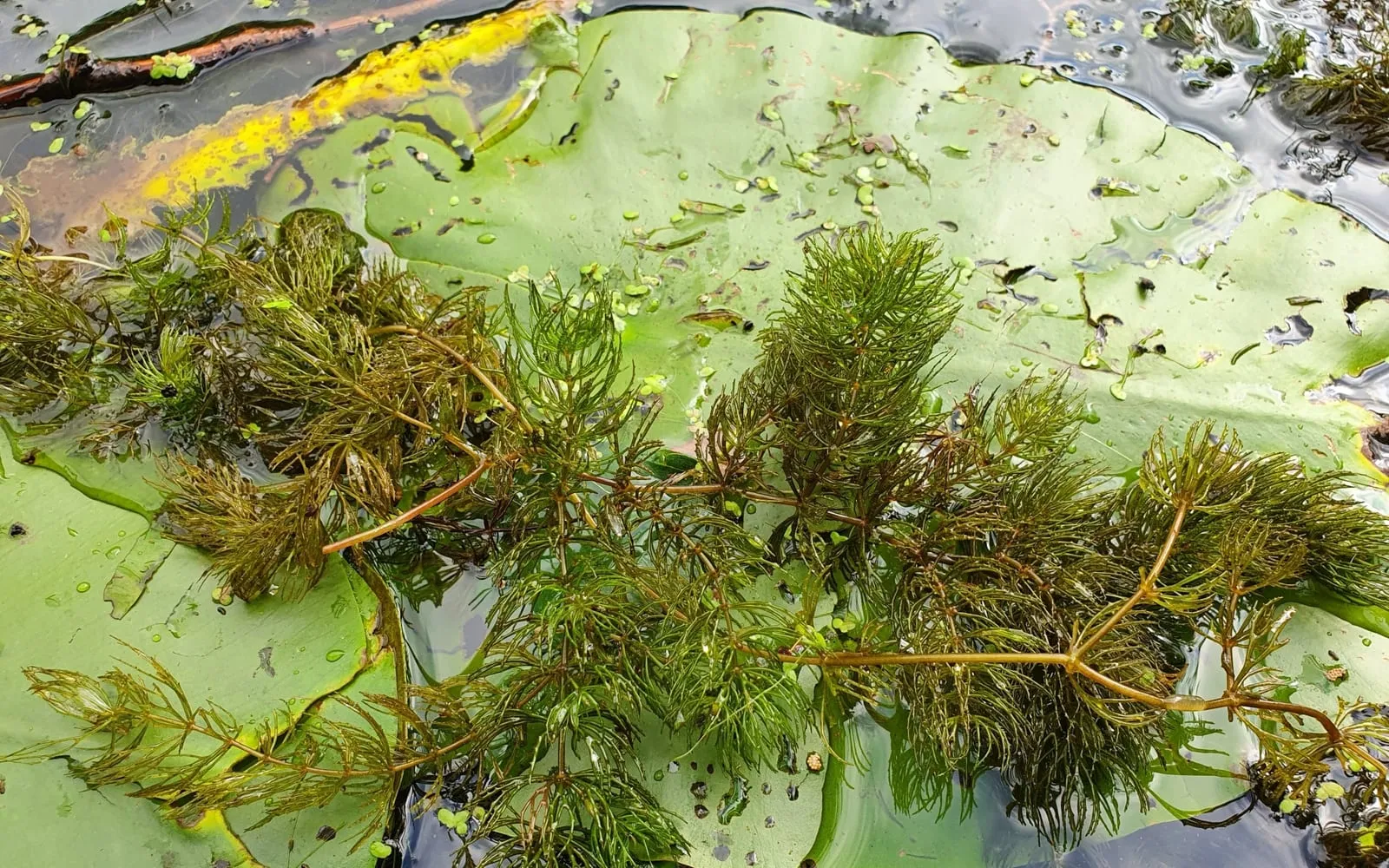
Hornwort is a submerged pond plant with no roots at all, an unusual trait among aquatic species that lets it drift wherever the water takes it rather than anchoring into mud or gravel. Dense whorls of thread-like, forked leaves cover long trailing stems that spend their entire life a little below the surface, absorbing everything they need directly through the leaf tissue. Gardeners grow it as an oxygenator, valued for the volume of leaf surface it offers a pond and the shelter it gives fish spawn and invertebrates.
It is also one of the most widely used plants in freshwater aquariums, where the same rootless habit that suits a pond makes it easy to weigh down with a lead strip or leave floating free, with no substrate needed at all.
Appearance and character
Stems branch repeatedly and carry stiff whorls of narrow, forked leaves spaced closely along their length, giving the whole plant a bottlebrush texture that is dark green in good light and can take on a bronze or reddish tinge under strong sun. There is no true root system. Fine, colourless rhizoid-like structures sometimes form at the stem base and anchor loosely into soft mud, but the plant grows and multiplies with no anchorage of any kind.
Flowers are minute, greenish and rarely seen, appearing underwater and pollinated by pollen released directly into the water rather than carried by any insect. Most gardeners never notice them; the plant is grown and propagated almost entirely from stem fragments, each capable of growing into a new plant.
Where it is from
Hornwort has one of the widest natural distributions of any aquatic plant, found across Europe, Asia, Africa and North America in still and slow-moving fresh water. Its native range is now hard to separate from the range it has spread into through the aquarium and water garden trade over the past century, since the two overlap across most of where it grows.
It favours nutrient-rich, still or slow-flowing water with a soft, silty bottom, and tolerates deep shade better than most submerged plants, growing in water too dark for many other oxygenators to manage.
How it grows
Growth happens by branching and fragmentation rather than by any single fixed structure. Stems lengthen through the growing season and readily break apart at the nodes, with each fragment able to grow roots-free into a fully independent plant. A single stem tip dropped into a bucket of pond water will be growing new whorls within days. That makes hornwort easy to establish from a handful of cuttings, and it also lets the plant get out of hand in a small, warm, nutrient-rich pond.
Because there is no root to hold it in place, the whole plant drifts on water movement, and a dense mass often gathers against the downwind side of a pond or around obstructions. Left unchecked it can shade out other submerged plants, so most gardeners thin it out several times a season once it has established.
Through the seasons
Spring brings rapid new growth as the water warms, with stems lengthening quickly once temperatures climb past about 10 deg C.
Summer is the peak growing period, and a healthy clump can double its mass within a few weeks in warm, sunlit water, needing regular thinning to keep some open water for fish and light for anything growing beneath it.
Autumn growth slows as the water cools, and stems often become denser and more brittle, breaking into smaller fragments that settle towards the bottom.
Winter the plant survives as a loose mass of stem fragments resting on the pond floor, insulated from hard frost by the depth of water above it. Growth all but stops until spring, but there is no single overwintering structure the way many other pond plants form.
Care difficulty
Easy, and among the least demanding plants a new pond keeper can add. It needs only open water and enough depth to keep a hard freeze from reaching the whole mass, and it multiplies readily from whatever fragments break off during routine thinning.
The one skill it does demand is restraint. A broken stem grows into a new plant as reliably as an intact one, so careless thinning can increase the amount of hornwort in a pond rather than reduce it, and removed material should be composted or given away rather than left to drift back in.
Watering
There is no planting depth in the usual sense, since hornwort has no roots to bury. It can be left entirely free-floating below the surface, weighted lightly with a stone or a strip of lead to stop it massing at one end of the pond, or tucked loosely into gravel, where it will sit rather than root. Any water deeper than about 30 cm suits it, and it grows well down to 2 m or more, tolerating far greater depth than most other oxygenating plants.
Warning signs, diseases and pests
Hornwort is rarely troubled by pests or disease, and most problems that show up are competition or grazing rather than infection. Blanketweed and other string algae sometimes tangle through a dense mass and compete for light and nutrients, more a sign of a pond running high in nutrients than a problem with the hornwort itself.
Ornamental grass carp, where kept, graze hornwort readily and can strip a planting back hard within a season; ducks and moorhens do the same on a smaller scale, nibbling at the soft growing tips. Neither causes lasting harm to an established clump, which regrows quickly from whatever remains.
A mass that turns pale, thin and straggly usually points to low light rather than disease, particularly in a shaded pond or one crowded with floating leaves from water lilies or other surface cover above it.
Growing environment
Full sun to fairly heavy shade both suit hornwort, which tolerates lower light better than most other submerged oxygenators and is a reasonable choice for the shadier end of a pond where little else grows well underwater. Still or gently moving water is ideal; strong flow tends to break the loosely attached stems apart faster than the plant can regrow.
No soil or planting medium is needed, and adding one brings no benefit, since the plant takes essentially everything it needs straight from the surrounding water.
Feeding
None needed. Hornwort draws nutrients directly from the water column through its leaves rather than through any root system, which is also why it is often relied on to help keep algae down in a nutrient-rich pond, competing with it for the same dissolved nutrients. Adding fertiliser intended for other pond plants serves no purpose here and, in a small pond, risks feeding an algae bloom instead.
Troubleshooting
The pond is filling up with hornwort faster than expected. Normal behaviour in warm, nutrient-rich water, where a healthy clump can double in a few weeks. Thin it out regularly through summer and remove the cuttings rather than leaving them to drift and regrow.
Stems have broken into lots of small pale fragments. Usually fragmentation from routine handling or fish activity rather than a health problem. Each piece is capable of growing into a new plant, so remove what is not wanted rather than assuming the plant is in decline.
Growth looks thin, pale and straggly. Almost always too little light, often from shading by floating leaves above. Trim back overhanging cover or move some of the hornwort to a brighter part of the pond.
Grass carp or ducks have stripped the planting back hard. Expected where either is kept in numbers. An established clump regrows from whatever remains, though a badly grazed pond may need protective netting around one section while it recovers.
Blanketweed is tangled through the hornwort. A sign of high nutrient levels in the water rather than a fault with the hornwort. Twist out the algae by hand with a stick or rake and address the nutrient source, such as leaf litter or fish overstocking, rather than treating the hornwort itself.
No roots ever form, even after months in the pond. Correct and expected. Hornwort has no root system at any stage of its life and grows well without one.
A clump has drifted to one side of the pond and piled up. Because nothing anchors it, wind and current push loose hornwort around freely. Weigh a portion down with a stone or a lead strip if you want it to stay in a particular spot.