
Outdoor plant
Chilean Wine Palm
Jubaea chilensis
Also known as Coquito palm
How to grow Chilean wine palm outdoors. Its extremely slow growth, remarkable cold tolerance, and the sap once tapped to make palm wine.
At a glance
- Difficulty
- Easy
- Water
- Regular watering while young, drought-tolerant once established
- Light
- Full sun
- Temperature
- Tolerates hard frost once established
- Hardiness
- USDA 8-11, RHS H5, hardy to -15 C
- Type
- Evergreen perennial palm
- Height
- 15-25 m, reached only after many decades
- Native to
- Central Chile
One of the most cold-hardy large palms in cultivation, tolerating hard frost that would kill most other palm species outright, which has made it a long-standing curiosity in temperate gardens well beyond its native Chile, including parts of the British Isles where it has been grown successfully for well over a century. Its main limitation is not cold but time: it is exceptionally slow-growing at every stage of its long life.
Hardiness zones describe winter cold alone. Summer heat, humidity, rainfall and the length of the growing season decide as much, so treat the range as the outer limit rather than as a recommendation.
Not known to be toxic
- Safe to eat
- The small, coconut-like seeds, known as coquitos, are edible, and the sap has historically been tapped to make a sweet syrup or fermented into palm wine
Chilean wine palm has no toxicity listing from the RHS or the ASPCA. Its seeds and sap both have a long history of food and drink use in its native Chile, a further indication that no part of the plant has meaningful toxicity, though wild harvest of the sap by felling the palm has historically threatened natural populations and is now restricted.
Source: RHS
About
The Chilean wine palm is among the most cold-hardy of all large, single-trunked palms, and one of the slowest-growing, sometimes taking a century or more to reach the massive, thick trunk for which mature specimens are known. Its common name comes from the historical practice of tapping the trunk for its sweet sap, once boiled into syrup or fermented into a wine known as vino de palma, a use that has become rare as the species has become protected in much of its native range following past overharvesting.
Grown for its eventual size rather than quick results, it has been a fixture of significant historic gardens across mild parts of Europe for generations, with some of the oldest cultivated specimens outside Chile now well over a hundred years old and only reaching full maturity in recent decades.
Appearance and character
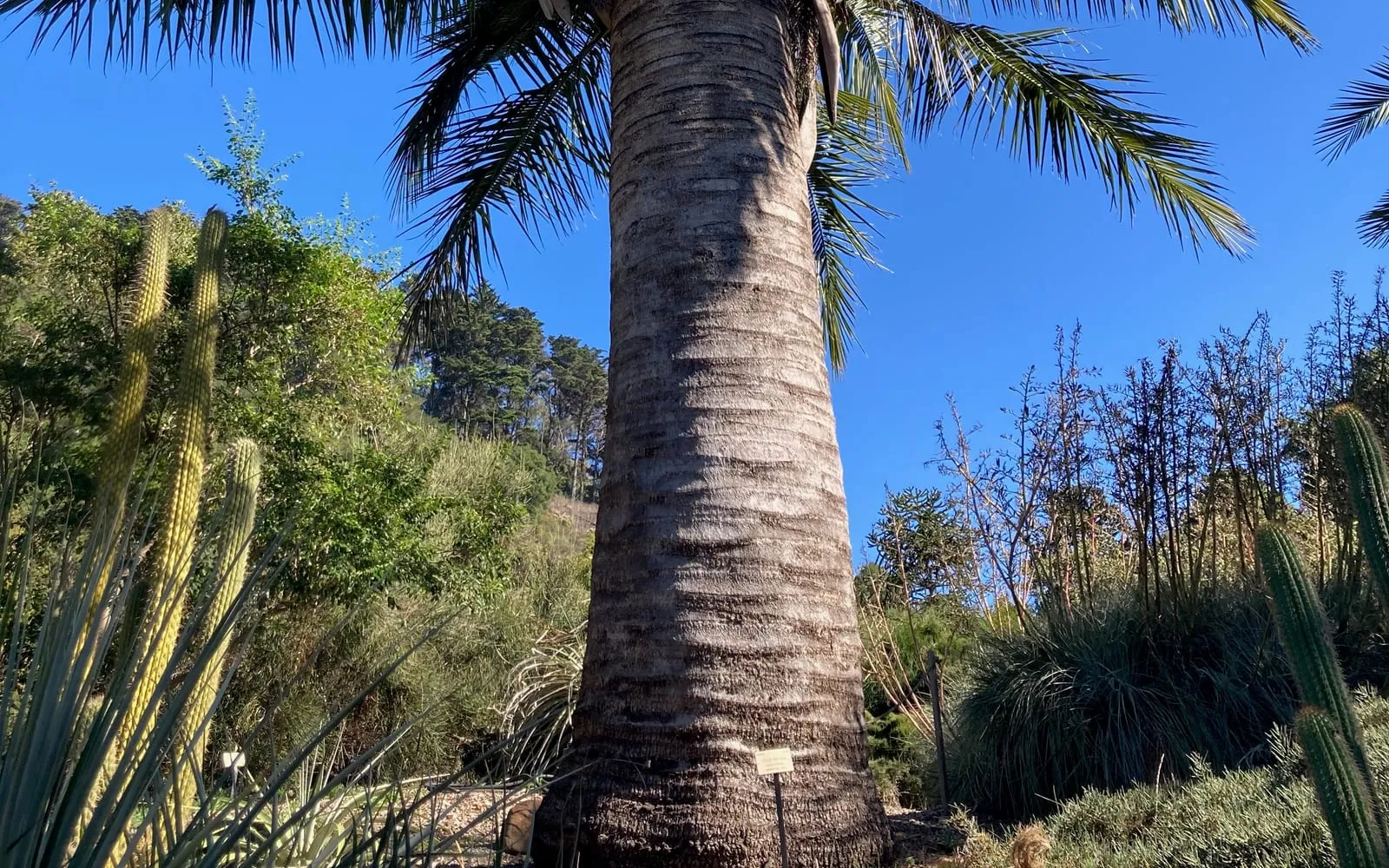
A massive, smooth, grey trunk, often noticeably swollen partway up its length, supports a dense, rounded crown of stiff, feather-shaped fronds. The trunk’s considerable girth, sometimes exceeding a metre in diameter on an old specimen, is one of the species’ most distinctive features and takes many decades of slow, steady growth to develop.
Large, branched flower clusters emerge from among the fronds on a mature tree, followed by clusters of small, round, hard-shelled fruit containing edible seeds resembling miniature coconuts, which is where the alternative name coquito palm comes from.
Where it is from
A narrow native range in the coastal hills and valleys of central Chile, in a Mediterranean-type climate with warm, dry summers and cool, wet winters, much more temperate than the climate most ornamental palms come from.
That Mediterranean origin, with real winter cold and a defined dry season, is the source of this species’ unusual cold tolerance, and it has allowed the palm to be grown successfully in gardens with a broadly similar climate pattern across parts of Europe, California and elsewhere, well beyond its small, now largely protected native range.
How it grows
An evergreen palm growing from a single crown, expanding both its trunk girth and, very gradually, its height over an extremely long lifespan. Growth at every stage is markedly slower than almost any other commonly cultivated palm, and a specimen planted today will still look modest after several decades, only reaching an imposing, thick-trunked maturity across multiple human generations.
This extraordinarily slow growth rate is central to the species’ conservation story: wild populations, historically felled in large numbers to tap sap from mature trunks, take so long to replace that overharvesting pushed the species toward serious decline before protective measures were introduced.
Through the seasons
Spring growth resumes gently as temperatures rise, with new fronds emerging slowly from the crown.
Summer is the main growing period, though even in ideal conditions visible progress from year to year remains modest by the standards of most other palms.
Autumn growth slows as temperatures drop.
Winter established plants tolerate hard frost with minimal damage, one of the most cold-tolerant large palms available for a temperate garden.
Care difficulty
Easy in terms of routine care, since an established plant needs very little beyond well-drained soil and full sun. The real challenge this species presents is patience: anyone planting one is investing in a garden feature for future decades rather than an immediate result, and that long timescale should shape expectations from the outset rather than being treated as a problem to solve.
Watering
Regular watering supports establishment while young. Once settled, this species tolerates real drought well, reflecting its native Mediterranean climate with a pronounced dry summer season, and deep, infrequent watering suits it better than frequent light watering.
Warning signs, diseases and pests
Scale insects occasionally appear on the fronds and are treated with a horticultural oil spray for significant infestations. Mealybug can colonise the crown or frond bases on occasion, though this species is generally untroubled by serious pests or diseases in cultivation, part of its broader reputation as a tough, resilient palm once established.
Very slow visible growth is entirely normal for this species at every stage of its life and is not, on its own, a sign of a problem; a young Chilean wine palm growing steadily but slowly is behaving as expected.
Growing environment
Full sun is important for the healthiest growth, and free-draining soil suits it well across a fairly wide range of soil types, reflecting its adaptability across a range of conditions in its native Chile. It performs well in a Mediterranean-type or temperate climate with a defined summer dry season, though it also tolerates a wetter climate reasonably well given adequate drainage.
Feeding
A palm-specific fertiliser containing adequate magnesium and potassium, applied two to three times through the growing season, supports healthy green fronds, though this naturally slow-growing species will not respond to feeding with the rapid growth a faster palm might show.
Troubleshooting
Growth seems extremely slow even after several years. This is entirely normal for the species, which is among the slowest-growing palms in general cultivation. Consistent, modest care over a very long period, rather than heavy feeding, is the appropriate approach.
A specimen is not producing flowers or fruit despite looking healthy. This species typically needs a very substantial trunk before flowering begins, meaning many decades of growth; a comparatively young or small specimen is not expected to flower yet.
You are considering tapping the trunk for sap. This practice historically threatened wild populations by requiring the tree to be felled, and is not recommended for a garden specimen; enjoy the palm as a long-term ornamental feature instead.
Fronds show minor scale insect infestation. Treat with a horticultural oil spray, focusing on the undersides of fronds where scale tends to cluster.
You are wondering whether this palm suits a smaller garden. Given how long it takes to reach its eventual massive size, a young specimen suits a much smaller space than its listed mature dimensions suggest for several decades, though it is worth planning for its eventual scale from the outset rather than assuming it will always stay compact.
A specimen seems to be growing faster than expected for the species. Exceptionally good conditions, particularly consistent warmth, sun and watering while young, can noticeably speed early establishment compared with the slow pace often quoted for this palm, though growth typically settles into its characteristically unhurried rate as the plant matures.