
Houseplant
Banyan Tree
Ficus benghalensis
Also known as Ficus benghalensis
How to grow the banyan, Ficus benghalensis, indoors. Its grove-forming aerial roots, its white bleeding sap, and how to keep a potted specimen in shape.
At a glance
- Difficulty
- Easy
- Water
- When the top few centimetres of mix have dried
- Light
- Bright indirect light to light shade
- Temperature
- Warm; keep above about 13 deg C
- Humidity
- Average to high
- Hardiness
- USDA 10-12, RHS H1b, hardy to 13 C
- Type
- Perennial
- Height
- Up to 30 m
- Native to
- the Indian subcontinent
A tender tropical foliage plant from the Indian subcontinent, growing in warm, humid, shaded to filtered light. It needs warmth, humidity and bright indirect light, and it cannot take frost or chill. It is safest above about 13 deg C, and cold, wet compost or dry air spoils it.
Hardiness zones describe winter cold alone. Summer heat, humidity, rainfall and the length of the growing season decide as much, so treat the range as the outer limit rather than as a recommendation.
Harmful if eaten
- Harm from
- Eating it, handling it and sap in the eyes
- Affects
- People, cats and dogs
Ficus benghalensis, the banyan tree, is irritating to people and toxic to cats and dogs. The ASPCA lists the Ficus genus (weeping fig, rubber plant and others) instead of this species by name, and the same latex chemistry applies. The milky sap carries ficin and furocoumarins, which can inflame the skin, make it sensitive to sunlight and irritate the eyes, and if leaves are eaten they can cause drooling, vomiting and mouth irritation. Wear gloves when pruning, and keep the plant away from pets.
Sources: ASPCA toxic and non-toxic plants, RHS potentially harmful garden plants
About
Ficus benghalensis is the banyan, a tree that can form a grove from a single plant. It drops woody aerial roots from its spreading limbs, and where those roots reach the ground they thicken into pillars that support the branches. The largest wild specimens shade several acres from what began as a single seedling, often one that germinated in the fork of another tree. India treats it as a national emblem, and village life across the subcontinent has long gathered in its shade.
Indoors it never builds that grove, but it keeps the same growth pattern in miniature. Thick leathery leaves, a pale bloom on the young shoots, and the occasional aerial root in humid air can all appear on a potted plant. Kept in a container it stays a manageable foliage plant that responds well to pruning and to a warm summer spent outdoors.
Appearance and character
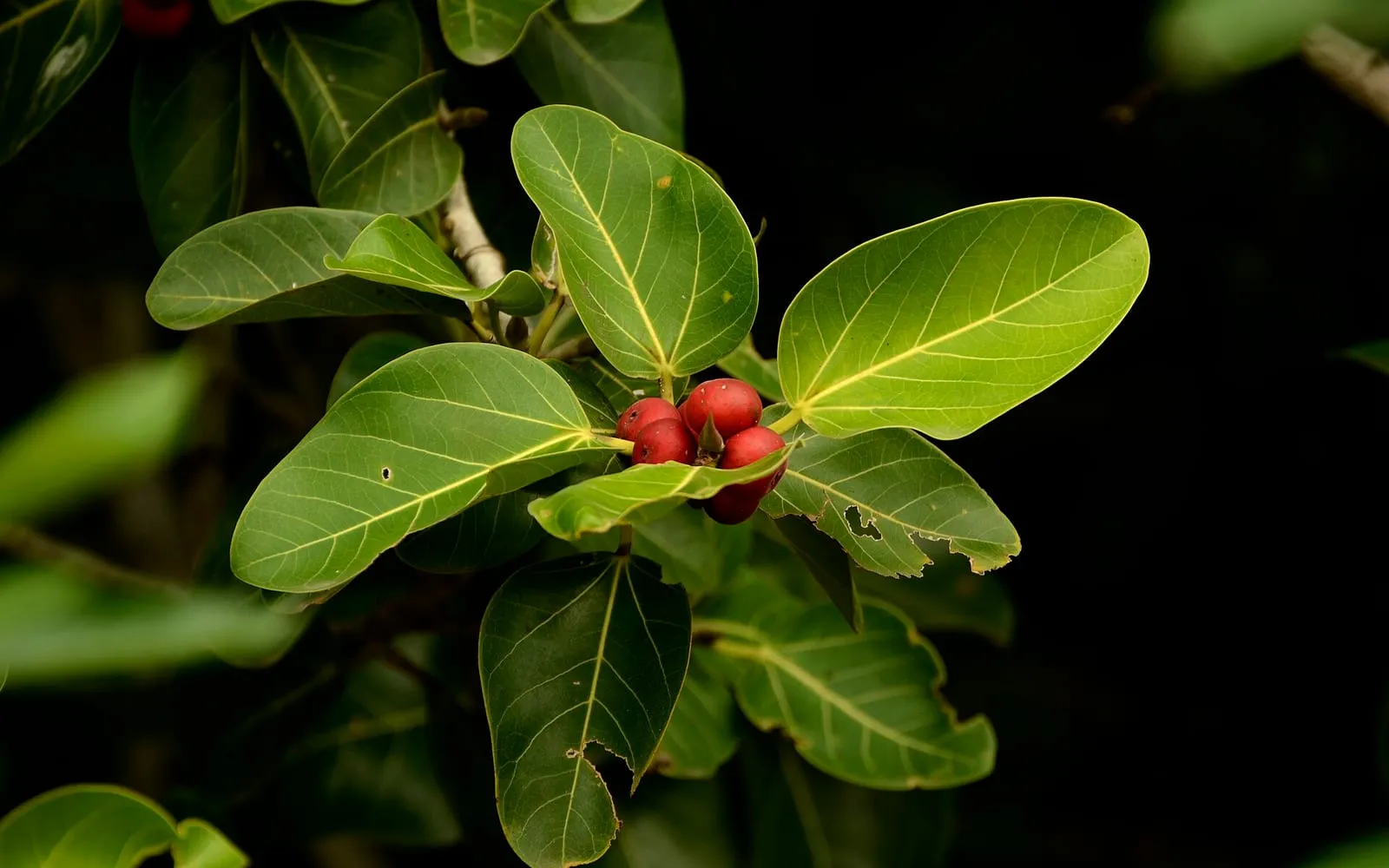
The leaves are broad ovals, stiff and slightly puckered, deep green above with a net of pale sunken veins and a dull fawn underside from a coat of fine hairs that is thickest on new growth. They sit on short stout stalks in a fairly open arrangement, so a young plant looks like sparse instead of bushy until pruning forces it to branch.
Every part contains a milky white latex that wells up the moment a leaf or stem is cut. The sap is sticky, stains cloth and can raise a rash on skin that reacts to it, so wipe pruning wounds and wash your hands afterwards. Small round figs, red when ripe and borne in pairs against the stem, appear on old outdoor trees but almost never on a potted one, since each fig depends on its own species of pollinating wasp.
Where it is from
The banyan is native across the Indian subcontinent, from the dry plains of India into the Himalayan foothills and south through Sri Lanka. In the wild it starts life as an epiphyte, a seed dropped by a bird or fruit bat into a crack or a branch fork of a host tree, where it germinates high off the ground and sends roots down the trunk towards the soil. Once those roots anchor, the fig thickens and can in time smother the host tree.
That start explains why the roots matter so much to the plant and why it copes with poorer, faster-draining conditions than a soft-stemmed houseplant would want. Warm, bright surroundings with a wet season and a dry one suit it, and it slows through the cooler months instead of growing at an even pace all year.
How it grows
Give it the brightest position you can find indoors, where a couple of hours of gentle morning sun does no harm, and turn the pot every week or two so it does not lean towards the light and shed leaves on the shaded side. Growth comes from soft green shoot tips that harden and turn woody as the season goes on.
Pot it in a gritty, open mix, something like a peat-free houseplant compost cut with bark and perlite, in a container only a size larger than the roots, since a banyan in a huge volume of wet compost can decline. Repot a young plant every couple of years in spring. New plants come readily from stem-tip cuttings struck in warmth, or from air-layering a woody shoot, which is how nurseries increase named forms.
Through the seasons
Spring starts growth as light returns, which is the moment to repot, to prune for shape and to start feeding again. Cuttings root fastest now.
Summer is its main growing season. It drinks more, grows fast in good light and takes well to a spell outdoors in a sheltered, part-shaded spot once nights stay reliably above about 15 deg C.
Autumn slows it as days shorten. Bring any plant that summered outside back indoors well ahead of the first cold nights, and begin easing off on water and feed.
Winter is close to a rest. Growth stalls, the plant needs far less water, and the main risks are cold wet compost at the roots and the parched air of a heated room.
Care difficulty
For a fig it is forgiving. It tolerates a missed watering more easily than a soggy one, puts up with ordinary room humidity once settled, and takes hard pruning well. Trouble usually comes from cold, wet compost that rots the roots over winter, or from dry, dusty air that browns the leaf margins and draws in mites. Leaf drop after a move or a cold draught is common, but the plant refoliates once it settles.
Watering
Water thoroughly when the top third of the compost has dried, letting the surplus drain and never leaving the pot in a full saucer. Between drinks the surface should feel dry to a finger pushed in. Through the growing season that might mean a weekly soak; in winter it can stretch to once a fortnight or less.
If your tap water is very hard, rainwater or filtered water suits it, though the banyan is less fussy about water than many houseplants. The quickest way to kill one is to keep the compost permanently wet in a cool room, which starves the roots of air and then rots them.
Warning signs, diseases and pests
Root rot in cold, wet compost is the serious risk. It shows as a sudden fall of yellowing leaves and a sour smell at the base of the pot, and the response is to lift the plant, cut away blackened roots and repot into fresh gritty mix before watering sparingly.
Brown, crisp leaf edges point to air that is too dry, often beside a radiator, and improve with the odd misting or a pebble tray. Spider mites and mealybugs move onto plants kept warm and dry, the mites stippling the leaves and spinning fine webs in the joints, the mealybugs showing as white fluff; wipe both off and treat with a suitable spray, repeating until they are gone.
Growing environment
A bright room out of harsh midday glare suits it, with steady warmth and no cold draught from a door or a single-glazed window. It dislikes sudden change more than most things, so once it is happy, leave it where it stands instead of shifting it about.
Ordinary room humidity is tolerated, though growth and leaf colour are better where the air holds a little moisture. Keep it above about 13 deg C, because below that it stops growing and cold injury becomes a risk.
Feeding
Feed every three or four weeks through spring and summer with a balanced liquid houseplant feed at half the label strength, then stop from mid-autumn until growth restarts. A recently repotted plant needs nothing for its first couple of months, since fresh compost supplies enough.
Overfeeding forces soft, sappy growth that mites and scale attack more easily, so err on the lean side. Yellowing of the oldest leaves during active growth, once rot has been ruled out, can mean the plant is hungry and ready for a feed.
Troubleshooting
Why has my banyan suddenly dropped a lot of leaves? A move, a cold draught or a swing in watering are the common triggers. Settle it in a stable, bright, draught-free spot and it will releaf.
The cut stem is leaking white sap. Is that a problem? No, that milky latex is normal for a fig. Wipe it up, keep it off skin and eyes, and the wound seals itself.
Will it grow the aerial roots it is famous for indoors? Rarely, and only in consistently humid, warm air. A pot plant keeps the potential but seldom meets the conditions.
How do I keep it bushy instead of leggy? Prune the growing tips in spring to force side shoots, and keep the light high, since a shaded banyan stretches and thins.
Is it safe around pets? The plant is not a dangerous poison. The latex can still irritate a mouth or skin, so keep a chewing pet away from cut stems and clear up trimmings.
Banyan Tree problem guides
Not sure what is wrong? See the common houseplant pests guide.