
Outdoor plant
Arrowhead
Sagittaria sagittifolia
Also known as Old world arrowhead
How to grow arrowhead, Sagittaria sagittifolia, at a pond margin. Planting depth, its arrow-shaped leaves, and the underwater tubers ducks dig up.
At a glance
- Difficulty
- Moderate
- Water
- Permanently wet soil or shallow standing water
- Light
- Full sun
- Hardiness
- USDA 5-10, RHS H6, hardy to -20 C
- Type
- Hardy aquatic perennial
- Height
- 30-90 cm above water
- Native to
- Europe, Western Asia
Fully hardy in shallow water that does not freeze solid, since the overwintering tubers form well below the surface in soft mud. It grows fastest in warm, nutrient-rich water and slows sharply once summer water temperatures drop below the mid-teens Celsius, which is when the plant begins forming next year's tubers rather than new leaves.
Hardiness zones describe winter cold alone. Summer heat, humidity, rainfall and the length of the growing season decide as much, so treat the range as the outer limit rather than as a recommendation.
Not known to be toxic
- Safe to eat
- The starchy autumn tubers, which are eaten as a root vegetable in parts of East Asia under a closely related species
Neither the RHS nor the ASPCA lists Sagittaria sagittifolia as toxic to people or animals. Ducks and other waterfowl dig up and eat the tubers through autumn and winter as a normal part of their diet, which is itself a reasonable sign of the plant's safety, though ornamental pond plantings are not usually grown with harvesting the tubers in mind.
Source: RHS
About
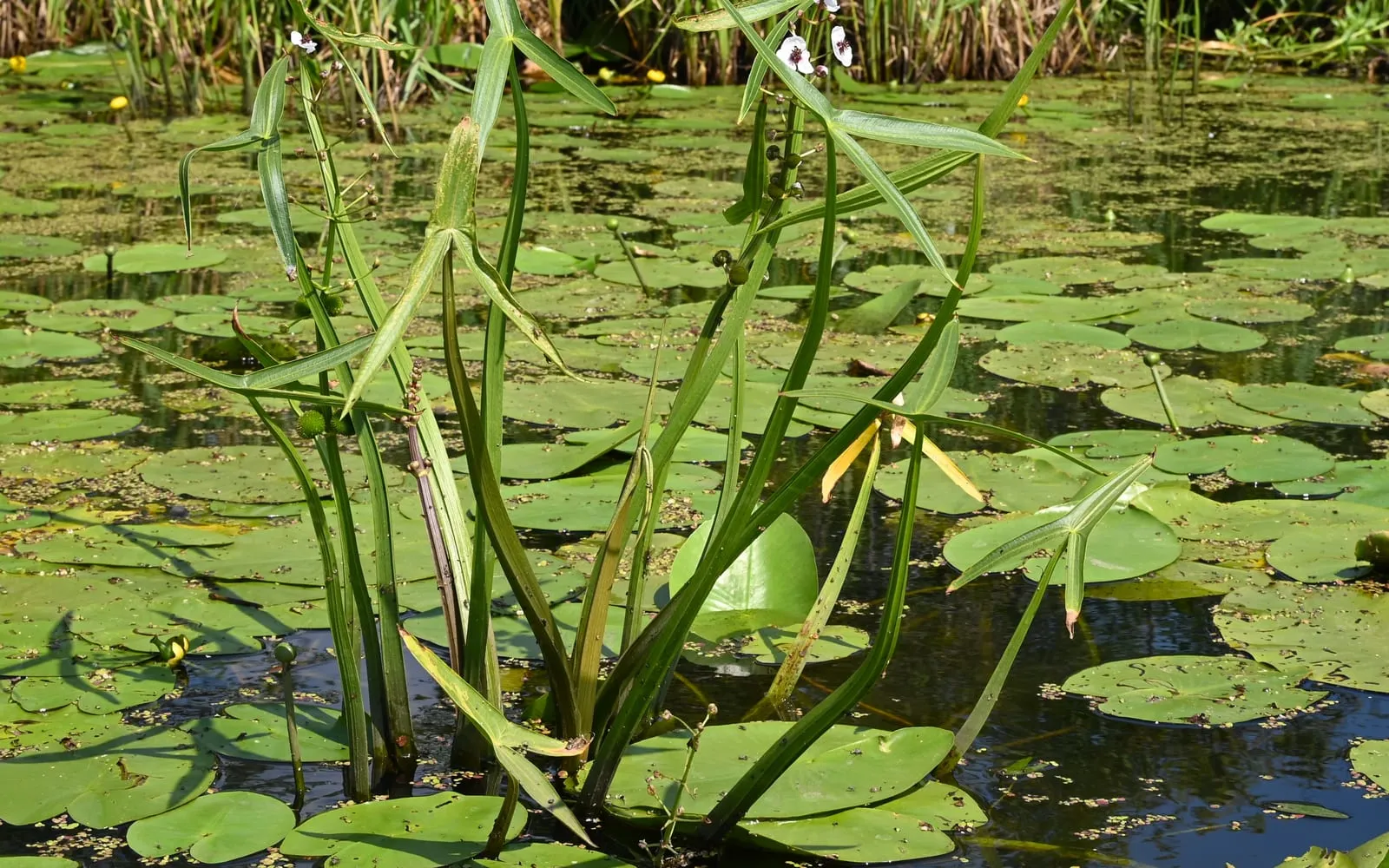
Arrowhead takes its name from its leaves, which are shaped like a broad arrow point with two long, backward-pointing lobes, held clear of the water on tall stalks above a base of narrower, ribbon-shaped submerged leaves. It is a native marginal plant across much of Europe, grown for the clean graphic shape of its foliage as much as for its modest white summer flowers.
The plant’s underground tubers, formed at the tips of runners each autumn, are a well-documented food source for wintering ducks and swans, and in parts of East Asia a closely related species is cultivated specifically for the same starchy tubers as a root vegetable.
Appearance and character
Three distinct leaf shapes appear on the same plant depending on how deep the water is at that point: narrow ribbon-like leaves fully submerged, oval floating leaves in intermediate depths, and the familiar arrow-shaped leaves held above the water where conditions allow. This range lets a single plant adapt its growth to whatever depth it finds itself in more than most marginal plants manage.
Flowers appear in whorls of three on a stalk rising above the leaves through summer, each one white with a dark purple centre, male flowers above female ones on the same spike. They are pretty rather than showy, and most gardeners grow the plant primarily for the leaves.
Where it is from
Still and slow-moving fresh water across Europe and western Asia, including ditches, canals, ponds and the margins of slow rivers, generally in shallow water over soft, nutrient-rich mud.
It relies on that mud for two things: rooting, and forming the starchy tubers each autumn that let the plant survive winter and resprout the following spring, since the top growth dies back completely each year.
How it grows
A hardy perennial that dies back completely to underground tubers each winter, unlike many pond marginals that keep a persistent rhizome. New growth each spring comes entirely from these stored tubers, sending up first the narrow submerged leaves and later the aerial arrow-shaped ones as the plant matures through the season.
Runners spread outward from the main clump through summer, each one forming a new tuber at its tip by autumn, which is both how the plant multiplies and why an established colony can spread further each year than the visible leaves alone would suggest.
Through the seasons
Spring growth begins from the previous year’s tubers once the water has warmed, starting with submerged ribbon leaves before the taller arrow-shaped leaves appear.
Summer is the main growing and flowering period, with white flower spikes appearing from July, and runners extending outward to form next year’s tubers.
Autumn top growth dies back as the tubers mature and detach from the parent plant, ready to overwinter independently in the mud.
Winter the plant survives entirely as dormant tubers below the water or mud surface, which waterfowl often dig up and eat over the colder months.
Care difficulty
Moderate. The plant itself needs little beyond shallow water and sun, but its habit of spreading by detached tubers means a planting in open pond mud can turn up in unexpected places the following spring, and containing it in a basket takes more planning than a plant that grows from a fixed rhizome in place and stays roughly where it was put.
Gardeners who want a self-contained clump for a small formal pond generally find the basket route worthwhile. Those with a larger, more naturalistic pond, or one shared with ducks that will help keep the tuber population in check, often let it spread loose with no ill effects beyond a slightly wider colony each year.
Watering
Shallow standing water or permanently wet mud, at a planting depth of roughly 5 to 30 cm over the crown depending on the plant’s size and the season. Deeper water suits an established clump better than a young one, since a small plant needs to reach the surface to photosynthesise fully.
Plant tubers or young divisions into a mesh aquatic basket filled with heavy aquatic loam if you want to prevent the runners escaping into open pond mud, since a plant grown loose in the substrate spreads much further over a few seasons.
Warning signs, diseases and pests
Aphids occasionally colonise the aerial leaves in summer and are easily dislodged with a hose. The more distinctive issue is waterfowl grazing: ducks and swans readily eat both the leaves and, particularly, the autumn tubers, and a pond with a resident duck population may see an arrowhead planting disappear almost entirely over winter. A wire cage around the basket during the tuber-forming months protects the crop where this matters.
Weak, pale leaf growth in summer is usually a sign of insufficient light rather than pest damage, since this plant needs strong sun to build up the reserves its tubers depend on.
Growing environment
Full sun is important, more so than for many other marginals, because the plant needs to build substantial food reserves in its leaves each summer to form healthy tubers for the following year. Nutrient-rich mud supports stronger growth than the lean substrate some other marginals prefer.
Feeding
An aquatic plant tablet pushed into the basket each spring supports strong summer growth and, by extension, a good crop of tubers for the following year. This is one of the few pond marginals where feeding has a fairly direct, visible payoff in the following season’s vigour.
Troubleshooting
The plant has spread well beyond where it was planted. Expected if grown loose in open mud rather than in a basket. Lift stray plants in spring and either discard or replant them where wanted.
Tubers have disappeared over winter. Check for grazing ducks or other waterfowl, which readily eat them. A protective cage over the basket during autumn and winter stops this.
Leaves stay narrow and ribbon-like all season, never forming the arrow shape. The water is probably too deep for the plant’s current size. Raise the basket closer to the surface, and expect the characteristic arrow leaves to appear as the plant matures.
Pale, weak growth despite adequate water depth. Check that the plant is getting enough direct sun; this species flowers and forms tubers poorly in shade.