
Outdoor plant
Water Soldier
Stratiotes aloides
Also known as Crab's claw, Water aloe
How to grow water soldier, Stratiotes aloides, a spiky rosette that rises to the surface to flower each summer and sinks again in autumn.
At a glance
- Difficulty
- Moderate
- Water
- Free-floating, rising and sinking with the seasons
- Light
- Full sun to light shade
- Temperature
- Active from about 10 deg C; overwinters submerged and dormant
- Hardiness
- USDA 5-9, RHS H5, hardy to -15 C
- Type
- Hardy submerged and floating perennial
- Height
- Rosettes 15-40 cm across
- Native to
- Europe, Western Asia
Hardy through a cold winter because it spends that winter submerged rather than exposed. The rosette sinks to the pond floor in autumn and rises again the following spring once the water has warmed. Air temperature above the pond matters less than whether the water body holds enough depth to avoid freezing solid to the bottom.
Hardiness zones describe winter cold alone. Summer heat, humidity, rainfall and the length of the growing season decide as much, so treat the range as the outer limit rather than as a recommendation.
Not known to be toxic
Water soldier carries no toxicity listing from the RHS, and there is no record of it poisoning people, pets or fish. The genuine hazard it presents is mechanical rather than chemical: the leaf margins are lined with sharp, saw-like teeth capable of cutting bare skin, so it is worth handling with gloves rather than bare hands, in the same way you would handle a plant with thorns.
Source: RHS
About
Water soldier forms a rosette of stiff, sword-shaped leaves that looks remarkably like the top of a pineapple, spending most of the year submerged just below the surface and rising to sit half-in, half-out of the water only when it flowers. Small, three-petalled white flowers appear above the rosette in summer, held just clear of the leaf tips before the whole plant sinks back down once flowering finishes.
It is a native British plant, most strongly associated with the fens and broads of eastern England, where dense stands still form in undisturbed dyke systems. In parts of North America it has become a regulated high-risk invasive species, and it is illegal to sell, transport or release in a number of US states despite having no confirmed wild population there yet.
Appearance and character
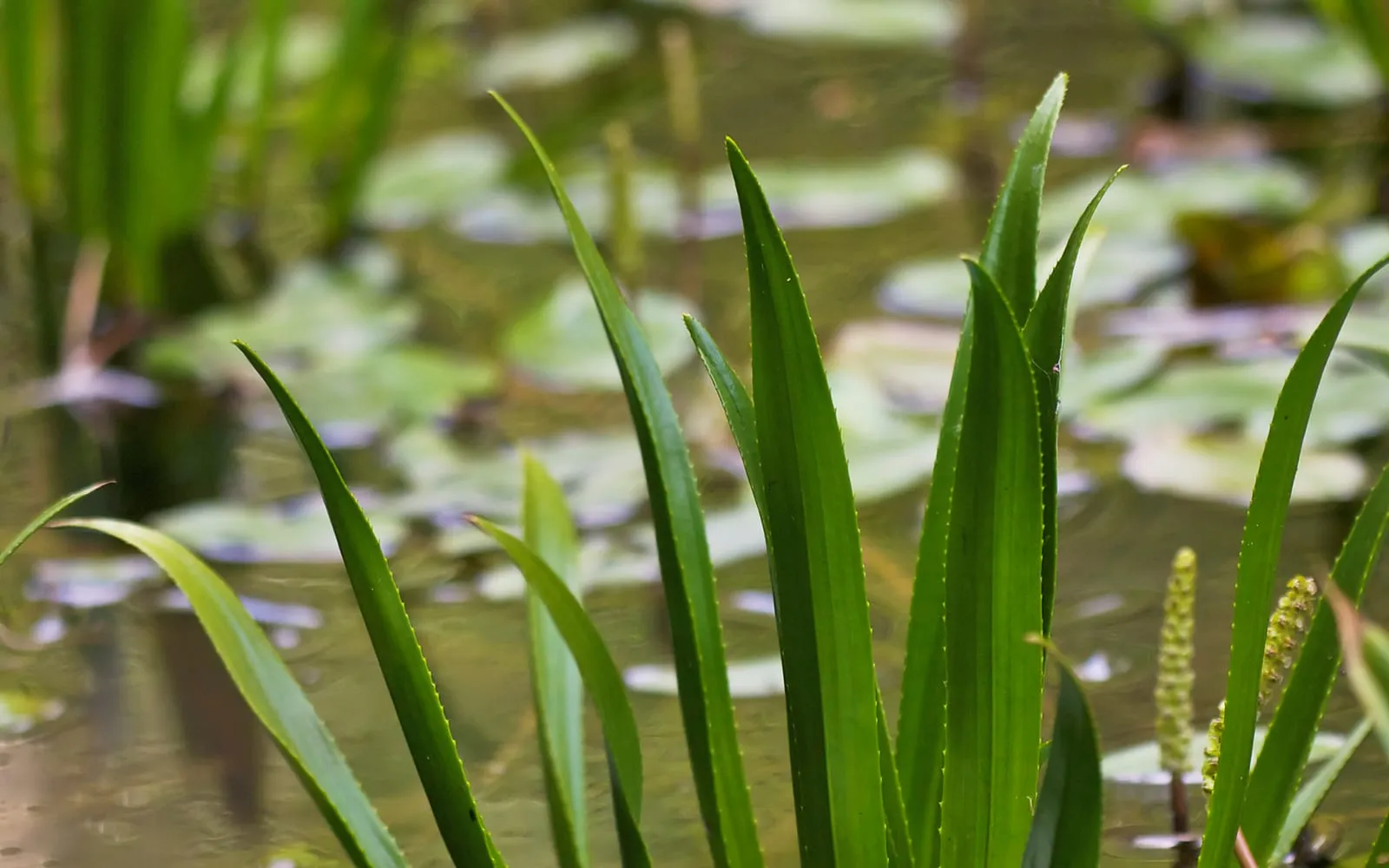
Leaves are narrow, rigid and triangular in cross-section, arranged in a tight spiral rosette and edged along both sides with small, backward-facing teeth sharp enough to draw blood if handled carelessly, the same defence that gives crab’s claw, one of its older names, its bite. The overall silhouette, a symmetrical, spiky rosette floating with its crown just above the waterline, is distinctive enough that it is rarely confused with any other British pond plant.
Male and female flowers grow on separate plants, both white with three petals and a yellow centre, opening for a few days in mid to late summer just above the leaf tips. Every wild and garden population recorded in Britain is female. Male plants have rarely, if ever, been found in Britain, so British water soldier never sets seed and increases entirely by offsets budding from the base of each rosette, a single sex propagating itself indefinitely without needing the other.
Where it is from
Water soldier grows across still, nutrient-rich fresh water in Europe and western Asia, typically rooting loosely in soft mud at the bottom of shallow lakes, fens, dykes and slow-flowing rivers. Its precise native range within that area is difficult to pin down, since centuries of deliberate cultivation as an ornamental pond plant have blurred the line between where it grew naturally and where people later introduced it.
Established colonies favour water rich in nutrients and largely free of strong current, conditions that match the slow-moving fen drainage systems of eastern England closely enough that the species has persisted there for centuries despite disappearing from many other former sites.
How it grows
Water soldier migrates vertically through the water column each year rather than spreading mainly sideways. The mechanism behind it is a slow change in the rosette’s own density. Fresh leaves produced in spring are relatively light, and as the rosette adds more of them through the season it becomes buoyant enough to rise steadily towards the surface. Older leaves gradually accumulate a crust of calcium carbonate drawn from the water, becoming heavier as they age, and by late summer that accumulated weight is enough to pull the whole rosette back down again, a see-saw between new, buoyant growth and old, mineral-laden growth rather than any active swimming or seasonal cue in the usual sense. By midsummer, at the point of maximum buoyancy, the rosette sits with its crown at or just above the waterline and flowers, before the balance tips back towards the old growth and it begins sinking again as the season turns, settling back to the pond bed by autumn.
Offsets form at the base of the rosette and detach to grow into independent plants, which is how a single introduction can build into a dense colony over several seasons even without fertile seed. Growth is slow to establish in a new pond, typically taking two or three years to build the offset network that produces a visually striking mass of rosettes at the surface each summer.
Through the seasons
Spring the submerged rosette begins its rise towards the surface as water warms and new leaf growth outpaces the weight of the old.
Summer the plant sits at the surface, flowers if male and female plants are both present, and produces offsets around its base before beginning its descent again towards the end of the season.
Autumn the rosette sinks back to the pond floor as growth slows and the leaves that carried it up through summer are shed or become waterlogged.
Winter it rests dormant on the pond bed, fully submerged and protected from frost by the water above, resuming its rise only once temperatures climb again the following spring.
Care difficulty
Moderate. The plant needs very little routine attention once established, but the seasonal rise and sink can alarm a new pond keeper who assumes a rosette that has disappeared below the surface in autumn has died, when it has in fact gone into its normal winter position. Establishing a new planting also takes patience, since a young offset can take a couple of seasons to build enough leaf mass to reach the surface and flower.
Watering
There is no planting depth in the conventional sense, since water soldier drifts and rises through the water column on its own rather than staying rooted to a fixed spot. It does best in still to gently moving water between about 30 cm and 1 m deep, shallow enough that the rosette can reach the surface in summer but deep enough that the whole plant does not freeze solid in a hard winter.
Warning signs, diseases and pests
Waterlily beetle occasionally moves onto water soldier from nearby water lilies, and both the adult beetles and their larvae strip patches of tissue from the leaf surface, leaving pale, skeletonised scars. A strong jet of water dislodges most of them, and fish in the same pond often clear up larvae that fall into the water.
Snails graze young, softer leaves at the rosette’s growing point, though established plants with their tough, mature foliage are largely unbothered. A rosette that fails to rise towards the surface in early summer, or one that sinks unexpectedly mid-season, is more often a sign of insufficient light or overcrowding than of disease, and thinning a dense colony usually restores normal growth the following year.
Growing environment
Full sun to light shade both suit water soldier, though flowering is more reliable in a sunnier spot. Still or gently moving, nutrient-rich water matches its natural habitat closely, and it tolerates the kind of fertile, slightly turbid water that many other submerged plants struggle with.
Given the sharp, tooth-edged leaves, position new plantings away from the edge of a pond used regularly by children or pets wading barefoot, and handle the rosettes with gloves when thinning or moving them.
Feeding
None needed. Water soldier grows well in ordinary garden pond water without any added fertiliser, and its preference for nutrient-rich conditions means it is more often a beneficiary of a well-stocked fish pond’s natural nutrient load than a plant that needs feeding to keep pace with faster-growing neighbours.
Troubleshooting
A rosette has disappeared from the surface in fresh autumn. Not a sign of trouble. Water soldier sinks to the pond bed every autumn as part of its normal cycle and rises again the following spring.
The plant has not flowered in several seasons. Many garden populations are entirely female and cannot set flowers that lead anywhere without a male plant present nearby; a lack of flowers alone is not a sign of poor health.
Leaves show pale, skeletonised patches. Check for waterlily beetle adults and larvae, especially if water lilies nearby show the same damage. A firm jet of water usually clears light infestations.
The rosette never seems to reach the surface in summer. Young offsets can take two or three seasons to build enough leaf mass to rise fully. Patience, rather than any change of care, is usually the fix.
Someone has been cut handling the plant. Expected if handled bare handed. The leaf margins carry small, sharp teeth along their whole length, so use gloves when thinning, moving or removing water soldier.
A once-thriving colony has thinned out over several years. Check water clarity and nutrient levels, since the species tends to decline in water that has become either too clear and low in nutrients or heavily shaded by overhanging growth.