
Outdoor plant
Cobra Lily
Darlingtonia californica
Also known as California Pitcher Plant, Cobra Plant
How to grow Darlingtonia californica in a bog garden. Why its roots need cold running water even on a hot day, and how its forked tongue misleads trapped insects.
At a glance
- Difficulty
- Difficult
- Water
- Keep permanently wet with a steady supply of cold rainwater or spring-fed water
- Light
- Full sun to light shade; roots must stay cool even in strong sun
- Temperature
- Tolerates summer heat in the air but needs cold water at the roots year-round
- Humidity
- Ordinary outdoor humidity
- Hardiness
- USDA 7-10, RHS H4, hardy to -7 C
- Type
- Hardy herbaceous perennial
- Height
- 30-70 cm
- Native to
- North America
Native to serpentine seeps and cold mountain streams in northern California and southern Oregon, where the water bathing its roots stays close to cold even through summer heat. A fully dormant plant tolerates overnight frosts to around -7 C without protection, but prolonged deep freezing and repeated freeze-thaw cycles damage it more than a single hard frost does. The detail that matters most in cultivation is not air temperature at all: this species needs its roots kept cool, ideally by a slow flow of cold water, regardless of how warm the air above it gets.
Hardiness zones describe winter cold alone. Summer heat, humidity, rainfall and the length of the growing season decide as much, so treat the range as the outer limit rather than as a recommendation.
Not known to be toxic
Cobra lily has no toxicity listing from the RHS or the ASPCA. The fluid inside its pitchers comes largely from the plant's own roots rather than from rainwater, and there is no documented case of it causing harm to a person or a pet.
Source: RHS
About
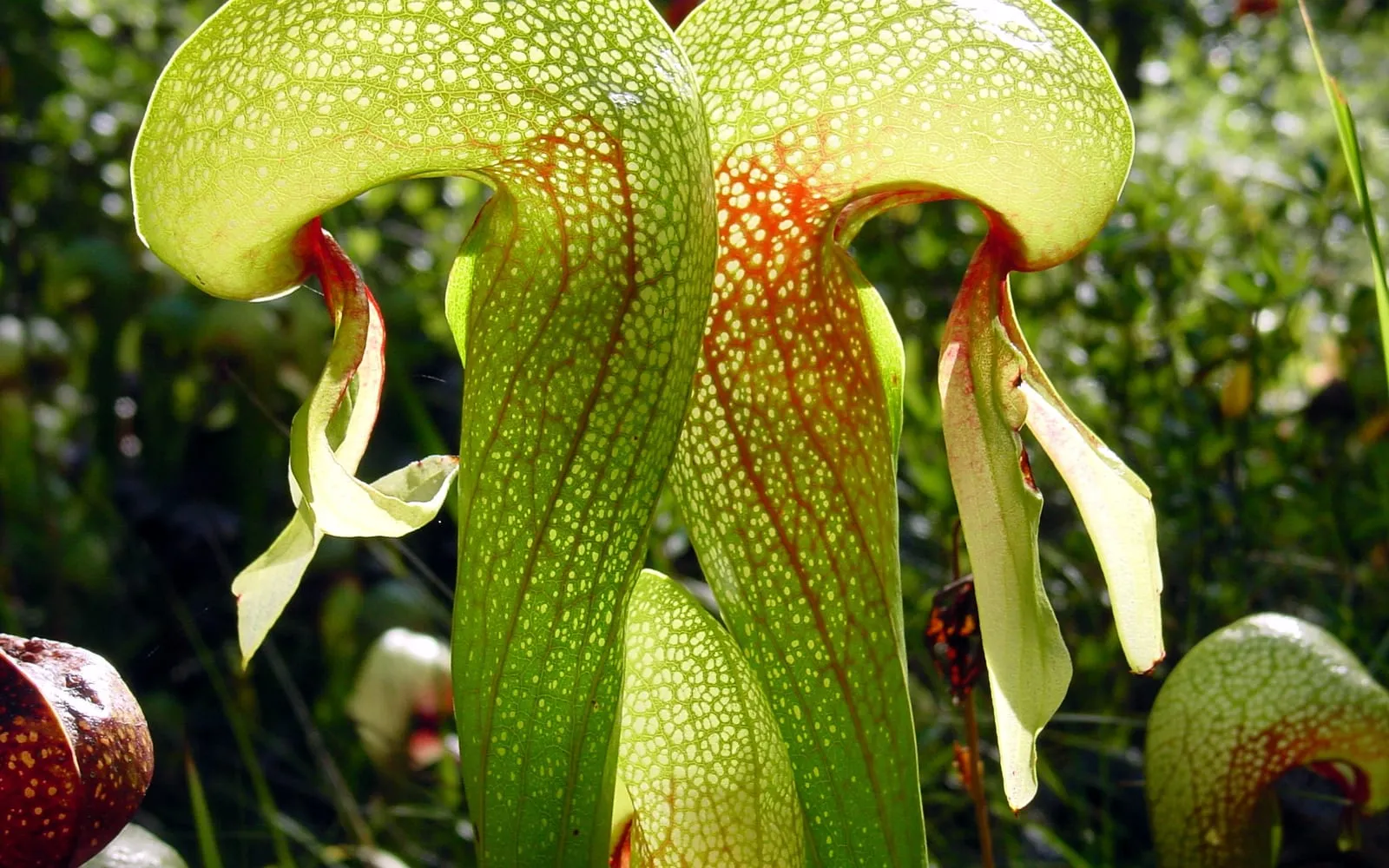
The cobra lily earns its name honestly: each pitcher arches over into a swollen, hooded chamber with two narrow, downward-pointing lobes hanging from the front like a forked tongue, giving the whole trap an unmistakable resemblance to a rearing snake. It grows in cold seeps and stream margins across a narrow band of northern California and southern Oregon, and it has a horticultural quirk that trips up more growers than any other part of its care: however hot the air gets, its roots need to stay cold.
The trap does not rely on stickiness or speed. Insects are drawn up into the domed hood by a trail of nectar, and once inside, they find themselves surrounded by pale, translucent patches in the wall, called areoles, that let light through in a way that mimics an opening to the outside. An insect trying to leave heads for the brightest of these false exits rather than the real one it came in through, and repeated failed attempts to escape eventually exhaust it enough to fall down the narrowing throat, which is lined with stiff, downward-pointing hairs that make climbing back out all but impossible.
Unlike a Sarracenia pitcher, this one does not collect rainwater at all; the fluid inside comes from the plant’s own roots, pumped up and physiologically regulated rather than passively filled from above. And where the plant was once thought to produce no digestive enzymes of its own at all, recent research has found it secretes at least one, though it still relies heavily on a resident community of bacteria to do most of the work of breaking down what it catches.
Appearance and character
Each pitcher is a slender, upright tube that curves over at the top into a swollen, balloon-like hood, translucent-spotted and often flushed with red or maroon over a base of pale yellow-green, particularly where it gets strong sun. The two hanging lobes beneath the hood, sometimes called the fishtail appendage, are covered in nectar glands and act as a landing platform and lure for passing insects before they ever reach the opening proper.
A healthy clump sends up a dense cluster of these hooded pitchers from a spreading network of underground stolons, and colonies in the wild can carry on expanding outward for decades, forming patches many metres across along a seep’s edge.
Flowers appear on tall, bare stalks well above the pitchers in spring, nodding and maroon-veined, with an unusual arrangement of overlapping sepals and petals that gives them a slightly untidy, papery look next to the sculptural precision of the traps below.
Where it is from
Serpentine seeps, boggy stream margins and mountain bogs in northern California and southern Oregon, almost always where cold water, often snowmelt, keeps moving through the root zone even during warm weather. The serpentine soils typical of these sites are naturally low in the nutrients most plants need and often carry heavy metals many plants cannot tolerate, which helps explain why so little else grows alongside it.
The constant movement of cold water is doing more than keeping the roots chilled; it also flushes away the mineral buildup that would otherwise accumulate around the roots in still water, which is part of why a stagnant pot of standing water causes this species to decline even when the temperature itself is not obviously wrong.
How it grows
New pitchers emerge through spring and early summer, unfurling from tightly rolled growth points and reaching full size over several weeks. The plant spreads mainly by stolons, thin underground runners that travel outward from the base of an established clump and eventually produce a new rosette of pitchers some distance from the parent.
Because of this spreading habit, a single plant given enough time and space in a suitable bog planting will slowly turn into a broad colony rather than staying a discrete clump, in much the same way it does in the wild. Division of an established colony, separating rooted sections of stolon in early spring, is the standard way to propagate it; seed is possible but slow and demands the same cold, wet, low-mineral conditions the adult plant needs.
Through the seasons
Spring brings flowering first, on tall stalks above last year’s pitchers, followed by a flush of new growth as the season warms. Divide an overcrowded colony now if needed, before new stolons get fully under way.
Summer is the trickiest season to manage well, since air temperatures can run warm even where the plant grows wild. Keep the water supply to the roots cold and moving if at all possible, through a slow trickle, frequent top-ups of chilled rainwater, or siting the planting where it gets some afternoon shade to limit warming.
Autumn brings a natural slowdown in growth as temperatures fall and day length shortens, with the season’s pitchers persisting well into the cooler months.
Winter is a genuine cold dormancy, and established plants tolerate overnight frosts to around -7 C without protection once fully dormant. What damages this species more than a single hard freeze is a long, cold, waterlogged spell with repeated freezing and thawing, so a bog planting that drains reasonably even in winter fares better than one that sits permanently flooded and ices over repeatedly.
Care difficulty
Difficult, and the difficulty is concentrated almost entirely on one point: keeping the roots cool through summer while everything above ground tolerates ordinary warm-season temperatures without complaint. A grower who can supply a steady trickle of cold, low-mineral water, whether from a small pump-fed stream, deep shaded reservoir, or frequent top-ups of chilled rainwater, finds the rest of its care straightforward.
Watering
Keep the planting permanently wet with cold rainwater, ideally moving rather than standing still, since stagnant water in a container tends to warm in the sun and lets mineral concentration build up around the roots. A slow drip irrigation system, a shaded reservoir topped up regularly with chilled water, or a lined bog bed fed by a small circulating pump are all better than a simple saucer of still water sitting in full sun.
Only rainwater or distilled water is suitable; this species is particularly sensitive to the dissolved minerals in tap water, given how directly its pitcher fluid is drawn from what its roots take up.
Warning signs, diseases and pests
Aphids occasionally target the flower stalks and the newest, softest pitcher growth. A gentle rinse with water or removal by hand usually deals with a light infestation without further intervention.
Botrytis can develop on dead or dying pitchers in still, humid conditions, appearing as a grey fuzzy coating. Remove affected pitchers and improve air movement around the planting rather than treating it with a fungicide as a first response.
Pitchers that stay short, pale and fail to develop their usual hood shape are the most reliable sign that the roots have been running too warm. Checking and improving the water supply’s temperature typically resolves this over the following season rather than immediately.
Growing environment
Full sun to light shade both work, provided the roots stay cool; in warmer climates, some afternoon shade over the planting, without shading the roots’ water supply from view of cool air, helps prevent overheating. Ordinary outdoor humidity is fine.
Root temperature matters more than air temperature, and a bog garden built with a reservoir of deep, shaded, frequently refreshed cold water at the roots will outperform a shallow pot baking in a sunny spot regardless of how well the rest of the setup is managed.
Use a low-nutrient mix such as sphagnum moss combined with perlite and coarse sand, ideally in a planting with enough depth and shading to keep the root zone several degrees cooler than the surrounding air.
Feeding
None applied to the roots or leaves. The plant’s own pitcher fluid, together with resident bacteria, breaks down insects lured up into the hooded trap, and no additional fertiliser should be used, since it damages the roots of a plant already adapted to some of the most nutrient-poor soils in North America.
An outdoor planting catches enough insects on its own; supplementary feeding is rarely necessary or advisable.
Troubleshooting
Pitchers are short, pale and poorly hooded despite otherwise good care. Almost always the roots running too warm. Improve the water supply’s temperature with more shade, deeper water, or more frequent refreshing.
The colony has stopped spreading after several good years. Often a sign the water has become mineral-laden or stagnant rather than a sign of age; flush the planting with fresh rainwater and check the source has not changed.
Leaves and pitchers collapsed after a hard winter freeze. Some dieback after a severe cold snap is normal even in an established colony, and new growth typically returns from the stolons the following spring.
Grey mould is spreading across dead pitchers. Botrytis, usually from still, humid air. Remove the affected material and improve airflow around the planting.
The plant sat in a shallow tray of water in full sun and declined over summer. A classic sign of roots overheating. Move to deeper, shaded, regularly refreshed water rather than a shallow, sun-exposed saucer.
Can it be grown in an ordinary bog garden alongside Sarracenia? Only if the water can be kept cooler than a typical bog bed manages in summer. Many growers give it a separate reservoir with extra shade or a small circulating pump rather than mixing it into a general bog planting.
Is a frozen pond or bog surface in winter a problem? Not on its own. Fully dormant plants tolerate overnight frost reasonably well; it is prolonged freeze-thaw cycling in waterlogged conditions, not a single cold snap, that causes the most damage.