
Outdoor plant
Purple Pitcher Plant
Sarracenia purpurea
Also known as Huntsman's Cup, Northern Pitcher Plant
How to grow Sarracenia purpurea in a bog garden. Winter dormancy, rainwater only, and the tiny food web living inside every water-filled pitcher.
At a glance
- Difficulty
- Moderate
- Water
- Keep the pot standing in 2-5 cm of water throughout the growing season
- Light
- Full sun, at least 6 hours a day
- Temperature
- Tolerates hard freezes when dormant; grows best 15-30 deg C in summer
- Humidity
- Ordinary outdoor humidity; the pitchers hold their own water supply
- Hardiness
- USDA 3-9, RHS H6, hardy to -20 C
- Type
- Hardy herbaceous perennial
- Height
- 10-25 cm
- Native to
- North America
The only Sarracenia that grows wild in Canada, found from Labrador down the eastern seaboard to the Gulf coast. A plant kept too warm through winter, or denied a proper freeze, weakens over a few seasons and stops pitchering well. Rainwater or distilled water only; the dissolved minerals in tap or bottled water build up in the compost and kill the fine roots long before the cold does.
Hardiness zones describe winter cold alone. Summer heat, humidity, rainfall and the length of the growing season decide as much, so treat the range as the outer limit rather than as a recommendation.
Not known to be toxic
Purple pitcher plant has no toxicity listing from the RHS or the ASPCA. The pitchers hold rainwater, drowned insects and decaying matter rather than any compound harmful to eat, and there is no documented history of poisoning in people or pets.
Source: RHS
About
The purple pitcher plant grows in bogs across a huge stretch of North America, from the Northwest Territories down to the Gulf of Mexico, and it is the hardiest of the nine Sarracenia species by a wide margin. Where other pitcher plants need a Carolina winter to stay content, this one is dug out of frozen Labrador peat and sits under snow for months without complaint.
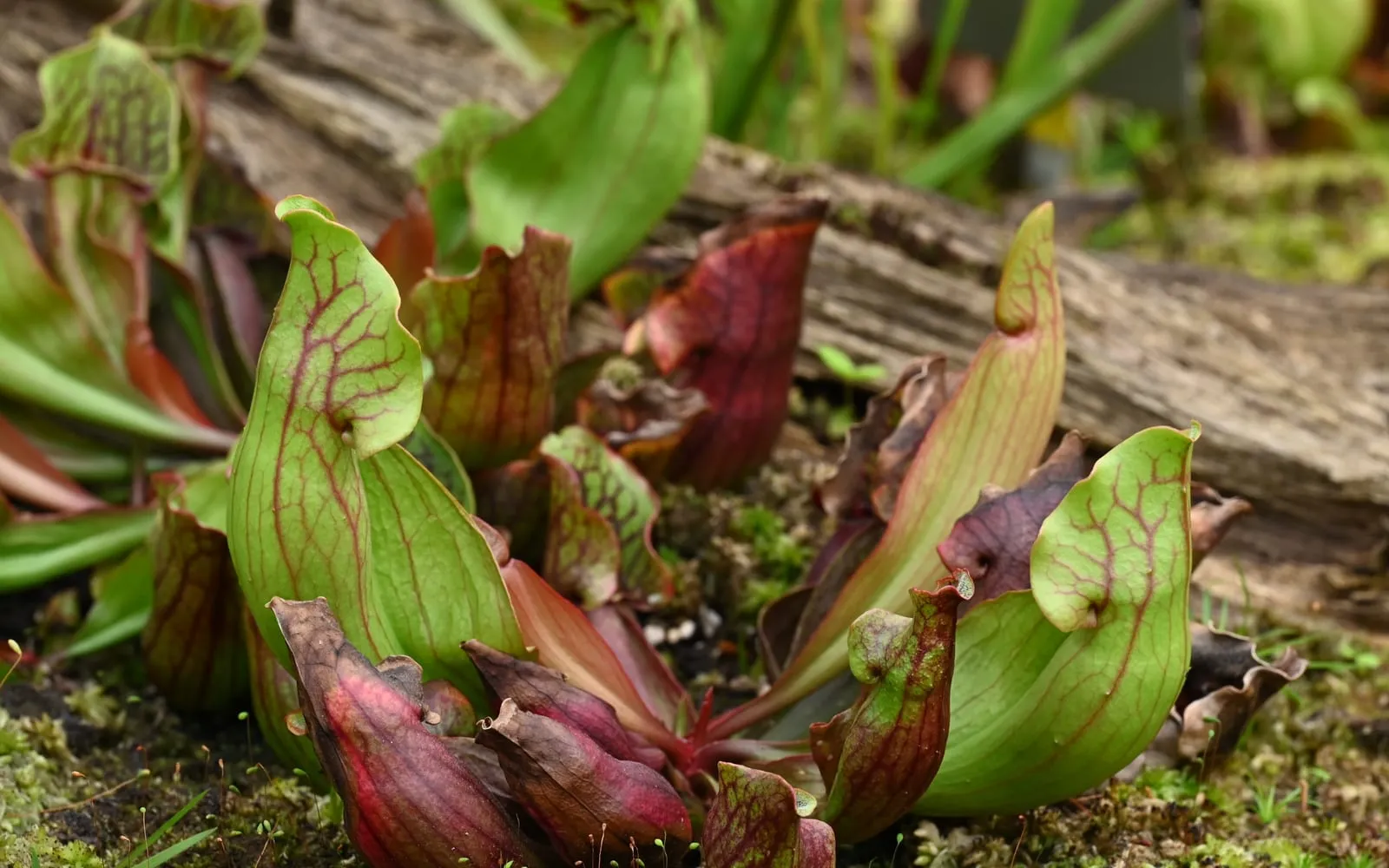
Its pitchers lie close to the ground rather than standing upright, forming a rosette that looks more like a squat, curling cup than a trumpet. Each holds a pool of standing water, and that water is the plant’s real trap. Rain falls in, insects fall in after it, and the pitcher does not so much digest its catch as host an entire community that does the work instead.
It is the provincial flower of Newfoundland and Labrador and the state wildflower of Michigan, and it is usually the pitcher plant a beginner outside the American South can keep alive outdoors year after year.
Appearance and character
Pitchers are short and stout, veined in maroon over green, and lined inside with stiff downward-pointing hairs that let an insect walk in easily and climb out only with great difficulty. A waxy zone below the rim adds to the trouble, and most prey eventually tires and drowns.
The flower is the plant’s most distinctive feature after the trap itself: a single, nodding, deep red-maroon bloom on a bare stalk well above the leaves, built around an odd umbrella-shaped style that shelters the reproductive parts from its own falling pollen. It opens in late spring, before most of the new pitchers have unfurled, and lasts for several weeks.
Colour varies enormously between populations, from plain green through heavily veined maroon to almost solid wine-red in plants that get full sun and cool nights. A pale, mostly green plant is usually one grown in too much shade rather than a different form.
Where it is from
Acidic, waterlogged bogs and fens, usually rooted directly into living sphagnum moss over peat that has been building for thousands of years. The water table sits at or near the surface all year, and the peat itself supplies almost nothing in the way of nitrogen or phosphorus, which is the condition that makes carnivory worth the plant’s energy in the first place.
Because sphagnum bog water is naturally acidic and almost mineral-free, a plant lifted straight from this habitat has no tolerance for garden compost, fertiliser or hard tap water. Recreating the low-nutrient, constantly damp conditions of a bog matters more for this species than getting the temperature right.
How it grows
New pitchers emerge from the centre of the rosette through spring and early summer, unfurling from a tight coil over a few days. Each pitcher lives for roughly a year before browning off and being replaced from underneath, so a healthy plant always shows a mix of fresh green growth and old pitchers going over.
The rhizome creeps slowly along the surface of the peat, branching as it goes, and an established clump eventually forms a dense mat of overlapping rosettes. Division in spring, cutting the rhizome into sections that each carry roots and at least one growth point, is the reliable way to propagate it; seed is possible but slow, taking two to three years to reach a flowering size.
Unlike a Venus flytrap or a sundew, this species does not fold, snap or secrete much in the way of its own digestive enzymes. It is largely a passive pitfall trap that leans on gravity, downward hairs and drowning rather than active movement.
Through the seasons
Spring brings the flower first, then a flush of new pitchers as the rhizome wakes from its winter rest. This is the point to repot or divide an overcrowded clump, before growth gets fully under way.
Summer is the main growing season. Pitchers fill with rainwater and insects, the rosette bulks up, and the plant wants full sun and a permanently wet root run. A pot standing in a saucer of rainwater rarely dries out on its own in a bog planting.
Autumn brings shorter days and cooler nights, and pitcher production slows and then stops. Leave the old pitchers in place; they still photosynthesise and feed the rhizome even after they have stopped catching anything.
Winter is a genuine dormancy, and it is not optional. The plant needs a period of cold, ideally with a hard frost or two, to reset its growth cycle. A bog garden left outdoors through a temperate winter does this on its own. A potted plant kept indoors on a warm windowsill all year, by contrast, will decline over two or three seasons and eventually fail to produce pitchers at all.
Care difficulty
Moderate. The plant tolerates a wide range of temperatures and is far more forgiving of cold neglect than of a warm, sheltered winter, but it depends entirely on rainwater and nutrient-poor soil, which rules out an ordinary garden bed or houseplant compost.
Most failures come from good intentions. A grower feeds it, waters it with tap water, or brings it indoors every autumn to protect it from a cold it is built to survive.
Watering
Stand the pot in a saucer or tray holding 2 to 5 cm of rainwater or distilled water throughout spring, summer and autumn. The peat mix should never be allowed to dry out completely during the growing season.
Reduce the water level over winter rather than removing it altogether; a shallow tray that occasionally runs dry between refills mimics the natural drop in the water table better than keeping the pot permanently flooded in the cold months. Never use tap water, softened water or water that has passed through a domestic filter jug, since the dissolved minerals and chlorine in all three accumulate in the peat and damage the roots over time.
If planted directly into a garden bog bed with a butyl liner, rainfall alone usually keeps it wet enough, and a liner without drainage holes stops mineral groundwater from seeping in underneath.
Warning signs, diseases and pests
Botrytis, a grey fuzzy mould, sometimes appears on dead or dying pitchers in damp, still conditions. Cut off and remove affected pitchers promptly and improve air movement around the plant rather than reaching for a fungicide.
Aphids occasionally colonise the new growth around the crown. A strong jet of water or a wipe with a damp cloth usually clears a light infestation; leave any predatory insects that turn up on their own, since they will often finish the job.
Root rot follows from anything other than rainwater, or from compost that contains real soil or fertiliser. Roots that have gone dark, soft and foul-smelling mean the mix needs replacing entirely with fresh peat and sphagnum, and any affected growth should be cut back to firm tissue.
A pitcher that never opens, staying folded and undersized, is not diseased. That is usually a sign of insufficient winter chilling the previous season, and the plant should recover the following year with a proper dormancy.
Growing environment
Full sun for at least six hours a day produces the deep maroon colour and the most robust pitchers; a shaded plant stays pale green and weak-stemmed. Outdoors, a pond margin, bog garden or large glazed pot with no drainage hole and a permanent water reservoir all work.
It shrugs off summer heat as long as its roots stay wet, and the winter cold described in hardiness above is a requirement rather than a risk. Ordinary outdoor humidity is fine; the pitchers supply their own water rather than depending on air moisture.
Plant it in a mix of two parts peat-free sphagnum moss to one part horticultural perlite or silica sand, never in ordinary potting compost, garden soil or anything containing added fertiliser.
Feeding
None from any bag or bottle. Nitrogen and phosphorus come from insects that fall into the pitchers and are broken down, largely by bacteria and small invertebrates living in the fluid, rather than from anything applied to the roots or leaves.
A plant grown outdoors catches enough on its own. One kept somewhere insects rarely reach, such as an enclosed porch, can be fed the occasional freeze-dried bloodworm or small insect dropped into a pitcher, no more than once or twice a month.
Troubleshooting
The pitchers stay small and pale, never developing much red colouring. Too little light. Move the plant somewhere it gets direct sun for most of the day.
Pitchers are collapsing and turning black at the base. Likely botrytis in still, damp air. Remove the affected pitchers and improve ventilation around the plant.
The plant produced no flowers this spring. A young division, or one that did not get a proper winter chill the year before. Established plants that have had a full cold dormancy flower reliably.
White crusty deposits are forming on the pot or compost surface. A sign that tap water or fertiliser has been used at some point. Flush the pot repeatedly with rainwater and switch to rainwater only from now on.
The rhizome feels soft and the whole plant is loose in its pot. Root rot, usually from non-rainwater or poor drainage. Unpot, cut away anything soft and discoloured, and repot into a fresh peat and sphagnum mix.
Can I bring it indoors for winter to protect it? No, and doing so is the single most common way this species is killed in cultivation. It needs the cold to reset properly; a warm windowsill in January weakens it over successive years.
Something is living inside the pitchers. Almost certainly meant to be there. Wild purple pitcher plants host mosquito larvae, midge larvae, mites and rotifers that help break down trapped prey, and a potted plant left outdoors will often attract the same.