
Outdoor plant
European White Bryony
Bryonia alba
Also known as White Bryony, Wild Hop
What white bryony is, Bryonia alba, an ivy-like poisonous climber with black berries, and how to identify and remove it safely.
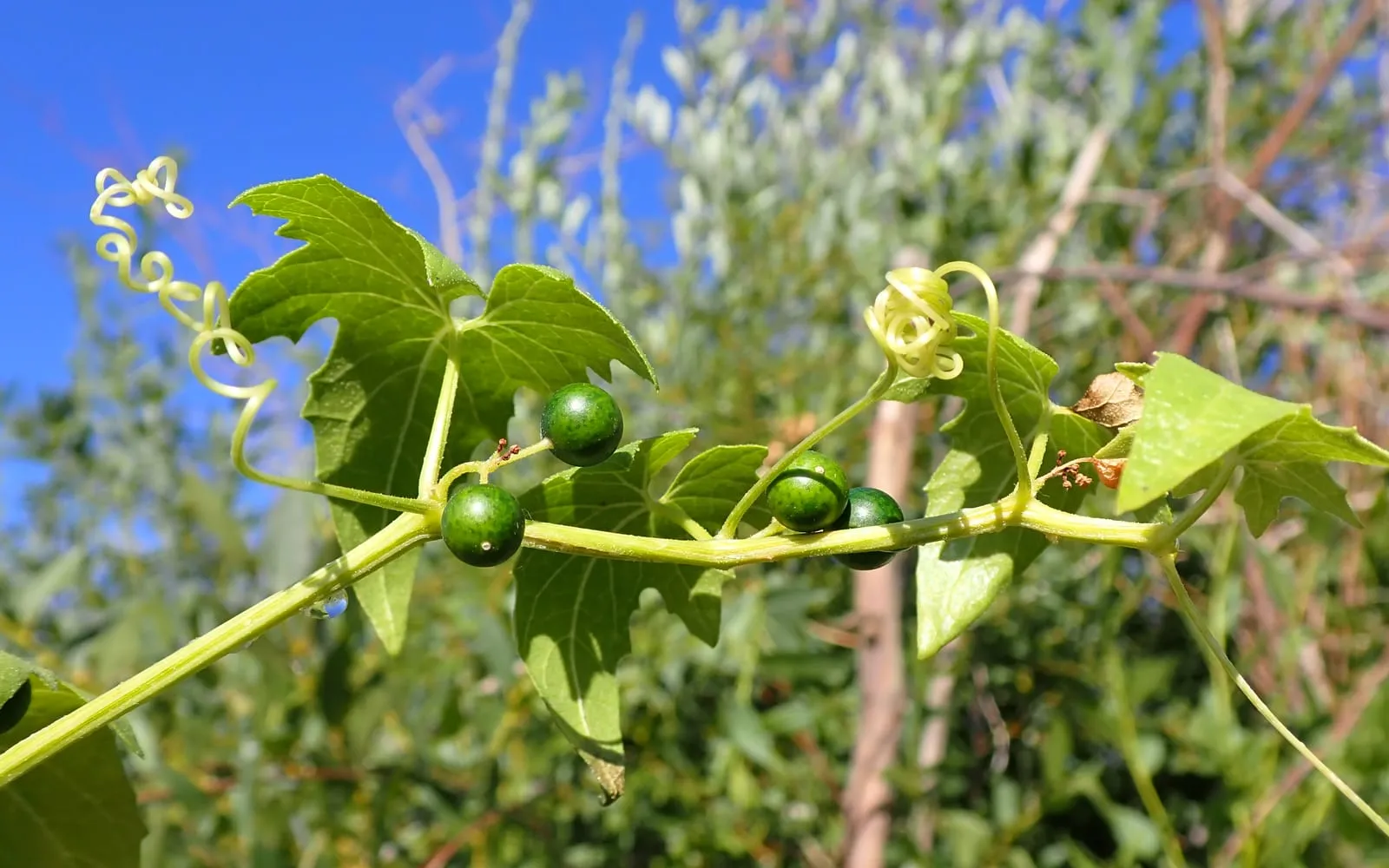
At a glance
- Difficulty
- Easy
- Water
- None; it is a wild plant that needs no watering
- Light
- Full sun to partial shade
- Temperature
- Fully hardy; the top growth dies back each winter
- Hardiness
- USDA 4-8, RHS H6, hardy to -25 C
- Type
- Herbaceous perennial climber from a large tuberous root
- Height
- 3 to 4 m of annual growth
- Native to
- Europe, Western Asia
The top growth is killed by frost each autumn and the plant regrows from its deep tuberous root every spring, so it survives cold winters unharmed underground. It grows fast in a warm summer and is untroubled by heat within its range. Where it has been introduced to North America it has become an aggressive weed, because the same hardiness and vigour let it spread with no natural check.
Hardiness zones describe winter cold alone. Summer heat, humidity, rainfall and the length of the growing season decide as much, so treat the range as the outer limit rather than as a recommendation.
Poisonous if eaten
- Do not eat
- Every part, and the root and berries most of all
- Harm from
- Eating it and handling it
- Affects
- People, cats, dogs and horses
All of white bryony is poisonous, and the large root and the ripe black berries are the most dangerous parts. It contains bitter cucurbitacins, the same class of compounds that make a wild gourd inedible, and the root acts as a violent purgative that has caused serious and occasionally fatal poisoning in people and livestock. As few as a handful of berries can make a child dangerously ill. The sap also irritates and can blister skin on contact. The root was once dug up and sold as a fake mandrake, but that history is a warning about its strength, not a sign that it is safe. Treat any swallowing of the root or berries as a medical emergency, and wear gloves to handle or dig out the plant.
Sources: RHS potentially harmful garden plants, ASPCA toxic and non-toxic plants
About
White bryony is a wild climbing plant of hedgerows and field edges, not a garden plant, and this guide is here to help you recognise it and deal with it rather than to grow it. It scrambles up through hedges and shrubs on coiling tendrils, dies back to the ground each winter, and returns from a large buried root that can be older and heavier than the annual growth suggests.
Two things make it worth knowing. It is poisonous in every part, and it is a smothering weed that can pull down a hedge or swamp a young tree over a season. Where it has spread outside its native range, especially in parts of North America, it is treated as a serious invasive weed.
The name is shared confusingly with red bryony and both are sometimes just called bryony, but they are different species. White bryony carries black berries when ripe; red bryony carries red ones.
Appearance and character
Leaves are palmate with five lobes, rough and slightly hairy, mid green, and look much like a coarse ivy or a vine leaf. They are carried alternately along the climbing stems.
Tendrils spring from beside the leaf stalks and coil tightly around any support, pulling the plant up through whatever it grows against. This is how a stem reaches three or four metres in a single season.
Flowers are small, greenish white to pale yellow, five-petalled and easily overlooked, opening through summer. White bryony carries both male and female flowers on the same plant, which is one difference from red bryony.
Berries follow the female flowers and ripen from green to a shining black, each holding a few seeds. Birds eat them and spread the seed widely, which is the main way new plants appear.
The root is the hidden part and the most important. It is a large, fleshy, pale tuber that swells year on year, storing the energy that drives the fast spring regrowth and holding much of the plant’s poison.
Where it is from
Bryonia alba grows wild across Europe and western Asia, in hedges, thickets, scrub, waste ground and the edges of woods and fields. It favours disturbed, fertile ground and climbs on whatever is nearby.
In its native range it is a familiar hedgerow plant kept in some check by the conditions and species around it. In North America, where it was introduced, it has spread aggressively and smothers native shrubs and trees. Several regions now list it as a noxious weed and ask that it be reported and removed.
How it grows
New shoots rise from the root in spring and climb fast once the weather warms, reaching for any support and covering it through summer. A single established root can throw up several vigorous stems.
The plant flowers and sets berries through summer and into autumn, then the top growth is killed by the first hard frost and dies back to the ground. The root survives the winter and repeats the cycle, growing larger and more vigorous each year.
Because it grows from that deep, persistent root and spreads by bird-sown seed, it is difficult to remove once established. Cutting the top growth alone achieves nothing lasting, since the root regrows.
Grow nothing like it on purpose. If it appears in a garden, deal with it while it is young and the root is still small.
Through the seasons
Spring brings fast new growth from the root, the young stems climbing quickly. This is the easiest time to trace a stem to its root and dig it out.
Summer is dense leafy climbing growth, flowering, and the first green berries forming as the plant smothers its support.
Autumn ripens the black berries, which birds then eat and spread. Remove them before this happens if you can.
Winter the top growth dies away completely, leaving the root alive underground and no sign above it, so the plant is often forgotten until it returns.
Care difficulty
There is no care to speak of, since this is a wild plant nobody needs to cultivate. It grows easily and vigorously on its own, which is exactly the problem. The real task is removal, and that is hard, because the deep tuberous root regrows from any fragment left behind and the plant reseeds from berries carried in by birds. Persistence over more than one season is usually needed.
Watering
None is required. White bryony is a wild, drought-tolerant perennial that draws on its large water-storing root and needs no watering from anyone. Nothing about managing it involves keeping it alive.
Warning signs, diseases and pests
If anyone has eaten the berries or any part of the root, treat it as a medical emergency. The black berries are the part most likely to tempt a child, and a small number can cause serious illness. Do not wait for symptoms.
The plant itself has few problems, because it is a tough wild species. The main warnings are about the harm it can cause.
It poisons livestock that graze it and has caused deaths in horses and cattle, so keep it out of paddocks and grazing. Wear gloves when handling or digging it, because the sap can irritate and blister skin.
As a weed it smothers and weakens hedges, shrubs and young trees by blocking their light, and a heavy growth can physically drag down thin branches.
Growing environment
It tolerates full sun to partial shade and grows in most soils, favouring the fertile, disturbed ground of hedge bottoms, field margins and waste places. It is not fussy, which is part of why it spreads.
It needs a support to climb, and uses hedges, fences and other plants freely. Given nothing to climb it sprawls along the ground instead.
No particular shelter, feeding or improvement is involved, since the aim is never to encourage it. The only decision worth making about its environment is how to remove it from yours.
Feeding
Never feed it. Feeding would only make a vigorous weed more vigorous. Rich, fertile ground already suits it well, so hedgerows and cultivated edges are where it turns up.
If it is growing in a border, the surrounding fertility you give your garden plants will also feed the bryony. Dig it out early before it establishes.
Troubleshooting
A child or pet has eaten the berries. Treat it as an emergency and get help at once. The berries are seriously poisonous and a small quantity can cause grave illness in a child, a dog or a cat.
How do I get rid of it? Dig out the whole root, which is large and deep, while wearing gloves, and follow the stem down to find it. Removing only the top growth fails, because the root regrows. Expect to return over more than one season, and clear the berries before birds spread the seed further.
Is this the same as red bryony? No. They are separate species. White bryony has black berries and bears male and female flowers on one plant. Red bryony has red berries and separate male and female plants. Both are poisonous climbers.
Is it the same as a grapevine or hop? No, though it can look like one at a glance and is sometimes called wild hop. It is unrelated and poisonous, so never treat its growth or berries as edible.
It has smothered my hedge. Cut the top growth to free the hedge, then trace and dig out the roots to stop it returning. Cutting alone gives only temporary relief, since the plant regrows from the root each spring.