
Outdoor plant
Creeping Jenny
Lysimachia nummularia
Also known as Moneywort, Herb Twopence
How to grow creeping Jenny, Lysimachia nummularia, a coin-leaved trailer that will root in a hanging basket or stand in shallow water at a pond edge.
At a glance
- Difficulty
- Easy
- Water
- Keep consistently moist; never let it dry out for long
- Light
- Full sun to partial shade
- Temperature
- Fully hardy, to about -15 deg C
- Hardiness
- USDA 3-8, RHS H5, hardy to -15 C
- Type
- Hardy evergreen to semi-evergreen trailing perennial
- Height
- 2-5 cm tall, trailing to 60 cm or more
- Native to
- Europe, western Asia
The zone range describes a plant that copes with cold reasonably well but says nothing about its unusual tolerance for wet feet. This is a groundcover that grows equally happily in an ordinary border, a boggy patch that kills most perennials, or rooted directly in the mud at a pond margin under a few centimetres of standing water.
Hardiness zones describe winter cold alone. Summer heat, humidity, rainfall and the length of the growing season decide as much, so treat the range as the outer limit rather than as a recommendation.
Not known to be toxic
Lysimachia nummularia is not listed as toxic by the ASPCA and carries no entry on the RHS list of potentially harmful garden plants. Some sources note trace saponins in the foliage capable of mild stomach upset if a large quantity were eaten, which is a low-level caution rather than a documented hazard. A more useful warning is about identity rather than chemistry: the common name creeping Charlie is shared with ground ivy, Glechoma hederacea, an unrelated and mildly toxic plant, so a positive identification by scientific name matters more here than usual before assuming safety.
Sources: ASPCA Toxic and Non-Toxic Plant List, RHS potentially harmful garden plants
About
Creeping Jenny will grow where most groundcover rots. Its trailing stems root at every leaf node across ordinary border soil the way many mat-forming perennials do, but it also stands rooted directly in mud at a pond margin under a few centimetres of standing water, which very little else on this list can manage.
Round, coin-shaped leaves give the plant its scientific name, nummularia, from the Latin for coin, and its cheerful yellow cup-shaped flowers open through summer along the length of every trailing stem.
The golden-leaved cultivar Aurea has become one of the most widely sold trailing plants for hanging baskets and container edges, valued for the way its bright foliage spills and drapes rather than for its flowers, which are the same as the plain green species.
Appearance and character
Stems are thin, square in cross-section and almost entirely prostrate, lying flat against soil or water and trailing over the edge of any container they are planted in. Leaves are rounded, 1 to 2.5 cm across, held in opposite pairs closely spaced along the stem, giving a dense scalloped look to a mature mat.
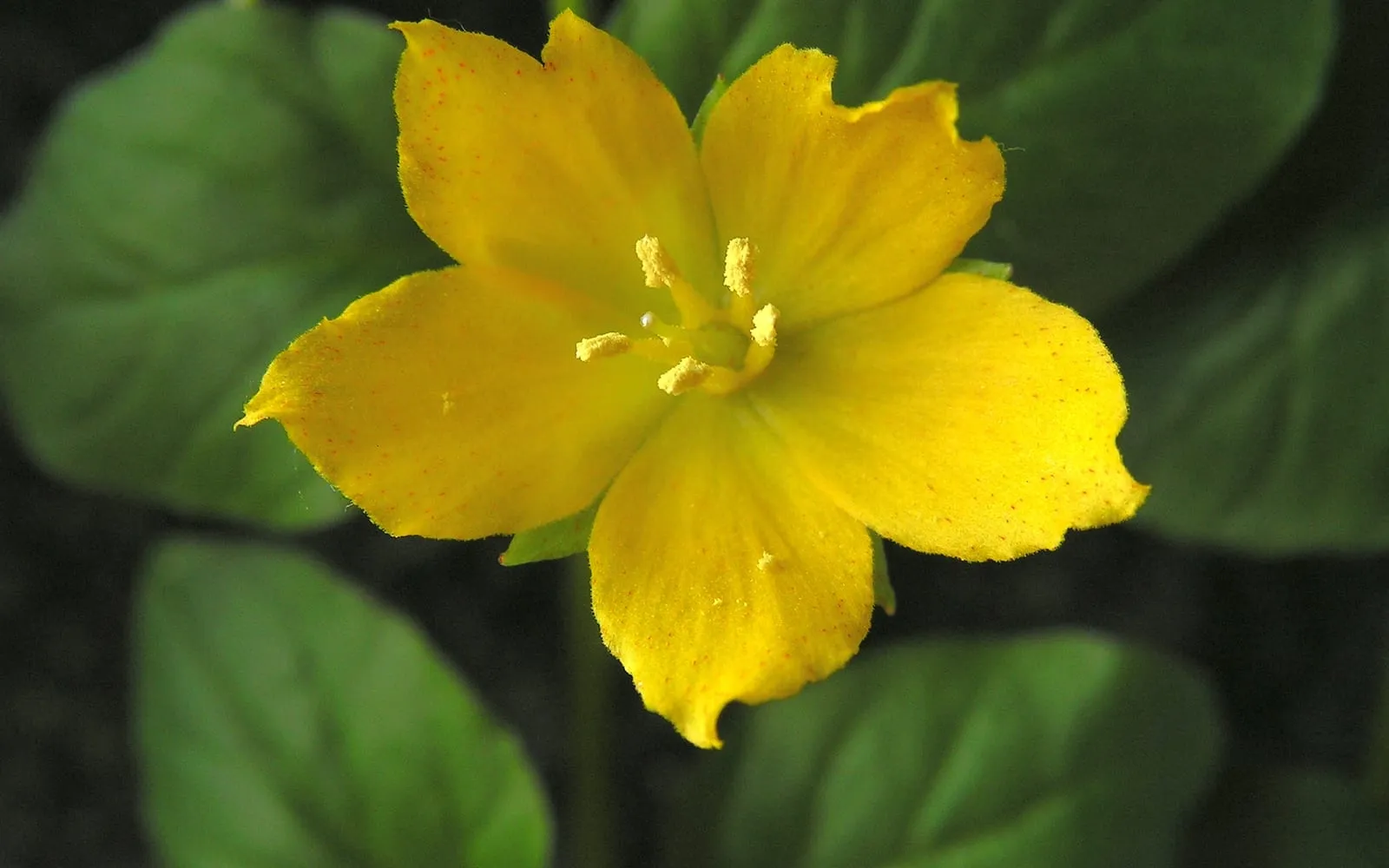
Flowers are bright yellow, cup-shaped, about 2 cm across, borne singly on short stalks at the leaf axils from June through August. A well-grown mat in flower reads as a green carpet dotted evenly with yellow rather than carrying a distinct flowering season the way a spiked flower would.
The species is green-leaved; the cultivar Aurea has bright golden-yellow foliage that holds its colour best in full sun and greens up somewhat in shade. Aurea is markedly less vigorous than the plain green species, which is one of the reasons it is grown in containers rather than as open ground cover, where the wild form would soon overwhelm it.
Growth is evergreen in a mild winter and semi-evergreen in a colder one, dying back to a resting crown that reshoots reliably in spring.
Where it is from
Lysimachia nummularia is native to Europe, including Britain, and east into western Asia, growing naturally in damp meadows, ditches, streamside mud and the shallow margins of ponds and slow water.
That native habitat explains its unusual versatility in cultivation. Few groundcover perennials evolved to grow both as ordinary border planting and as a marginal aquatic, and creeping Jenny does both because its wild range already spans dry-ish grassland at one edge and standing water at the other.
Introduced widely to North American gardens for hanging baskets and pond planting, it has escaped cultivation in parts of the eastern and north-western United States, where it spreads along streambanks and around ponds and has been flagged as invasive in several states, including a recommendation from the New York Invasive Species Council to prohibit its sale. Check local advice before planting it near a natural watercourse in a region where it has naturalised.
How it grows
Spread happens through rooting stem nodes, exactly as with several other plants in this group, but creeping Jenny does it in wet ground as readily as in ordinary soil. That ability sets its growing method apart. A trailing stem laid across damp mud can root within days rather than weeks.
In a border, plant divisions 20 to 30 cm apart for full cover within a season on reliably moist soil. At a pond margin, plant rooted sections directly into aquatic planting baskets or into the mud at the water’s edge, submerged by no more than a few centimetres, and the stems will extend both along the bank and out over the water surface.
In a hanging basket or container, a single small plant fills the space and begins trailing over the edge within weeks, needing regular watering since a hanging container dries faster than open ground.
Established plants in the right conditions grow fast enough to need regular trimming to keep them within bounds, whether that boundary is a border edge, a basket rim or the limits of a pond shelf.
Through the seasons
Spring brings fresh growth from the resting crown after any winter dieback, and this is the best time to plant new sections into a border, basket or pond margin.
Summer is flowering time, from June through August, and also the season of fastest stem extension, particularly at a pond edge where warm shallow water accelerates growth further.
Autumn slows growth without stopping it in a mild season. Trim back any stems that have spread beyond their bounds before winter, since it is easier to control growth now than to untangle it in spring.
Winter brings dieback in a cold season, with the crown surviving underground or underwater to reshoot the following spring; in a mild winter the evergreen foliage persists with little change.
Care difficulty
Easy almost everywhere it is given enough moisture, and the plant fails far more often from drought than from any pest or disease. A border planting that is allowed to dry out repeatedly thins and struggles, while the same plant at a permanently damp pond margin needs almost no attention beyond periodic trimming.
Containers and hanging baskets need the most consistent care, since they dry faster than open ground and the golden cultivar in particular shows stress quickly when watering lapses.
Its vigour in the right conditions is itself a maintenance task. A patch in reliably moist, fertile soil spreads fast enough to need trimming back from neighbouring plants at least once a season.
Watering
Keep the soil consistently moist at all times. This is not a plant that tolerates the drying-out-between-waterings routine that suits many groundcovers, and a border planting left dry for more than a few days shows it in wilted, dulled foliage.
At a pond margin, watering is not a concern at all, since the roots sit in permanently wet mud or shallow water. This is the position where the plant performs with the least effort from a gardener.
Containers and hanging baskets need checking daily in hot weather, since they hold far less reserve moisture than open ground and the trailing habit that makes them attractive also increases the leaf surface losing water to evaporation.
Warning signs, diseases and pests
Slugs and snails graze the soft leaves, particularly on new growth in spring, though an established mat usually outgrows the damage.
Crown rot can set in where the soil is wet but stagnant rather than moving or well-aerated, which sounds contradictory for a plant this tolerant of water but reflects the difference between the oxygenated shallows of a pond margin and a waterlogged, airless border pocket.
Rust appears as orange pustules on the leaf undersides in humid, still conditions and is largely cosmetic on vigorous, well-spaced plants.
Leaf spot shows as small dark blotches after prolonged wet weather and rarely needs treatment beyond removing the worst-affected leaves.
Growing environment
Full sun to partial shade both suit it, with the golden Aurea cultivar holding its brightest colour in more direct sun and greening up somewhat in shade.
Moisture is non-negotiable. Moist to wet soil, boggy ground, and shallow standing water at a pond margin are all within its range, and it is one of the few groundcover plants suited to a spot that floods occasionally.
It is not fussy about soil type or pH within that moisture range, growing equally in clay, loam or the silty mud found at a pond edge.
Feeding
In open ground on reasonable soil, feeding is rarely necessary, and the plant grows vigorously enough on its own that added fertiliser mostly encourages growth that then needs trimming back.
Container and hanging basket plants benefit from a monthly balanced liquid feed through summer, since compost in a pot is exhausted within a season and the plant’s fast growth draws on it quickly.
At a pond margin, feeding is unnecessary and best avoided, since fertiliser running off into the water can encourage algae rather than helping the plant, which already grows readily in nutrient-rich pond mud.
Troubleshooting
Can it really grow in water? Yes, rooted in mud at a pond margin under a few centimetres of standing water, which is well within its native habitat. It will not tolerate being permanently submerged in deep water, only shallow margins.
My hanging basket plant has wilted badly. Almost certainly drought. This plant needs consistently moist compost, and a basket that dried out even once can take a full soak and a few days to recover fully.
The golden cultivar has turned green. Too much shade. Move it to a brighter position, where new growth should come through gold again, though established green growth will not revert.
It has spread into the lawn or a neighbouring bed. Trim any stem that crosses a boundary at its rooted point before it establishes further, the same approach that controls other trailing, node-rooting groundcover.
Orange pustules have appeared on the leaves. Rust, more common in humid, crowded conditions. Thin the patch for better airflow and remove the worst leaves.
Is it the same plant as ground ivy or creeping Charlie? No, though it shares a common name with ground ivy, Glechoma hederacea, a different and mildly toxic plant. Check the scientific name, Lysimachia nummularia, to be sure which one you have.
Is it invasive where I live? Check locally before planting it near a pond or watercourse. It has naturalised and been flagged as invasive in parts of the eastern and north-western United States, spreading along streambanks from garden plantings.