
Outdoor plant
Lewisia
Lewisia cotyledon
Also known as Siskiyou lewisia, Cliff maids
How to grow lewisia, Lewisia cotyledon. Why its fleshy leaf rosette collects water and rots from the centre, planting it on a slope or in a vertical crevice to shed rain off the crown, and why it deceives on looks alone.
At a glance
- Difficulty
- Moderate
- Water
- Regular watering through spring and summer; keep the crown dry through autumn and winter
- Light
- Full sun to partial shade; benefits from some shade in hot climates
- Temperature
- Cool to warm temperate
- Hardiness
- USDA 6-9, RHS H5, hardy to -15 C
- Type
- Hardy evergreen perennial
- Height
- 15-30 cm in flower
- Native to
- North America
The zone number describes cold tolerance the plant largely has, since it survives hard frost readily once established. What it does not describe is the plant's real limiting factor, which is winter wet rather than winter cold. A lewisia planted where rain can sit against its crown through a mild, damp winter is far more likely to fail than one exposed to a much colder but drier winter.
Hardiness zones describe winter cold alone. Summer heat, humidity, rainfall and the length of the growing season decide as much, so treat the range as the outer limit rather than as a recommendation.
Not known to be toxic
Lewisia carries no toxicity listing from the RHS or the ASPCA. A related wild species, bitterroot, Lewisia rediviva, was historically eaten by Indigenous peoples of western North America after peeling and cooking the root, though it can cause mild digestive upset if eaten raw in quantity. Lewisia cotyledon itself has no documented history of toxicity and is not typically grown as food.
About
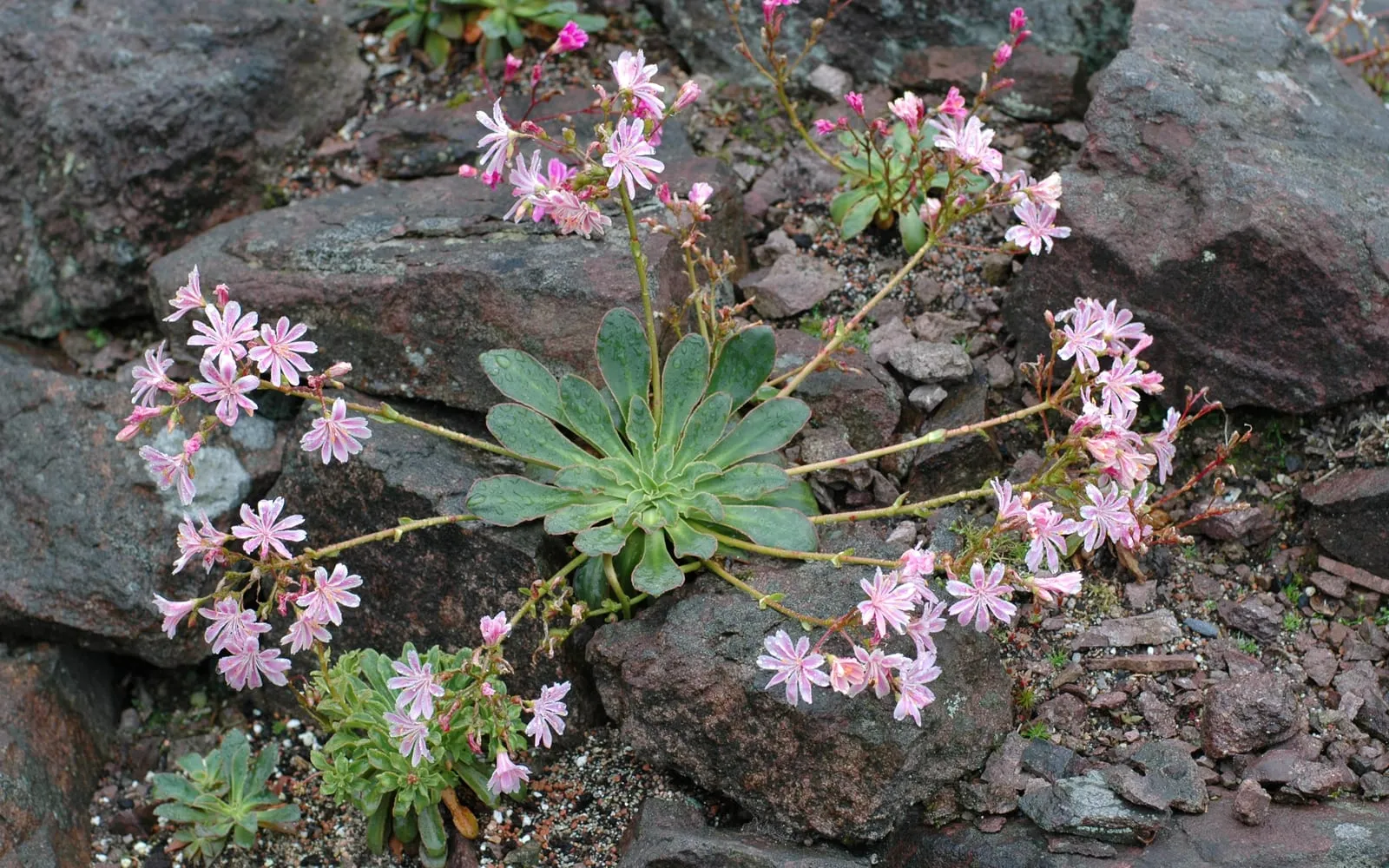
Lewisia produces a rosette of thick, fleshy, spoon-shaped evergreen leaves from which stems carrying clusters of vividly striped or solid-coloured flowers rise through late spring and early summer, in shades running from white and pale pink through orange, magenta and deep purple. It is one of the most visually striking plants in this rockery collection, and also the one that most reliably catches out gardeners who treat its succulent-looking foliage as a sign the plant is forgiving of wet conditions.
The opposite is true. That fleshy rosette, arranged as a shallow funnel with the leaves angled slightly upward from a central point, collects rainwater and holds it directly against the crown, the plant’s most vulnerable point, rather than shedding it away the way a narrower or more upright leaf shape would. Where sea thrift tolerates coastal wet because its native habitat is regularly flooded and drained, lewisia’s own native cliffs are steep and sharply draining specifically to stop this kind of pooling from happening in the wild, and a flat garden bed removes that protection unless the gardener rebuilds it deliberately.
Appearance and character
Broad, fleshy, blue-green leaves form a dense rosette 10 to 15 cm across, thick enough in cross-section that the plant is sometimes mistaken for a succulent by gardeners unfamiliar with it, though it belongs to the family Montiaceae rather than to a true succulent group. The rosette persists year-round as the plant’s main structure, with new leaves continually replacing older ones from the centre outward.
In late spring, branched flower stems rise 15 to 30 cm from the centre of the rosette, each carrying loose clusters of open, many-petalled flowers, often with fine pinstripe markings running the length of each petal in the wild species and named cultivars alike. The display can last several weeks and sometimes repeats with a lighter second flush later in summer if the plant is not stressed by heat or drought during that period.
Where it is from
Lewisia cotyledon is native to the Siskiyou Mountains of southern Oregon and northern California, where it grows rooted into vertical or steeply sloping rock faces and cliff crevices, often with almost no soil visible around the roots at all. That vertical, sharply-draining habitat is the direct explanation for the plant’s crown rot problem in cultivation: on a cliff face, water runs off immediately and never pools against the rosette, while the same rosette planted flat in an ordinary garden bed sits like a shallow bowl, catching exactly the rainfall its wild ancestors never had to shed.
Gardeners who plant lewisia on a slope, tucked sideways into a gap between two rocks, or set at a deliberate angle in a raised scree bed rather than flat and upright, are recreating the geometry of its native cliff habitat rather than following an arbitrary planting trick. The angle does the same job the cliff face does in the wild: it lets water run off the rosette instead of collecting in it.
How it grows
Growth is centred entirely on the rosette, which slowly replaces its own leaves from the middle while the plant’s single, fleshy root system anchors it into whatever crevice or scree pocket it is growing in. Unlike the spreading, mat-forming habit of most other plants in this collection, lewisia stays as a single, self-contained rosette or a small cluster of offset rosettes rather than colonising a wide area.
The crown, where the rosette meets the root, is the plant’s single point of failure. Water that collects there, whether from rain, from overhead watering, or from soil that has been mounded up against the base of the rosette rather than left to fall away from it, sits in direct contact with living tissue and encourages the fungal rot that is by far the most common cause of a lewisia dying. A plant that survives hard frost without difficulty can rot through in a mild, wet week if the crown stays damp.
Through the seasons
Spring brings the main flowering display, usually from April through June, and it is the best time to plant new lewisia, giving the root system a full growing season to establish in its scree pocket before the following winter’s wet weather arrives.
Summer is a period of active growth and, often, a second lighter flush of flowers if the plant has not been stressed by extreme heat. Watering during this period should go to the soil around the rosette, never onto or into the rosette itself, and a top-dressing of coarse grit right up against the base of the leaves helps keep splashing rain away from the crown.
Autumn is when the risk shifts from heat stress to wet stress, as rainfall typically increases while temperatures are still mild enough for fungal rot to spread quickly. This is the point in the year to check that drainage around the crown is working as intended, before winter rain arrives in earnest.
Winter is the season lewisia is most often lost, not from cold but from wet. The plant survives hard frost to around minus 15 deg C without trouble, but a crown sitting in cold, waterlogged soil for weeks at a time will rot regardless of how mild the actual temperature is. Some growers cover the crown with a pane of glass or a cloche during the wettest months specifically to keep rain off without warming the plant, treating winter wet as a separate problem from winter cold entirely.
Care difficulty
Lewisia is rated moderate rather than easy specifically because its one demand, keeping the crown dry, requires the gardener to think about the planting geometry rather than choosing a sunny spot and free-draining soil the way many other rockery plants allow. A flat bed with excellent soil drainage several centimetres down can still kill a lewisia if the rosette itself sits level and collects rain at the surface.
The fix is almost entirely about planting position and angle rather than ongoing maintenance: a lewisia planted correctly, tucked into a vertical crevice or set at a tilt on a raised scree mound, largely looks after itself once established, which is why the plant has a reputation for being both fussy and, once the geometry is right, remarkably trouble-free.
Watering
Water regularly during spring and summer to support active growth and flowering, directing water to the soil around the plant rather than over the rosette. From autumn through winter, reduce watering sharply and rely on natural rainfall unless the plant is under cover, since this is the period when a wet crown is most likely to rot.
Where lewisia is grown in a container, which many growers prefer specifically for the control it gives over winter wet, moving pots under the eaves of a building or into an unheated greenhouse for the wettest months is a common and effective precaution.
Warning signs, diseases and pests
Crown and root rot, both caused by water sitting against the base of the rosette rather than by any specific pathogen unique to the species, is the dominant problem lewisia growers encounter. It shows as leaves at the base of the rosette turning soft, translucent and brown, often starting at the point where the leaves meet the crown rather than at the leaf tips.
Slugs and snails are drawn to the fleshy leaves, particularly on young plants, and can cause significant damage in a single wet night if unchecked. Vine weevil grubs occasionally attack the roots below ground, weakening the plant in a way that is easy to mistake for crown rot until the roots are inspected.
Growing environment
Full sun suits lewisia in cooler climates, while some afternoon shade is beneficial where summers are hot, protecting the fleshy leaves from scorching. A vertical or steeply sloping planting position, a dry-stone wall crevice, a raised scree bed, or a rosette deliberately set at an angle rather than flat, is the most important environmental factor for long-term survival.
Soil must be a sharp, gritty scree mix, with a generous proportion of coarse grit or stone chippings worked through it, and a thick layer of grit as a top-dressing pulled right up under the lowest leaves of the rosette to keep the crown itself out of direct soil contact.
Feeding
Lewisia needs very little feeding, and rich soil or heavy fertiliser tends to produce soft, lush growth that is more vulnerable to rot than the tighter growth the plant produces on lean scree. A single, very dilute liquid feed in spring as growth resumes is enough for most plants, and it can be omitted entirely without harming an established lewisia growing in reasonable scree soil.
Avoid any feeding in autumn or winter, since the plant should be slowing down rather than producing soft new growth heading into the wettest part of the year.
Troubleshooting
Leaves at the base of the rosette have turned soft, translucent and brown. This is crown rot, almost always caused by water sitting against the base of the plant. Remove the affected leaves, improve drainage immediately around the crown with fresh grit, and check whether the plant’s position or angle is letting water collect where it should be running off.
The whole rosette has collapsed suddenly after a wet spell. This is advanced crown rot that has reached the growing point itself, and by this stage the plant usually cannot be saved. Take the loss as a signal to replant future lewisias at a steeper angle or in a more sharply-draining position.
The plant flowered well but looked stressed and faded by midsummer. This points to heat stress rather than a watering problem, particularly in a hot climate or an exposed, fully sun-baked position. Providing some afternoon shade the following summer usually resolves it.
Slugs have stripped chunks out of the fleshy leaves overnight. Lewisia’s succulent leaves are attractive to slugs and snails, particularly on young plants without much bulk. Clear nearby hiding places, water in the morning rather than the evening, and consider a pet-safe ferric phosphate control around vulnerable plantings.
A container-grown lewisia performed well in summer but rotted over winter despite being under cover. Check that the cover is keeping rain off rather than just providing shade, since even a sheltered position can still catch driven or splashing rain in a windy winter. Moving the pot closer to a wall or under a solid overhang usually solves this.
New growth in spring looks weak and the rosette has not filled out as expected. This can follow a winter with some crown damage that was not severe enough to kill the plant outright. Improve drainage around the crown before the following winter, and avoid feeding until the plant shows clear signs of vigorous new growth.
The plant has produced offset rosettes around the original one. This is normal and not a sign of stress; lewisia often clusters into several rosettes from a single crown over a few years. Established clusters can be carefully divided in late summer if a larger spread is wanted, taking care not to damage the crown of either piece during the split.