
Outdoor plant
Maiden Pink
Dianthus deltoides
Also known as Meadow pink
How to grow maiden pink, Dianthus deltoides. Why it comes from dry grassland rather than mountain scree, its short natural lifespan, and telling it apart from other pinks by its toothed, triangular-marked petals.
At a glance
- Difficulty
- Easy
- Water
- Occasional watering while establishing; drought-tolerant once mature
- Light
- Full sun
- Temperature
- Cool to warm temperate
- Hardiness
- USDA 3-9, RHS H6, hardy to -20 C
- Type
- Hardy evergreen perennial, often short-lived
- Height
- 15-20 cm
- Native to
- Europe, Asia
Hardy across a wide range of temperate winters, reflecting a native range that spans most of Europe and into western Asia. The zone number says nothing about the plant's short natural lifespan, typically two to four years, which is a far more common cause of an established clump disappearing than any winter it is rated to survive.
Hardiness zones describe winter cold alone. Summer heat, humidity, rainfall and the length of the growing season decide as much, so treat the range as the outer limit rather than as a recommendation.
Harmful if eaten
- Do not eat
- Sap and foliage
- Harm from
- Eating it and handling it
- Affects
- People, cats, dogs and horses
The RHS lists Dianthus deltoides as potentially harmful, noting it as a skin allergen that can cause dermatitis in sensitive people handling the foliage without gloves. Species-specific animal toxicity data for maiden pink is limited, but the wider Dianthus genus, including carnation, Dianthus caryophyllus, is listed by the ASPCA as toxic to cats, dogs and horses, with mild gastrointestinal upset and mild dermatitis as the typical signs from an unidentified irritant. Serious poisoning is not documented for this genus.
About
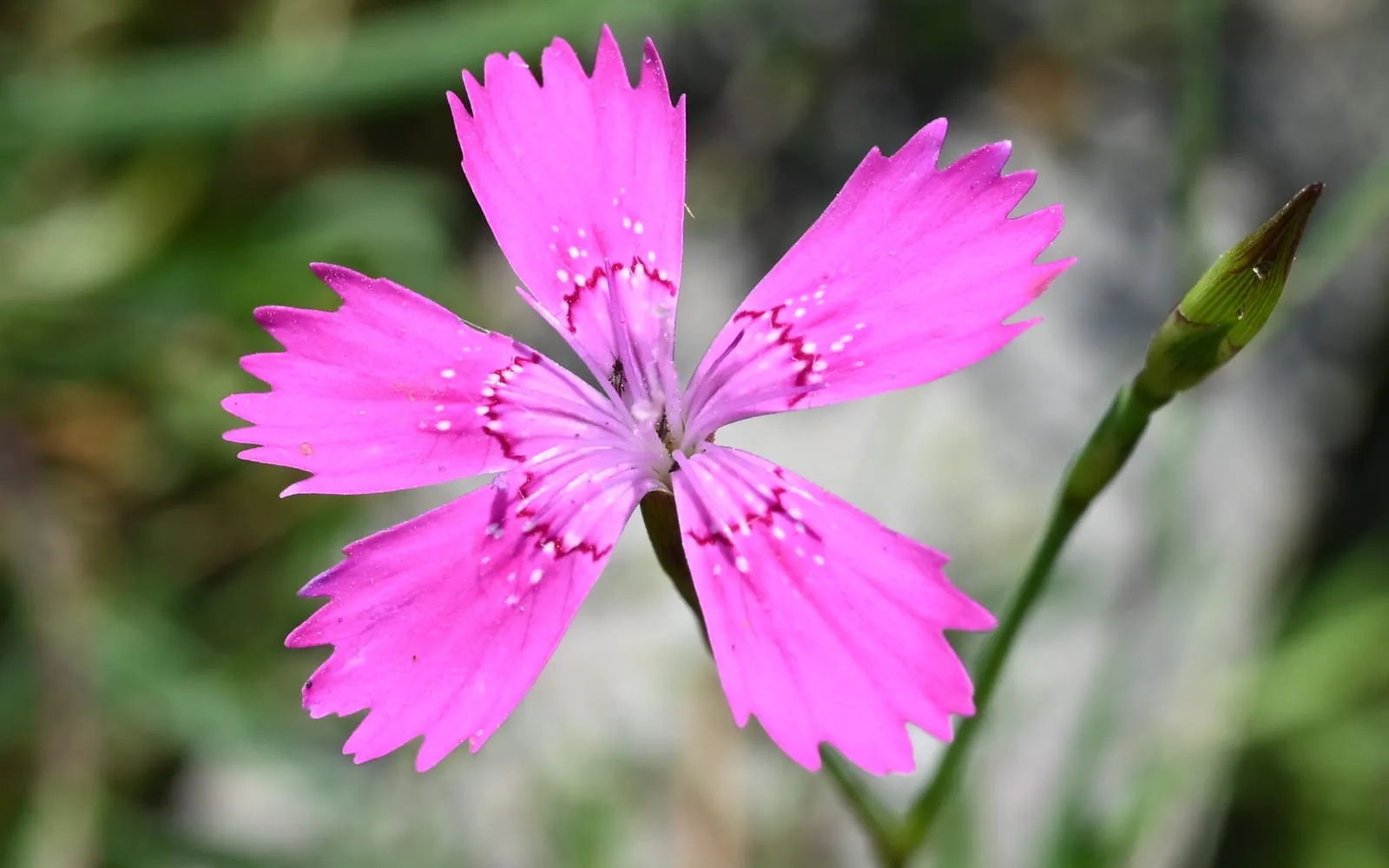
Maiden pink is a low, mat-forming perennial covered in small, five-petalled pink or occasionally white flowers through summer, each petal edge finely toothed and marked at the base with a darker triangular blotch that gives the species its name, deltoides, from the Greek letter delta and its triangular shape. It is a smaller, scrappier relative of the garden carnations and border pinks bred for cut flowers, and it reads more as a wildflower than as a cultivated one, which suits its role as ground cover between paving and larger rocks.
Where several plants in this rockery collection are true mountain alpines adapted to scree and exposed rock, maiden pink comes instead from ordinary dry grassland and unimproved meadow across much of Europe, and its main horticultural quirk follows from that origin rather than from any fussiness about drainage: individual plants are often short-lived, declining after two to four years even in good conditions, which means the sustainable way to keep a patch going is to let it self-seed rather than to expect one planting to persist for a decade.
Appearance and character
Narrow, blue-green, grass-like leaves form low, dense tufts, giving the non-flowering foliage a texture closer to a fine ornamental grass than to a typical rockery perennial. From early to midsummer, wiry flower stems rise 15 to 20 cm above the foliage, each carrying small, single flowers with distinctly serrated petal edges, unlike the smoother-edged petals of many larger garden pinks.
The name maiden pink specifically describes Dianthus deltoides rather than the whole genus, and the diagnostic feature separating it from other low, mat-forming Dianthus species is the small, darker triangular mark at the base of each petal, visible when the flower is viewed face-on. A single plant produces a long succession of individual flowers over several weeks rather than one concentrated flush, giving a more scattered, meadow-like display than the solid sheet of colour aubrieta or basket-of-gold produce.
Where it is from
Dianthus deltoides grows wild across most of Europe, including Britain, and extends into temperate parts of western Asia, typically found in dry, unimproved grassland, heath and open, sandy or chalky ground rather than in the higher mountain scree that shapes species like lewisia or rock jasmine. That grassland origin, rather than a true alpine one, explains why maiden pink tolerates ordinary rockery or border soil reasonably well without needing the sharply gritty mix a scree specialist demands.
The same origin also explains its short natural lifespan. Dry grassland is a habitat maintained by disturbance, grazing, mowing or periodic fire keeping competing vegetation down, and species adapted to it, maiden pink among them, often invest in flowering and seed production early rather than in building a long-lived woody crown the way a slower alpine cushion plant does. In a garden setting without that disturbance, older clumps tend to decline on a similar timescale to their wild counterparts.
How it grows
Maiden pink grows from a central tuft that thickens gradually, sending up flowering stems each summer and slowly widening at the base, but it does not spread by rooting stems the way aubrieta or creeping phlox do. Its main means of persisting in a planting over the years is self-seeding rather than vegetative spread, and a gardener happy to let some seedlings establish nearby will usually find the species maintains itself in a bed even as individual older plants decline.
Established clumps that are not divided or refreshed periodically become woodier and less floriferous with age, similar in principle to several other rockery plants in this collection, but the underlying cause here is closer to natural senescence than to legginess from neglected pruning, and renewal from seed or division is a more reliable fix than a hard cutback alone.
Through the seasons
Spring brings renewed growth from the evergreen or semi-evergreen tufts, and it is a good season for planting new maiden pink or sowing seed directly where flowering is wanted.
Summer is the main flowering period, typically running from June into August with individual flowers opening in succession over several weeks rather than all at once. Deadheading spent flowers extends the display, and allowing some flowers to set seed toward the end of summer supports the self-seeding that keeps a planting going long term.
Autumn is a suitable time to lift and divide older, declining clumps, and self-sown seedlings from earlier in the year often establish well if transplanted while still small.
Winter is handled without difficulty by established plants down to around minus 20 deg C, and the low, evergreen or semi-evergreen foliage tuft usually persists through a typical temperate winter with little damage.
Care difficulty
Maiden pink is an easy, undemanding plant for most gardens and requires no special drainage mix or winter protection, but the gardener’s mental model needs adjusting slightly from a typical long-lived rockery perennial. Individual plants are not built to last indefinitely, and treating a declining three-year-old clump as a failure of care rather than as the plant’s expected lifespan leads to unnecessary troubleshooting.
The practical approach is to let a few flowers set seed each summer rather than deadheading everything, since the resulting seedlings are what keeps a patch self-sustaining as older plants fade.
Watering
Established maiden pink needs very little supplemental watering beyond normal rainfall in most temperate climates, reflecting its dry grassland origin. New plantings and self-sown seedlings benefit from occasional watering during their first season while roots establish, particularly in a dry spring.
Consistently wet soil, rather than drought, is the more common cause of poor performance, since the species’ grassland habitat drains freely and does not hold standing water even after heavy rain.
Warning signs, diseases and pests
Rust occasionally affects Dianthus species, appearing as small orange pustules on the leaves and stems, usually in humid conditions with poor air circulation. Removing affected growth and improving spacing between plants generally controls it.
Aphids sometimes cluster on flower buds and new growth in spring, and slugs and snails graze on young seedlings, particularly self-sown ones before they have built up any bulk. Established, mature tufts are rarely bothered seriously by either.
Growing environment
Full sun is essential for good flowering, and maiden pink performs poorly in shade, producing fewer flowers on thinner, weaker growth. An open, unshaded position in a rockery, gravel garden or the front of a border suits it well.
Soil should be free-draining and can be poor without harming the plant, since it comes from unimproved grassland rather than rich meadow. Overly fertile soil tends to shorten an already short natural lifespan further and produces lax, floppy growth that flowers less freely than a plant grown lean.
Feeding
Maiden pink needs no routine feeding in ordinary garden soil, and rich feeding is more likely to shorten its lifespan and produce weak, floppy stems than to improve flowering. This follows the same pattern as several other lean-soil specialists on this site: a plant adapted to nutrient-poor ground performs its best display precisely when it is left unfed.
If growing in impoverished soil where growth looks stunted rather than compact, a single light spring feed can help, but it is rarely needed for a species this well suited to poor ground.
Troubleshooting
An established clump has died out after two or three years despite good care. This is often the expected natural lifespan of the species rather than a cultivation failure. Maiden pink is frequently short-lived, and allowing some flowers to set seed each summer, or sowing fresh seed periodically, is the reliable way to keep a planting going over many years.
Flowering has become sparse and the plant looks leggy. Overly rich soil, too much shade, or an ageing clump nearing the end of its natural lifespan are the usual causes. Check light levels first, then consider whether the clump is old and due for replacement from seed or a fresh division.
Small orange pustules have appeared on the leaves and stems. This is rust, more common in humid, crowded conditions with limited airflow. Remove affected growth promptly and improve spacing to reduce recurrence.
Seedlings have appeared unexpectedly nearby the original planting. This is normal self-seeding rather than a problem, and it is the main way this short-lived species persists in a garden over time. Thin seedlings if they are too dense, or transplant them to extend the planting.
Handling the foliage has caused mild skin irritation. The RHS lists Dianthus deltoides as a skin allergen. Wearing gloves when weeding or handling the plant directly avoids this for anyone with sensitive skin.
A pet has chewed on the foliage. The wider Dianthus genus is associated with mild gastrointestinal upset and mild dermatitis in cats, dogs and horses according to ASPCA data for carnation, a close relative. Watch for vomiting, diarrhoea or skin irritation and contact a veterinarian if symptoms appear or persist.
The plant is floppy and sprawling rather than forming a neat, tight mat. This usually points to soil that is richer than the species needs, or to a position with less than full sun. Reducing feeding and, where possible, moving to a sunnier, leaner spot both help restore a tighter habit.