
Houseplant
Tailed Maidenhair
Adiantum caudatum
Also known as Adiantum caudatum, Walking Maidenhair
How to grow Adiantum caudatum, the tailed or walking maidenhair fern. Its long trailing fronds that root at the tip, its hairy stalks, and its care.
At a glance
- Difficulty
- Moderate
- Water
- Keep evenly moist; never dry out or waterlog
- Light
- Bright indirect light
- Temperature
- Warm; keep above about 12 deg C
- Humidity
- High
- Hardiness
- USDA 10-12, RHS H1b, hardy to 10 C
- Type
- Evergreen fern
- Height
- Fronds 20 to 40 cm long, trailing
- Native to
- Tropical Asia and Africa
A trailing maidenhair from the warm forests of tropical Asia and Africa, growing on shaded banks and rocks in humid air. It needs warmth, high humidity and bright indirect light, and it cannot take frost or dry air. It is safest above about 12 deg C, and a dry root ball quickly browns the fronds.
Hardiness zones describe winter cold alone. Summer heat, humidity, rainfall and the length of the growing season decide as much, so treat the range as the outer limit rather than as a recommendation.
Not known to be toxic
A safe plant to keep around pets and children. Maidenhair ferns are not listed as toxic by the ASPCA or the RHS, and no harmful compound is recorded in Adiantum. A pet or child that chewed a frond would come to no real harm, so this trailing fern poses no hazard in a home with animals.
Sources: ASPCA toxic and non-toxic plants, RHS potentially harmful garden plants
About
Both of its names describe the same growth habit. Instead of finishing in a tidy point, each slender frond of Adiantum caudatum runs on into a long, bare, whip-thin extension of the rib, which bows over and, wherever it settles onto damp moss or earth, puts down roots and starts a young plant of its own. This tip-rooting habit explains the name walking maidenhair and makes it useful in a hanging pot where the tails can hang free and multiply.
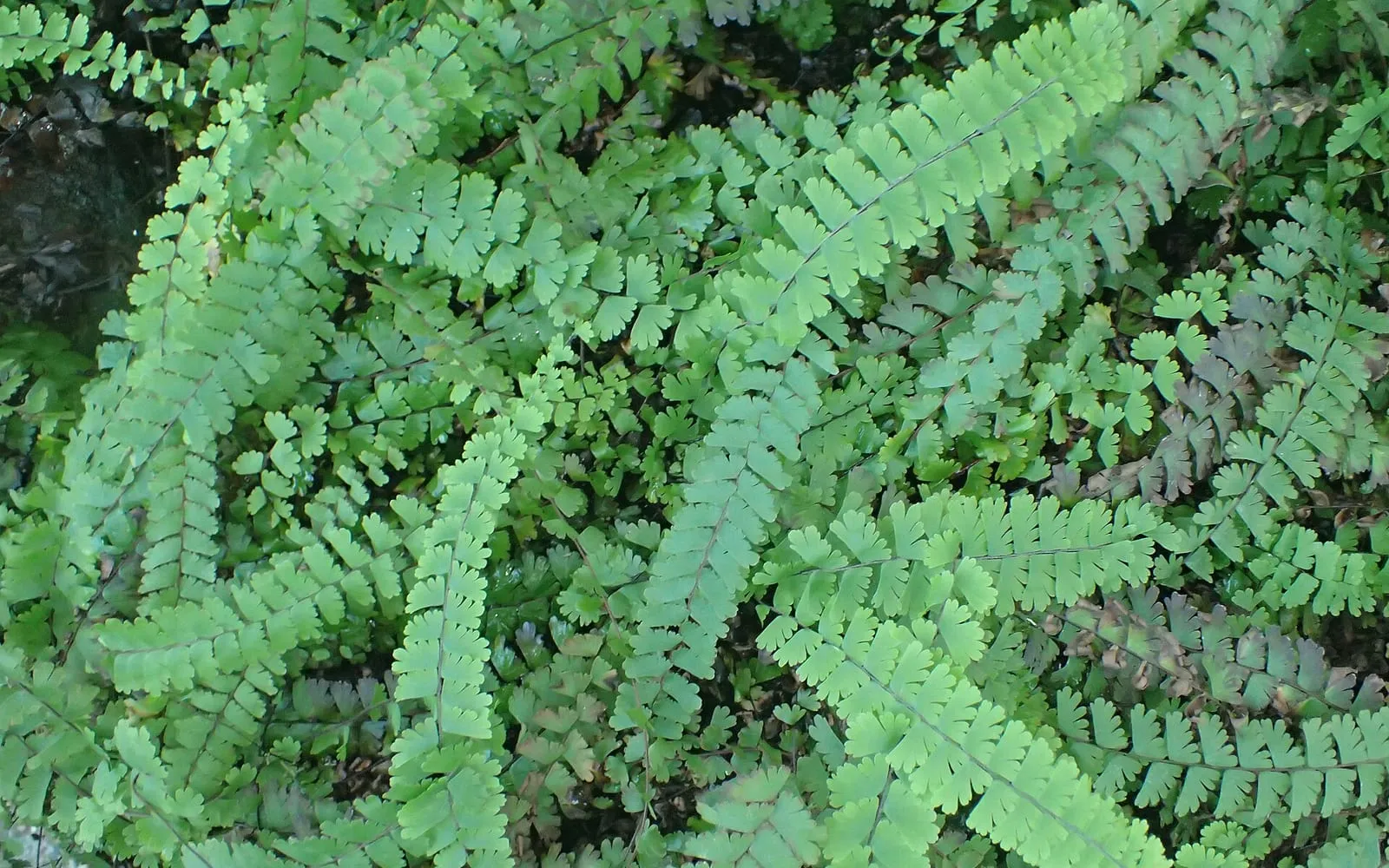
The blades themselves are narrow and divided a single time, lined with small fan-shaped green segments along a dark, downy central rib, and they lean out and downward instead of standing tall. Left to grow, the plant becomes a hanging mass of these tail-tipped fronds, a form quite different from the flat, splayed fans of the cool-climate maidenhairs.
Its home is the warm forest of tropical Asia and Africa, where it grows on shaded banks and mossy rock in humid air. That makes it a plant for a warm room. Warm surroundings, damp air, filtered brightness and roots that never go dry keep it growing well in a basket. A dry atmosphere and a dried-out pot scorch the fine segments quickly.
Appearance and character
The fronds are long, narrow and cut only once, lined with small fan-shaped green segments along a dark, downy central rib, and they lean out and trail instead of standing upright.
Every frond tapers into a long, leafless, whip-like tail, the drawn-out rib that roots when it meets damp ground. This is how the plant spreads into fresh soil.
Young plantlets sprout at those rooting tips, so a single specimen can knit into a patch or pack a hanging basket with trailing, tail-ended fronds.
The dark, downy stalks and the trailing manner mark it out clearly from the flat, fan-shaped fronds of the hardy maidenhairs.
Where it is from
Adiantum caudatum spreads through the warm forests of tropical Asia and Africa, gripping shaded banks, old walls and mossy rock in humid air. Warmth, shade and moisture are the constants of its habitat.
Those constants dictate its care. It needs heat, high humidity, filtered brightness and a root run that is forever damp yet free-draining. Frost, chill and a dry atmosphere are outside its reach, and a dried-out pot browns the fine segments almost at once.
How it grows
Across the warm months it makes fresh fronds that lengthen into their rooting tails, and it slows through winter. Warmth, humidity and unbroken dampness keep the fronds sound, whereas a dry atmosphere and drought scorch them.
Set it in a loose, peat-free potting mix that drains fast yet holds its damp, by preference in a hanging pot so the tails can dangle and take root, and keep the mix damp with rainwater. Never let the root ball run dry.
Give it filtered brightness away from the sun, warmth over roughly 12 deg C, and moist air from a tray, a humidifier or a cluster of plants. Pin a tail-tipped frond onto a pot of damp mix to raise a new plant from it.
Propagation is simple: peg a rooting tip onto damp mix and it forms a plantlet, or split the crown.
Through the seasons
Spring brings fresh arching fronds. Start feeding again, hold the mix damp and the air moist, and peg down tails to make new plants.
Summer is the main growing season. Keep the mix damp, the air humid, the monthly feed running, and the fronds off any direct sun.
Autumn slows growth as the light thins. Cut the feed back and raise the humidity against the drying effect of heating.
Winter rests the fern. Keep it over about 12 deg C, damp instead of wet, and clear of cold draughts.
Care difficulty
Moderate, and largely a question of warmth, humidity and never letting the root ball run dry. Given those, it is a good trailing fern that raises its own young from its rooting tails. It goes wrong in a dry atmosphere, a dried root ball or hard sun, which scorch the fine segments, and in cold, waterlogged, stale mix, which rots the roots.
Watering
Keep the mix damp, watering before the surface dries, and use rainwater or filtered water, since the fine segments brown from salts and drought. A hanging plant dries faster than one on a shelf, so check it more often.
Never leave it standing in water, since the roots rot in a sodden, airless mix. Ease off a little in winter, holding the mix barely damp, and tip out any water that gathers in the saucer under a hanging pot.
Warning signs, diseases and pests
Browning, crisping segments usually mean the root ball dried out, the room is too arid, or the water is hard. Raise the humidity, hold the mix damp, water with rainwater, and take off the worst fronds.
Warm, arid air brings on spider mites, which stipple the fronds; raise the humidity and treat at once. A cold, waterlogged, stale mix rots the roots, so keep the mix open and the plant warm.
A frond that has browned badly can be cut back, and fresh arching fronds come up from the crown.
Growing environment
Filtered brightness suits it, out of the sun that scorches the fine segments. Too dim a spot leaves it thin, so aim for somewhere bright yet shielded.
Warmth over about 12 deg C and a humid atmosphere keep it fresh, well away from radiators and cold draughts. A steamy bathroom, a glass case or a group of plants all suit it.
Grow it in a loose, moisture-holding, peat-free mix in a hanging pot, sited in a warm, humid, softly lit spot where the tails have room to swing.
Feeding
Feed monthly across the growing season with a weak, balanced liquid, since ferns are light feeders that dislike a strong dose. Ease off through autumn and stop over winter.
An occasional flush of plain water clears away salts. A freshly potted or divided plant lives on its new mix for the first weeks before feeding starts.
Troubleshooting
The fronds are browning. Usually a dried root ball, an arid room or hard water. Raise the humidity, hold the mix damp, water with rainwater, and trim the worst fronds.
What are the long bare tips? They are the frond tails, the drawn-out ribs that root wherever they touch damp ground, which is how the walking maidenhair spreads. Peg one onto damp mix to raise a new plant.
The fronds look dull and speckled. Spider mites, from warm, dry air. Raise the humidity and treat at once.
Can it take direct sun? No. Direct sun scorches the fine segments. Keep the light bright but filtered.
Is it safe around pets? Yes. No maidenhair carries a listed toxin, so it is safe alongside cats, dogs and children.
Tailed Maidenhair problem guides
Not sure what is wrong? See the common houseplant pests guide.