
Outdoor plant
Northern Sea Oats
Chasmanthium latifolium
Also known as Inland sea oats, River oats
How to grow northern sea oats, Chasmanthium latifolium, one of the few ornamental grasses that tolerates real shade, with flat seed heads that rattle in wind.
At a glance
- Difficulty
- Easy
- Water
- Regular watering; performs best with consistent moisture
- Light
- Partial to full shade; tolerates full sun with reliable moisture
- Hardiness
- USDA 5-9, RHS H6, hardy to -20 C
- Type
- Hardy deciduous perennial grass
- Height
- 60-120 cm
- Native to
- Eastern and central North America
Reliably hardy through an ordinary temperate winter across most of its native range, which reaches from the mid-Atlantic United States down into the Gulf Coast and west into Texas. Cold is rarely the limiting factor for this species in cultivation; the more relevant question for a new planting is how enthusiastically it will self-seed in a given climate, since it spreads far more freely in a mild, reliably moist garden than in one prone to summer drought.
Hardiness zones describe winter cold alone. Summer heat, humidity, rainfall and the length of the growing season decide as much, so treat the range as the outer limit rather than as a recommendation.
Not known to be toxic
Northern sea oats has no toxicity listing from the RHS or the ASPCA and is considered safe around pets and children. It is a member of the true grass family with no recorded history of harm from contact or ingestion, and its flattened, papery seed heads present no sharp edges or barbed awns of the kind that make some other ornamental grasses a mechanical hazard.
Sources: RHS potentially harmful garden plants, ASPCA toxic and non-toxic plants
About
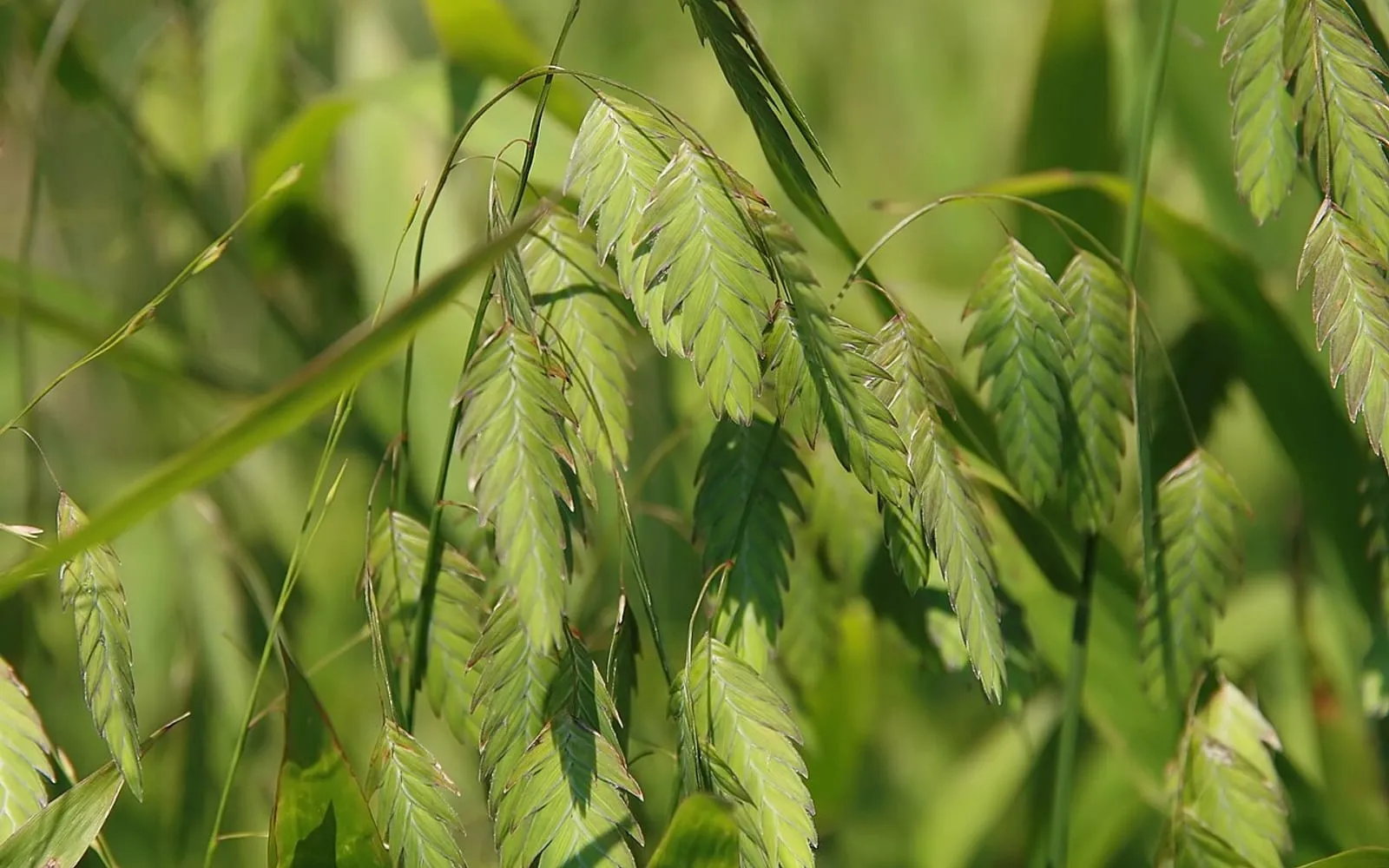
Northern sea oats does two things few other ornamental grasses manage together. It tolerates real shade, thriving in the dappled light of a woodland edge where most sun-loving prairie grasses fail outright, and it produces a distinctive seed head: flat, oat-like clusters that dangle from arching stems and audibly rattle against each other in even a light breeze, a sound unlike almost anything else in a shaded border.
That combination of shade tolerance and self-seeding vigour is worth weighing before planting. A single clump in the right damp, shaded conditions can seed itself around a bed enthusiastically over a few seasons, more so than almost any other grass in this collection, and a gardener who values the species for its shade tolerance should also plan from the outset to manage its spread rather than being surprised by it later.
Appearance and character
Broad, bamboo-like leaves, wider than those of most ornamental grasses, grow on upright, gently arching stems, giving the plant a lush, architectural look distinct from the fine-textured prairie grasses common in sunnier borders. Foliage stays fresh green through summer, turning a warm bronze or copper colour in autumn as the growing season ends.
The flattened, drooping seed heads that give the plant its common name develop from mid to late summer, starting green and maturing to a straw-bronze colour, each spikelet flat and papery and arranged in a loose, dangling cluster that moves and rattles readily in wind. Left standing, the dried seed heads hold their shape and colour well into winter, one of the plant’s most valued features in a shaded border that would otherwise have little winter interest.
Where it is from
Chasmanthium latifolium is native to a broad swathe of eastern and central North America, from Pennsylvania south to Florida and west into Texas and Wisconsin, growing on the shaded, moist banks of streams and rivers and in woodland openings. That riverbank and woodland origin, rather than the open prairie that most ornamental grasses come from, is the source of its unusual shade tolerance, and it explains why the species performs so much better in a damp, shaded border than the majority of grasses grown for ornament.
Its native riverbank habitat also explains why the seed heads carry such a distinctive rattle. A grass evolved to grow among tree roots and in dappled shade gains little from the visual signalling that a bold, brightly coloured seed head offers a prairie grass out in the open, and relying instead on sound and movement to draw the eye works just as well under a canopy where wind, rather than direct light, is often the more reliable visitor.
How it grows
Plant in spring into moist, moderately fertile soil, in partial to full shade for the best foliage and habit, or full sun where soil moisture can be kept consistent. Establishment is reasonably fast, and a young plant fills out into a respectable clump within its first couple of growing seasons.
Growth spreads gradually by short rhizomes and, more significantly, by generous self-seeding once a clump matures and begins flowering. In a favourable, damp, shaded spot this can become a real management task rather than an occasional chore, and gardeners who do not want the species spreading beyond a defined area should plan to cut and remove seed heads before they mature and drop.
Cut the whole clump back close to the ground in late winter, once the foliage has faded, or leave the seed heads standing later into winter for structure before doing so, whichever suits the display better in a given garden.
Through the seasons
Spring brings the cutback of the previous year’s growth if it was left standing, followed by fresh green shoots and broad new leaves as the soil warms.
Summer is the main growing period, with the clump filling out and the distinctive flattened seed heads beginning to develop from midsummer onward.
Autumn brings the seed heads to their fullest, straw-bronze display, alongside the foliage’s turn to a warm bronze or copper colour, and this is the key window for removing spent seed heads before they drop if self-seeding needs to be controlled.
Winter the dried seed heads, if left uncut, continue to rattle in wind and hold their shape, providing rare winter interest and movement in a shaded part of the garden.
Care difficulty
Easy in terms of basic cultivation, and the real skill in growing this species well lies in managing its enthusiasm for self-seeding rather than in any demanding routine care. In the right damp, shaded spot it needs very little beyond an occasional cutback and, where relevant, active removal of seed heads before they mature.
Watering
Water regularly, particularly where the plant is grown in full sun rather than its preferred shade, since consistent moisture supports the lush, broad-leaved growth this species is valued for. It tolerates short dry spells once established but performs noticeably better with reliable moisture than left to dry out repeatedly through summer.
Warning signs, diseases and pests
Rust occasionally appears as small orange pustules on the leaf blades, usually in a humid, still summer, and rarely does serious harm to an established clump.
The most common issue reported with this species is unwanted self-sown seedlings spreading beyond the intended planting area, particularly in a consistently moist, shaded garden. Removing seed heads before they mature and drop is the effective response, since the spread is a management task rather than a health problem.
Growing environment
Partial to full shade suits this species best, and it is one of the more shade-tolerant ornamental grasses available, thriving under the dappled canopy of deciduous trees where most sun-loving grasses struggle. It tolerates full sun where soil moisture is reliably maintained, and moist, fertile soil produces the strongest growth, though it copes reasonably well with poorer ground once established.
Feeding
Feed sparingly. A single application of a balanced general fertiliser in spring is usually enough, particularly on poor soil, and this species does not need the rich feeding regime a hungrier border perennial might, since it already performs well in the moist, humus-rich soil typical of a shaded woodland-edge planting.
Troubleshooting
Seedlings are appearing well beyond where I originally planted this grass. This is the species’ well-known tendency toward vigorous self-seeding rather than a sign of anything wrong. Cut and remove seed heads before they mature in autumn to control it, particularly in a consistently damp, shaded garden where seedlings establish most readily.
Can this grass really handle deep shade, or does it need some sun? It tolerates real shade better than almost any other ornamental grass, thriving under a deciduous tree canopy, though it also grows well in full sun provided the soil stays consistently moist.
The foliage looks pale and stressed in a sunny spot. Check soil moisture first. In full sun this species needs reliably damp soil to perform well, and a sunny position that is allowed to dry out repeatedly produces weaker, more stressed growth than the same plant would show in shade.
When should I cut the plant back? Late winter, once the foliage and seed heads have faded, though leaving the seed heads standing into early winter for their rattling, structural display is a reasonable trade-off against a slightly later cutback.
Is the rhizome spread as much of a concern as the self-seeding? Less so. The rhizome spread is gradual and easily contained by lifting and trimming an expanding clump, whereas the wind-and-water-dispersed seed is the more significant route by which this species spreads beyond where it was planted.
Is it safe for a garden used by children and pets? Yes. It carries no toxicity listing and has no sharp seed heads or awns of the kind some other ornamental grasses carry, making it one of the more benign choices in this collection from a safety standpoint.