
Outdoor plant
Siberian Squill
Scilla siberica
Also known as Wood squill, Spring squill
How to grow Siberian squill, Scilla siberica. Planting a true bulb for the earliest intense blue of spring, naturalising in grass, and its spread as an invasive in North America.
At a glance
- Difficulty
- Easy
- Water
- Rain is generally enough once established
- Light
- Full sun to light shade, ideal under deciduous trees
- Temperature
- Fully hardy, needs a cold winter
- Hardiness
- USDA 2-8, RHS H6, hardy to -35 C
- Type
- Bulbous perennial, naturalising freely
- Height
- 10-20 cm
- Native to
- Southwestern Russia, the Caucasus and Turkey
Among the hardiest bulbs sold for a temperate garden, unfazed by cold that would trouble most other spring flowers, and needing that cold to flower reliably each year. What the zone leaves out is heat tolerance rather than cold: it performs poorly in a hot, dry summer climate and struggles in USDA zone 9 and warmer regardless of the winter it receives, since the bulb wants a cool, moist rest as much as it wants a cold one.
Hardiness zones describe winter cold alone. Summer heat, humidity, rainfall and the length of the growing season decide as much, so treat the range as the outer limit rather than as a recommendation.
Toxic if eaten
- Do not eat
- Every part, and the bulb most of all
- Harm from
- Eating it and handling it
- Affects
- People, cats, dogs and horses
Siberian squill contains scilliroside and related cardiac glycosides, the same class of compound found in bluebell and lily of the valley, concentrated most heavily in the bulb. Eating any part causes vomiting, abdominal pain and diarrhoea, with the cardiac glycosides capable of affecting heart rhythm in a larger ingestion, and grazing animals from deer to rabbits generally avoid the plant for exactly this reason, which is part of why it naturalises so freely in areas with heavy deer pressure where more palatable bulbs get eaten before they can establish. Contact with the sap causes mild skin irritation in some people. Cases of serious poisoning are uncommon since the taste is unpleasant, and the realistic risk is a young child pulling up and chewing flowers rather than a pet, since most animals show little interest in it.
Sources: RHS potentially harmful garden plants, ASPCA toxic and non-toxic plants
About
The name is misleading. Siberian squill is not native to Siberia at all; it grows wild in southwestern Russia, the Caucasus and northern Turkey, several thousand kilometres from the region its common name suggests. The mistake appears to date to an early confusion over where introduced garden specimens had been collected, and it stuck long after botanists sorted out the plant’s real range.
What it is known for is colour and timing. The flowers open an intense, saturated blue rarely matched by anything else flowering that early, and they open extremely early, often pushing up through late snow cover while most of the garden is still bare. A established drift under bare deciduous trees in February or March, blooming against dead leaves and lingering frost, is one of the most striking sights a small bulb can produce for so little effort.
That vigour has a downside. In parts of North America, particularly the Great Lakes region and Ontario, Siberian squill has escaped cultivation comprehensively enough to be classed as invasive, forming dense carpets in woodland understory that can crowd out native spring ephemerals before they get a chance to establish.
Appearance and character
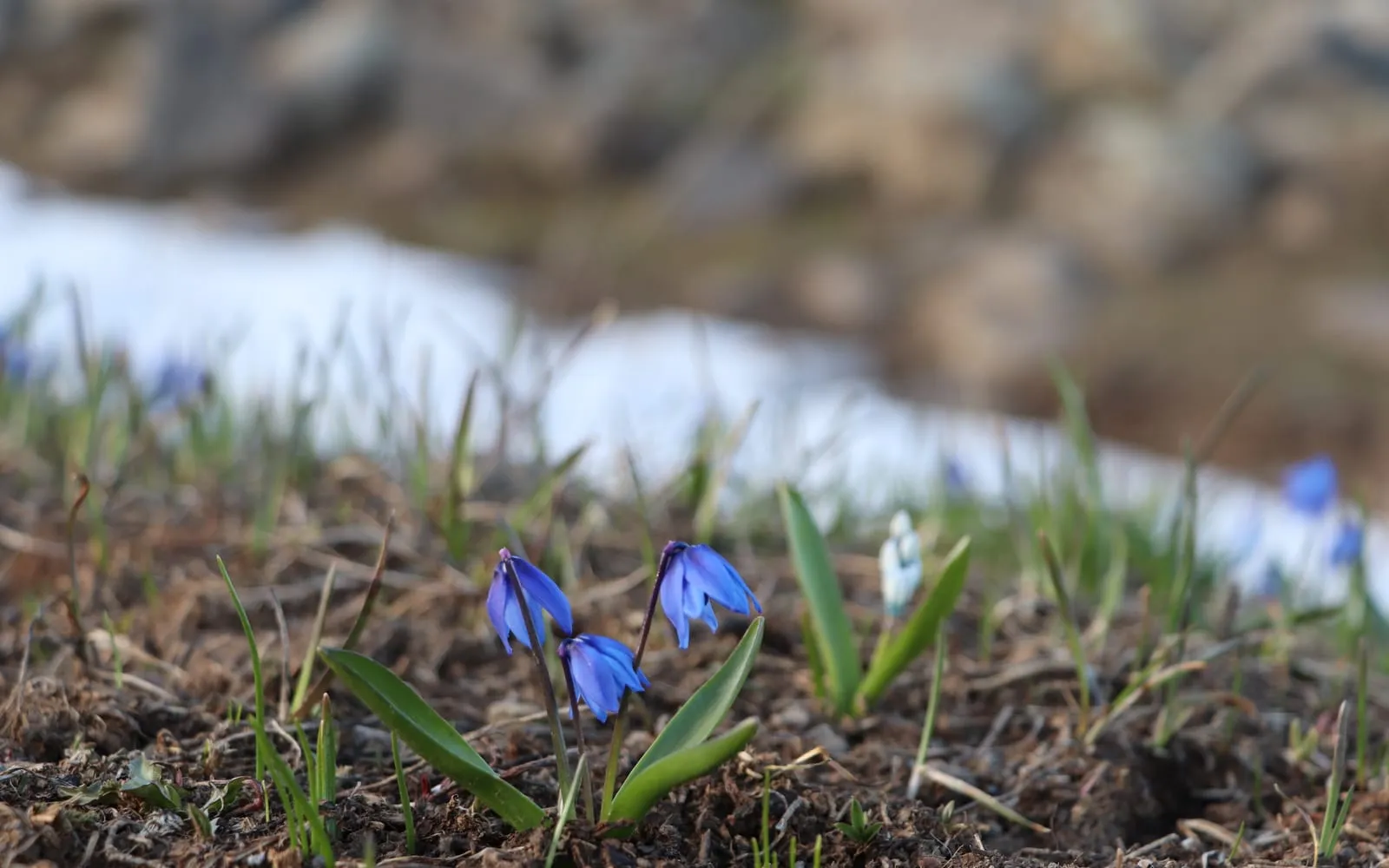
Narrow, strap-shaped leaves emerge in a small basal cluster, with one to three flowering stems appearing from the same bulb, each carrying one to four nodding, bell-shaped flowers.
The flowers hang downward rather than facing outward or upward, six petal-like segments forming a loose open bell, in a deep gentian blue with a darker stripe running down the centre of each segment. A white-flowered form exists but is far less commonly grown than the true blue.
The bulb is small, typically 2 cm or less across, rounded and covered in a dark papery tunic, similar in general appearance to a small tulip or hyacinth bulb but noticeably smaller than either.
Flowering finishes within two to three weeks, after which the narrow leaves persist for several more weeks, photosynthesising and building the bulb’s reserves for the following year before dying back completely by early summer.
Where it is from
Southwestern Russia, the Caucasus mountains and northern Turkey, growing wild in deciduous woodland, scrub and rocky mountain slopes, typically at low to moderate altitude where a proper cold winter is guaranteed.
That range gives the bulb a genuine need for winter chilling to flower well, paired with reasonable summer moisture rather than the bone-dry rest some Mediterranean and Central Asian bulbs demand. It is this tolerance of a damper summer, alongside the intense cold hardiness, that makes it such an easy and reliable naturaliser across most of temperate North America and northern Europe, and also what allows it to spread unchecked into woodland it was never planted in.
The plant reached western European gardens in the early nineteenth century and has been a staple of naturalised spring plantings ever since, prized long before its invasive potential in parts of North America became widely recognised.
How it grows
A bulbous perennial that multiplies both by bulb offsets and by self-sown seed, and does both readily enough that a modest planting can become a substantial colony within a handful of years.
Plant bulbs 5 to 8 cm deep and about 5 cm apart in autumn, from September through November, in any reasonable garden soil. It tolerates a wider range of soil types than most spring bulbs, doing well in anything from light sandy ground to moderately heavy clay, provided the site does not stay waterlogged.
Growth begins very early, often visible as soon as the coldest part of winter passes, and flowering follows within a few weeks in a mild spell. The whole visible cycle, from first leaf tip to yellowed and collapsed foliage, takes only ten to twelve weeks.
Left undisturbed in grass or under trees, a planting spreads on its own timetable through both routes of increase, and in many gardens the main task after the initial planting is deciding whether to let it continue spreading or to remove it from areas where it is not wanted, rather than doing anything to encourage it further.
Through the seasons
Autumn is planting season, any time from September through November, in generous groups scattered rather than lined up for the most natural effect.
Winter brings the first shoots through in a mild spell, sometimes visible through a light covering of snow.
Spring is flowering, from February into April depending on climate, typically among the earliest bulbs to bloom in a given garden alongside snowdrops and the earliest crocuses.
Summer is dormancy. The leaves die back by early summer and nothing further needs doing until the following autumn, though this is also the window in which self-sown seedlings from the previous spring are establishing themselves unseen below ground.
Care difficulty
Easy, and arguably too easy in some situations. Once planted, it needs no routine care, tolerates a wide range of soil and light conditions, and shrugs off cold that would damage far tougher-looking plants.
The real consideration in some regions is whether to grow it at all, rather than how to grow it well, since a bulb this vigorous and this resistant to grazing animals can spread readily from a garden into adjoining woodland with little to stop it. Gardeners in parts of North America, particularly the upper Midwest and southern Ontario, should check local guidance before planting it near any area of native woodland.
Watering
Water once after autumn planting to settle the bulbs, and after that natural rainfall through winter and spring is generally sufficient in most temperate climates.
It tolerates a damper spring than many bulbs, so there is little need to worry about occasional wet weather during the growing period, though standing water at any point causes bulb rot.
No watering at all is needed through summer dormancy, and in fact none should be given, since the resting bulb does best in soil that dries out somewhat once the foliage has died back.
Warning signs, diseases and pests
Very little troubles this plant, which is itself part of why it spreads so readily. Deer, rabbits and squirrels, which happily dig up and eat tulip and crocus bulbs, generally leave Siberian squill alone because of the cardiac glycosides it contains, removing one of the natural checks that limits other spring bulbs.
Bulb rot in soil that stays consistently waterlogged is the main genuine risk, showing as clumps that fail to appear or that come up weak and yellow. The remedy is improving drainage rather than treating the bulbs, since there is no cure once rot sets in.
The larger concern in much of North America is the plant’s own spread rather than any pest. Where it has established in woodland outside cultivated gardens, it can form dense enough carpets to shade out and outcompete native spring wildflowers before they emerge. Deadheading spent flowers before they set seed, and removing unwanted bulbs by hand, are the practical ways to keep a planting contained if this is a local concern.
Growing environment
Full sun to light shade suits it well, and it performs particularly nicely under deciduous trees, flowering in the bright, unshaded conditions of late winter before the canopy fills in for the year.
Moist but free-draining soil is ideal, and it tolerates a wider range of soil types than most spring bulbs, from light sand to moderate clay, provided standing water does not collect around the bulbs.
It naturalises particularly well in grass, since the foliage dies back early enough, usually by late spring, that a lawn can be mown at a reasonably normal time rather than needing weeks of extra uncut growth the way daffodils require.
Space generously for the most natural effect, since the bulbs are small and a thin scattering reads as sparse in the first year, though a planting will fill in on its own within a few seasons regardless of the initial density.
Feeding
Very little feeding is needed in reasonable garden soil. The bulb is adapted to fairly ordinary mountain and woodland ground and does not need richness to perform well.
On poor soil, a light scatter of balanced granular feed as the leaves emerge in late winter supports a struggling patch, though most established plantings need nothing at all from one year to the next.
Avoid high-nitrogen feeds, which encourage lush leaf growth without improving flowering and can, in a plant already this vigorous, speed up unwanted spread.
Troubleshooting
Is it really from Siberia? No. The plant’s actual native range is southwestern Russia, the Caucasus and northern Turkey. The common name is a long-standing misnomer rather than an accurate description of where it grows wild.
It has spread well beyond where I planted it. That is entirely typical. It multiplies by both bulb offsets and self-sown seed, and in some parts of North America has spread aggressively enough to be considered invasive. Deadhead before seed sets and remove unwanted bulbs by hand if you want to keep it contained.
Deer and squirrels leave it completely alone. That is normal and one of its more useful traits. The cardiac glycosides that make it mildly toxic also make it unpalatable to most grazing animals, unlike tulips and crocuses.
Flowers came up but seem smaller than expected. Usually overcrowding in an old planting, or too little winter chill in a mild climate. Established clumps benefit from occasional thinning if flowering declines noticeably over several years.
How deep should I plant the bulbs? 5 to 8 cm deep, about 5 cm apart, in autumn from September through November.
Can I plant it in a lawn? Yes, and it is one of the better bulbs for this. The foliage dies back early enough in late spring that normal mowing can resume without the long wait daffodils and other larger bulbs require.
Is it a problem for pets? All parts contain cardiac glycosides and are moderately toxic if eaten, though most animals avoid it because of the taste. The realistic risk is a child pulling up and chewing the flowers rather than a pet, since animals show little interest in it.