
Outdoor plant
Aubrieta
Aubrieta deltoidea
Also known as Rock cress, Purple rockcress
How to grow aubrieta, Aubrieta deltoidea. Why it goes woody and bare at the centre rather than rotting, the hard shear it needs straight after flowering, and its life in a dry stone wall.
At a glance
- Difficulty
- Easy
- Water
- Regular watering while establishing; drought-tolerant once mature
- Light
- Full sun
- Temperature
- Cool to warm temperate; flowers best where spring stays cool for several weeks
- Hardiness
- USDA 4-8, RHS H6, hardy to -20 C
- Type
- Hardy evergreen perennial
- Height
- 5-10 cm, trailing to 60 cm
- Native to
- Europe, Western Asia
Hardy well beyond anything a UK or northern European winter tests, and the zone range understates how easy this plant is in cold climates. Its real limiting factor is heat and humidity rather than cold: in hot, humid summers it declines and often needs replacing after two or three years, while in a cool, dry climate the same plant can persist for a decade.
Hardiness zones describe winter cold alone. Summer heat, humidity, rainfall and the length of the growing season decide as much, so treat the range as the outer limit rather than as a recommendation.
Not known to be toxic
Aubrieta is a member of the cabbage family and carries no toxicity listing from the RHS or the ASPCA. It has no history of causing skin or digestive irritation and is commonly planted at ground level in beds and walls where children and pets have direct access to it.
About
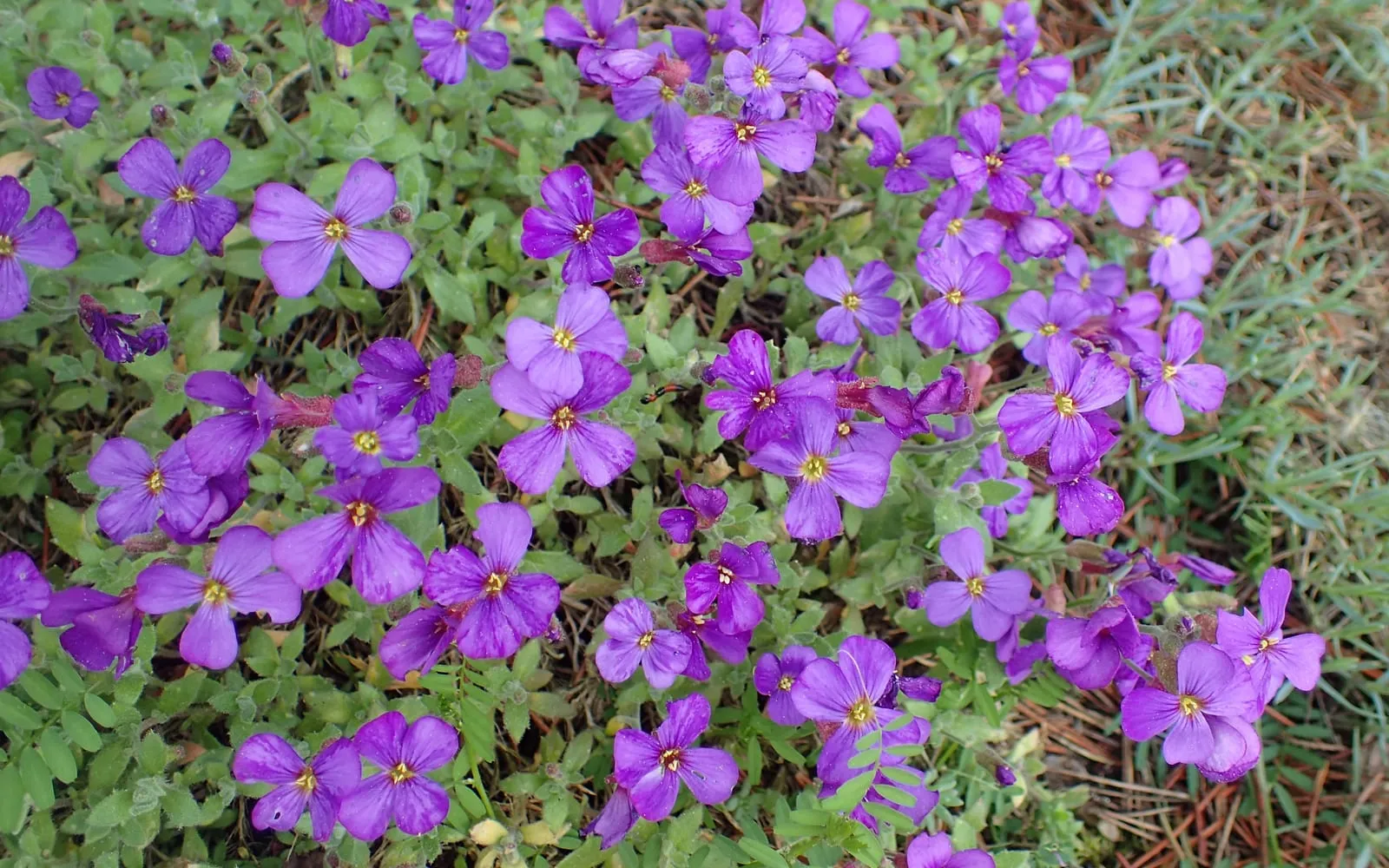
Aubrieta is a low, trailing perennial grown for one of the most concentrated flower displays a rockery produces all year, covering itself almost entirely in small, four-petalled purple, pink or blue flowers for four to six weeks in spring. It is a member of the cabbage family, related to wallflowers and alyssum, and it shares their fast growth and tolerance of poor, dry soil. Those traits help it root into the thin soil packed into the joints of a dry stone wall and thrive there.
Unlike the alpines on this site that fail by rotting at the crown in wet winter conditions, aubrieta’s characteristic failure is almost the opposite problem: without an annual hard cutback after flowering, the mat turns woody and bare in the middle within a few years, spreading outward from a dead core rather than dying from excess moisture. Its main threat is neglect of the shears rather than neglect of drainage, and that sets the whole of its care apart from most of the species covered in this rockery collection.
Appearance and character
Small, grey-green, hairy leaves with a scalloped edge form loose mats that trail and cascade rather than sitting flat, spreading readily over the edge of a raised bed, wall or large rock. The leaves alone are unremarkable and easy to overlook for most of the year, which makes the spring transformation more dramatic by contrast.
For several weeks in April and May the foliage almost disappears beneath a dense covering of small, cross-shaped flowers in shades from pale lilac through violet to deep magenta-purple, depending on the cultivar. Named varieties bred for stronger colour and more compact habit, such as those in the Cascade and Whitewell Gem groups, are more widely sold than the wild species today, but all share the same basic flower shape and trailing habit.
Where it is from
Aubrieta deltoidea is native to rocky, mountainous ground across south-eastern Europe and into Turkey, including parts of Greece, Sicily and the wider eastern Mediterranean, where it grows on limestone cliffs, scree and stony banks in full exposure to sun and wind. That native limestone habitat is the reason garden plants perform best in neutral to alkaline soil and struggle on strongly acidic ground, and it is also why the species tolerates heat and drought with more ease than cold, damp winters, though the modern garden hybrids sold today have been selected for hardiness well beyond what the wild Mediterranean populations experience.
The trailing, cascading habit suits a dry stone wall or the top of a retaining wall particularly well, since the stems root as they spread and can colonise vertical or near-vertical stony surfaces with very little soil, a growth habit shared with wall bellflower and equally rooted in a native range of rock crevices rather than open ground.
How it grows
New growth radiates outward from a central crown as trailing stems that root where they touch soil, giving the plant a natural way to spread that a gardener can encourage by pegging a stem down onto bare ground nearby. Left to its own devices for several years without cutting back, the centre of the plant becomes increasingly woody, the stems there stop producing new leaves and flowers, and the whole mat gradually shifts outward, leaving an expanding bald patch in the middle that widens every season.
This is a different mechanism from the crown rot that affects several other rockery plants in wet winters, and it means the fix is preventative pruning rather than better drainage. A plant sheared hard immediately after flowering responds by throwing new growth from lower down the stems rather than only from the tips, which keeps the whole mat renewing itself and delays the bare-centre problem by years.
Through the seasons
Spring is when aubrieta performs, with the main flush of flowers running through April and into May in most temperate climates. As soon as the display fades, cut the whole plant back hard, by around half its height, using shears rather than secateurs for speed on a mat this size; this single task does more for the plant’s long-term health than any amount of feeding or watering.
Summer is a quiet recovery period following the hard cutback, with the plant regrowing a fresh, tight mat of foliage rather than flowers. This is also a reliable time to take softwood cuttings from the new growth if propagating more plants, and the parent plant needs little attention beyond occasional watering in extended dry spells.
Autumn brings continued steady foliage growth and is a suitable time to plant new aubrieta, giving it a full season to root before winter without the stress of also trying to flower.
Winter is handled without difficulty by established plants down to around minus 20 deg C, well beyond what most gardens will ever test it against. The evergreen mat stays reasonably tidy through winter and needs no protection in a typical temperate climate.
Care difficulty
Aubrieta is among the easiest plants covered anywhere on this site, tolerant of poor soil, drought, hard frost and general neglect. It needs one main task each year for a reliable spring display: a hard shear after flowering. Gardeners who skip it often end up with a once-solid mat thinning into a ring of growth around a dead, woody middle.
Because the plant tolerates being cut back so hard, the usual anxiety about over-pruning does not apply here; a nervous, light trim achieves far less than a confident cut to around half the plant’s height, and it is difficult to damage aubrieta by cutting it too hard immediately after flowering.
Watering
Water new plants regularly through their first spring and summer to help the root system establish, soaking the ground rather than sprinkling the surface. Once established, aubrieta is drought-tolerant and needs supplemental watering only during prolonged dry spells, since its native limestone habitat receives hot, dry summers with little rainfall.
Overwatering an established plant in heavy, poorly-drained soil is a more realistic risk than underwatering it, since the roots evolved for free-draining stony ground and sit poorly in soil that stays saturated for long periods.
Warning signs, diseases and pests
Downy mildew is the most common disease problem, appearing as a greyish, felty coating on the underside of leaves during cool, damp spring weather, particularly on plants growing crowded together with poor air circulation. Improving spacing and avoiding overhead watering in the evening reduces the risk considerably.
Aphids cluster on the soft new growth that follows the post-flowering shear, usually without causing lasting harm to an otherwise healthy plant, and slugs and snails graze on young seedlings and fresh regrowth after rain. Flea beetles occasionally shot-hole the leaves of plants in this family during warm, dry spells, leaving small round holes that are unsightly but rarely serious on an established mat.
Growing environment
Full sun is essential for the dense flowering aubrieta is grown for; in shade the plant survives but flowers thinly and grows leggier, with longer gaps between leaves as it stretches toward the light. A south-facing wall, raised bed or rockery slope suits it well.
Soil should be free-draining and ideally neutral to alkaline, matching the limestone habitats the species comes from, though it tolerates a wider range of soil types than many true alpines as long as drainage is reasonable. Poor, stony ground produces a tighter, more floriferous plant than a rich, heavily improved bed, where growth tends to be soft and leggy.
Feeding
Aubrieta needs very little feeding, and in most garden soil none at all. Rich or heavily fed ground produces lush, soft growth at the expense of flowers, the same trade-off seen in many other plants bred originally from poor mountain or coastal soils. If growth looks weak on poor soil, a single light application of a balanced fertiliser after the post-flowering cutback is enough to support the regrowth that follows.
Avoid feeding in autumn or winter, since soft growth produced late in the season is more vulnerable to cold damage than growth that has had a full summer to harden off.
Troubleshooting
The centre of an established plant has gone bare and woody, with flowers only around the outer edge. This is the classic result of several years without a hard post-flowering cutback. Renovate by cutting the whole plant back hard in late summer or early spring, and commit to an annual shear immediately after flowering from then on to prevent it recurring.
Flowering was thin and patchy this spring. The most common cause is a missed cutback the previous year, since aubrieta flowers best on compact growth produced after a hard shear. Shade, overcrowding and overly rich soil producing soft, leafy growth instead of flowers are the other usual causes.
Grey, felted patches have appeared on the underside of the leaves. This is downy mildew, favoured by cool, damp, crowded conditions in spring. Remove and dispose of affected growth, improve air circulation by thinning nearby planting, and avoid watering onto the foliage in the evening.
Small round holes have appeared across the leaves during a warm, dry spell. This is flea beetle damage, which is cosmetic on an established plant and rarely needs treatment. Keeping the plant well watered during dry weather reduces the beetle activity that causes it.
The plant has stretched and stopped flowering well in a shaded spot. Aubrieta needs full sun to flower densely, and a position that gets less than several hours of direct sun each day will produce leggy, sparsely-flowered growth however good the soil is. Move the plant, or accept reduced flowering in that position.
New plants died over their first winter despite the species being rated fully hardy. Winter losses in young aubrieta are far more often down to waterlogged soil than to cold, since the roots have not yet built up the resilience of an established plant. Check drainage at the planting site before assuming cold was the cause.
Cuttings taken from a mature plant have failed to root. Aubrieta roots most readily from soft, non-flowering growth taken in early summer straight after the post-flowering cutback, when the plant is producing exactly the kind of fresh shoots that strike well. Cuttings taken from older, woodier stems root far less reliably.