
Outdoor plant
Mexican Feather Grass
Stipa tenuissima
Also known as Nassella tenuissima, Texas needle grass, Angel hair grass
How to grow Mexican feather grass, Stipa tenuissima. It self-seeds freely and is a restricted invasive weed in California and parts of Australia.
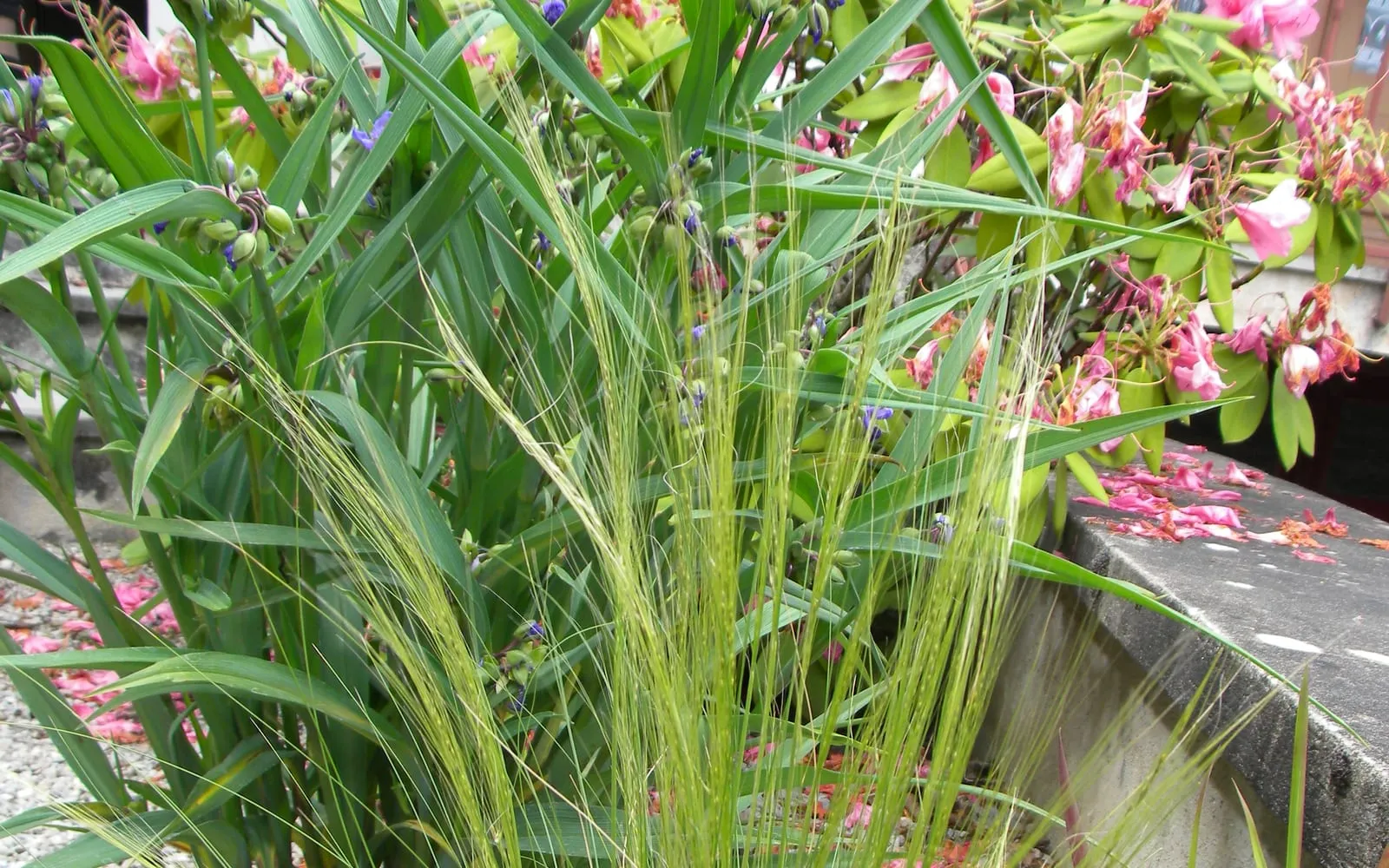
At a glance
- Difficulty
- Easy
- Water
- Regular watering while establishing, drought-tolerant once mature
- Light
- Full sun
- Hardiness
- USDA 6-10, RHS H5, hardy to -15 C
- Type
- Evergreen to semi-evergreen perennial grass, short-lived in cold climates
- Height
- 30-60 cm
- Native to
- Northern Mexico, Southwestern United States
Reliably hardy through an ordinary temperate winter but not fully frost-proof the way many prairie grasses are, and a hard, prolonged freeze can kill an established clump outright rather than checking its growth. In a marginal climate it behaves more like a short-lived perennial than a permanent fixture, self-seeding generously enough that losing the parent plant to a cold winter often matters less than it would with a species that does not replace itself so readily.
Hardiness zones describe winter cold alone. Summer heat, humidity, rainfall and the length of the growing season decide as much, so treat the range as the outer limit rather than as a recommendation.
Not known to be toxic
Mexican feather grass carries no toxic compounds and has no listing from the RHS or the ASPCA as harmful to eat. The hazard it does carry is mechanical rather than chemical. Its narrow seed heads taper into a sharp, barbed awn that can work into an animal's skin, eyes, ears or gums, a problem well documented in grazing livestock across Stipa and Nassella species generally, and a dog that pushes its face into a mature, seeding clump can pick up an awn the same way. This is a physical injury risk rather than a poisoning risk, and it is worth checking a pet's coat, paws and mouth after contact with a seeding clump.
Sources: RHS potentially harmful garden plants, ASPCA toxic and non-toxic plants
About
Mexican feather grass moves more than almost any other ornamental grass sold. Its foliage is hair-fine, so light that the whole clump ripples and shifts in the slightest air movement, catching low sun in a way that has made it a favourite for planting where movement matters as much as form, such as along a path edge or beside a seating area.
Its prolific, wind-carried seed production has also made it a serious weed outside cultivation, especially because the plant thrives in poor soil and full sun. Before planting it, check local rules where you live. California’s Department of Food and Agriculture lists it as a Class B noxious weed, and it is a prohibited, regionally controlled pest in New South Wales and a state-prohibited weed in Victoria, Australia, where authorities estimate tens of millions of hectares of grassland are vulnerable to invasion if it escapes further. Treat this as a plant to grow with active management of its seed rather than as a neutral, consequence-free ornamental in any climate mild and dry enough for it to naturalise.
Appearance and character
The foliage is the entire display: extremely fine, almost thread-like blades that arch outward and downward from a rounded base, forming a soft, tousled mound rather than the upright, structured habit of most ornamental grasses. Fresh growth is bright green, fading through summer to a warm, straw-blond colour that many gardeners find as attractive as the green phase.
Flower heads appear in late spring and early summer as fine, feathery plumes barely distinct from the foliage around them, adding to the soft, blurred texture of the whole plant rather than standing out as a separate feature the way a bolder grass’s flower spikes do. As the seed matures, the plumes dry to the same pale gold as the leaves, and the whole clump can look almost uniformly straw-coloured by late summer.
Where it is from
Stipa tenuissima is native to dry grassland and rocky ground across northern Mexico and the southwestern United States, in a climate of hot, dry summers, mild winters and unpredictable, often sparse rainfall. It evolved to establish fast from seed after disturbance and to tolerate long dry periods once rooted, which is exactly the combination of traits that makes it invasive outside its native range: a garden setting rarely offers the summer heat and competition that keep its population in check at home.
How it grows
Plant in spring into free-draining soil in full sun, giving the clump room to reach its mature spread since crowding blurs the airy, see- through habit that gives the plant its value. Establishment is fast, and a young plant often reaches a reasonable size within its first growing season.
Once settled, growth is vigorous rather than slow, and the plant seeds itself around a bed readily, sometimes extremely so in a warm, dry climate. Deadheading before seed sets is the main tool for keeping it contained, and in a region where it is regulated, removing spent flower heads before they mature carries real legal weight, well beyond ordinary tidying.
A mature clump can decline after a few years, particularly in heavier or wetter soil, at which point lifting and dividing or replacing it with self-sown seedlings, where those are permitted, keeps a planting going.
Through the seasons
Spring brings strong new growth and the best window for planting or dividing, along with the season’s first flush of fine, feathery flower heads.
Summer is the peak display, with the foliage fading from green to straw-blond and the flower plumes maturing and setting seed, the point at which deadheading matters most where self-seeding needs to be controlled.
Autumn growth slows, and the pale, straw-coloured clump continues its constant movement in wind through the season.
Winter foliage persists in a mild climate, staying evergreen through an ordinary winter, though a hard, prolonged freeze can damage or kill an established clump outright in a way it would not touch a cold-hardy prairie grass.
Care difficulty
Easy where the climate suits it, and the real work is management rather than cultivation. The plant needs very little watering, feeding or shelter, but it demands active deadheading in any setting where uncontrolled self-seeding would be a problem, whether that is a neighbouring wild area, a shared boundary, or a region where the species carries legal restrictions.
Watering
Water regularly through the first growing season while the roots establish. After that, an established clump tolerates real drought and generally performs better with less water than more, since consistently damp soil favours the crown rot this species is prone to over the tight, drought-adapted growth it shows in a lean, dry position.
Warning signs, diseases and pests
Rust occasionally shows as small orange pustules on the fine foliage, usually in a wet or humid season, and is rarely a serious threat to an otherwise healthy plant.
Crown rot is the more consequential risk, appearing as a clump that browns and collapses from the centre, almost always tied to soil that stays wet through winter rather than to any pathogen specific to this species. Improving drainage before replanting is the only real fix once it has taken hold.
The far more common “problem” reported with this species is uncontrolled spread from self-sown seed, addressed through deadheading and removal of unwanted seedlings rather than through any treatment aimed at a pest or disease.
Growing environment
Full sun and sharp drainage suit this species best, and it tolerates poor, stony or sandy soil with ease, generally performing worse rather than better as soil fertility and moisture retention increase. It is a poor fit for a damp, shaded or heavy-clay position, where both its health and its characteristic airy habit suffer.
Feeding
None to minimal. This is a plant adapted to naturally lean, dry ground, and richer soil or routine feeding produces looser, less finely textured growth that loses some of the delicate movement the species is grown for, without meaningfully improving its health.
Troubleshooting
Seedlings are appearing all over the garden and beyond the original planting. This is the species’ defining trait rather than a fault in how it was grown. Deadhead flower heads before they set seed to control it, and check local invasive species rules, since several jurisdictions regulate or prohibit planting it altogether.
Is this plant legal to grow where I live? Check first. It is a listed noxious weed in California and a prohibited pest in parts of Australia, among other regulated regions, and rules change, so a local check before planting is worth more than any general answer here.
The clump has collapsed and browned from the centre. This usually points to crown rot from consistently wet soil rather than cold damage or a pest. Remove the affected plant and improve drainage substantially before planting anything else in the same spot.
My dog has been rubbing at its face or ears after walking through a mature, seeding clump. Check for a lodged seed awn. The sharp, barbed tips can work into skin, ears and eyes mechanically, and persistent irritation is worth a vet check rather than assuming it will resolve on its own.
The plant did not survive a hard winter that other ornamental grasses in the same bed shrugged off. This species is less reliably cold-hardy than many prairie grasses, and a severe or prolonged freeze can kill it outright even within its listed hardiness range. Consider a more sheltered position or accept that it may need periodic replacing in a marginal climate.
How do I stop it looking untidy by late summer once the flower heads have faded. Cutting the whole clump back by roughly a third after flowering tidies the display and, done before seed sets, doubles as control for self-seeding.
Is there a less invasive grass with a similar fine, moving texture I could grow instead? Prairie dropseed offers some of the same fine texture in a clump-forming species that self-seeds only modestly, though its habit is more rounded and fountain-like than the loose, tousled mound this species forms, and it does not move in wind in quite the same restless way.