
Outdoor plant
Bracken
Pteridium aquilinum
Also known as Common bracken, Brake fern, Eagle fern
How to identify and control bracken, Pteridium aquilinum. The commonest fern in the world, the carcinogen in the spores, and why bruising the fronds is the trick.
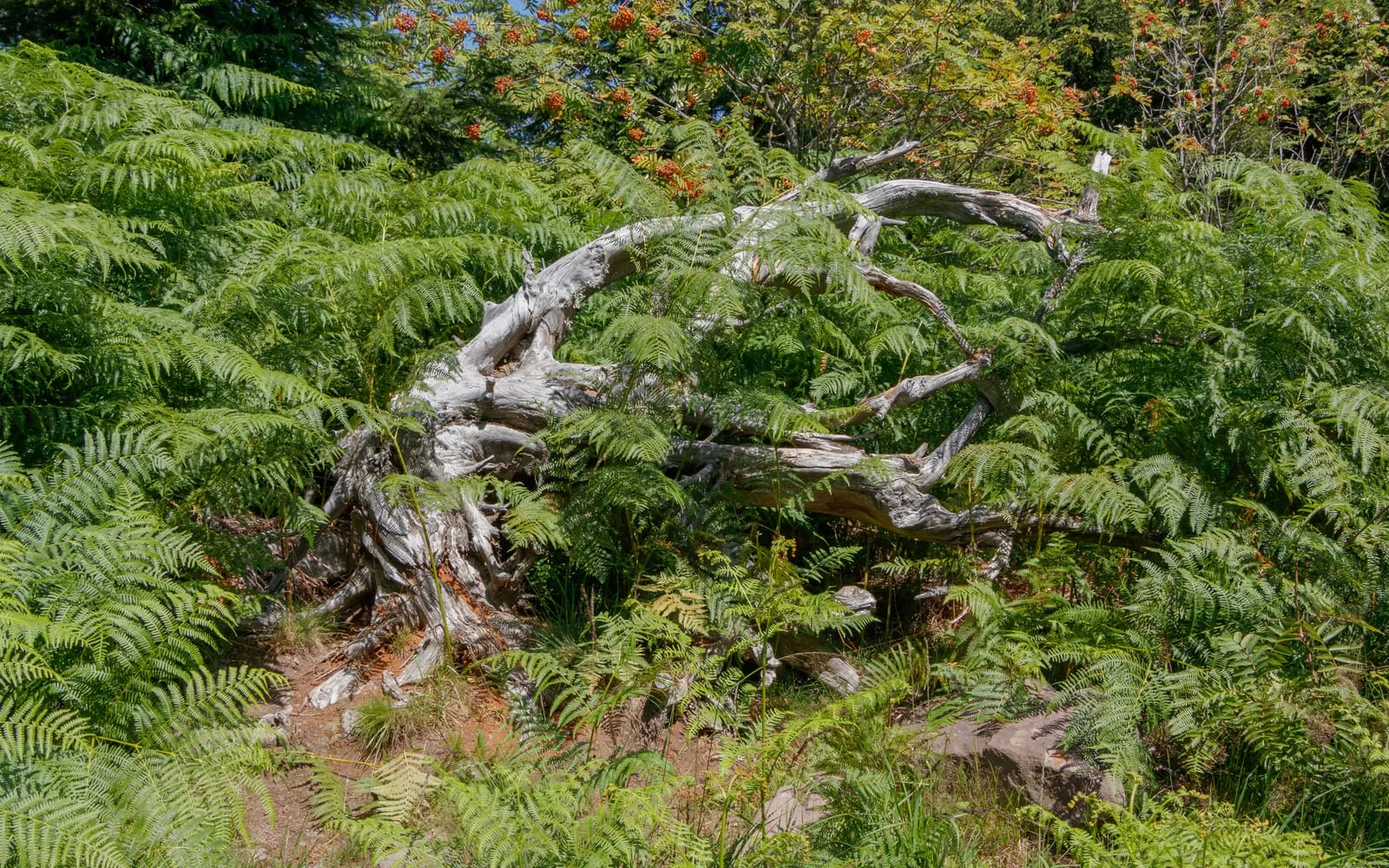
At a glance
- Difficulty
- Difficult
- Water
- Not applicable
- Light
- Full sun to partial shade
- Temperature
- Fully hardy, and the fronds are killed by the first hard frost
- Hardiness
- USDA 3-9, RHS H7, hardy to -35 C
- Type
- Perennial fern, spreading by deep long-lived rhizomes
- Height
- 1-2 m, and up to 3 m in shelter
- Native to
- Every continent except Antarctica, and native throughout Britain
- Best month
- June in the Northern Hemisphere, December in the Southern Hemisphere
It grows on every continent except Antarctica and is among the most widely distributed vascular plants on earth, so nothing in the climate constrains it. The constraint is chemical. Fronds contain ptaquiloside, a confirmed carcinogen, which is why eating young fiddleheads is linked to raised gastric cancer rates in the parts of Japan, Korea and Brazil where they are a traditional food, and why long exposure in livestock causes bright blindness and bladder tumours. Spores carry it too, so cut on a still day and wear a mask.
Hardiness zones describe winter cold alone. Summer heat, humidity, rainfall and the length of the growing season decide as much, so treat the range as the outer limit rather than as a recommendation.
Every month named in this guide is for the temperate Northern Hemisphere. If you garden in the Southern Hemisphere, shift each one by six months, so June becomes December. Closer to the equator the wet and dry seasons matter more than the calendar, and the shift stops being a useful guide.
Poisonous if eaten
- Do not eat
- All parts, especially the young fronds and the spores
- Harm from
- Eating it
- Affects
- People, cats, dogs and horses
Bracken contains ptaquiloside, an established carcinogen, along with thiaminase which destroys vitamin B1. The carcinogenic effect is documented across several routes. Cattle grazing bracken develop bladder tumours in what is called bovine enzootic haematuria, and the compound passes into milk. Horses and other monogastric animals develop thiamine deficiency with incoordination and weight loss. Sheep grazing it develop bright blindness. For people the evidence is of increased stomach and oesophageal cancer risk in populations that eat bracken fiddleheads regularly, notably in parts of Japan and Korea where they are a traditional food. Spore inhalation is a recognised concern and spores are released from July to September, so avoid walking through spore-bearing bracken in late summer, keep dogs out of it, and do not cut or strim it dry without a mask. Bracken beds are also the main habitat for the ticks that carry Lyme disease, so cover legs and check for ticks after walking in it. None of this makes bracken a reason for alarm on a walk, and it is a reason to keep it out of a garden and to handle it sensibly when clearing it.
Sources: RHS potentially harmful garden plants, ASPCA toxic and non-toxic plants
About
Bracken is the commonest fern in the world and one of the most successful plants on the planet, and where it reaches a garden it is a serious problem.
The rhizome system runs a metre or more below the surface, spreads laterally for many metres, and lives for centuries. Single clones on British hillsides have been estimated at over a thousand years old. Nothing you can do at the surface reaches it directly.
Above ground it makes a closed canopy 1 to 2 m tall by midsummer that shades out everything beneath it, and the dead fronds form a thick litter layer in winter that suppresses seedlings of anything else.
It has spread substantially across British uplands over the last century as grazing patterns changed, and it is a major conservation problem on moorland and in ancient woodland.
It is also poisonous, though the risk is specific. The fronds contain a carcinogen, the spores released in late summer are a recognised inhalation risk, and bracken beds are the main habitat for the ticks that carry Lyme disease.
Control is possible with persistence, and the method that works is repeated cutting at the right moments rather than anything applied to the ground.
Appearance and character
A perennial fern reaching 1 to 2 m, and up to 3 m in a sheltered woodland edge, dying back completely after the first hard frost.
Fronds are large and broadly triangular, held roughly horizontally at the top of a stiff upright stalk, and divided three times into fine segments.
The stalk is smooth, green to brown, and stiff enough to hold the frond out flat, which is what gives a bracken bed its layered canopy.
Fronds unroll in spring as tightly coiled croziers, the fiddleheads, pushing up from the ground through May and June.
Spores are borne in a continuous line along the rolled-under margin of the frond segments, rather than in discrete round dots as in most ferns, and they are released from July to September.
Autumn turns the fronds a rich orange-brown, and they collapse after frost into a thick persistent litter.
Rhizomes are black, wiry and up to 2 cm thick, running horizontally at 15 cm to over a metre deep, and they carry large food reserves.
Unlike most British ferns, bracken has no crown and the fronds arise singly from the rhizome at intervals, which is why a bracken stand looks like a field rather than a group of plants.
Where it is from
Every continent except Antarctica, and native throughout Britain and Ireland.
It grows on acid, free-draining, deep soil, on heathland, moorland, hillsides, woodland edges, roadsides and neglected ground, and it avoids waterlogged ground and strongly alkaline soil.
Its British extent has increased markedly over the past century, as upland grazing changed and as the traditional uses that kept it cut disappeared.
Those uses were extensive. Bracken was cut for livestock bedding, for thatch, as a packing material, and burnt for potash used in soap and glass making. Regular cutting for those purposes kept it in check across large areas.
The rhizome system is long-lived. Clonal bracken stands in Britain have been dated at over a thousand years, making them among the oldest living organisms in the country.
It is a serious problem on moorland and in ancient woodland, where it shades out ground flora, and control on nature reserves is a continuing management cost.
The traditional aerial treatment used on hill land, asulam, has had a complicated regulatory history across Britain and the European Union, and approvals for it differ elsewhere again, so anyone considering large-scale control should check the current position where they are rather than relying on what was once permitted.
How it spreads
By rhizome, overwhelmingly, and by spores to a limited and slow extent.
Rhizomes run horizontally at 15 cm and vertically to a metre or more, extending a stand outwards by up to a metre a year at the edges.
Food reserves stored in the rhizomes let it regrow repeatedly after cutting, which is why control depends on exhausting them rather than removing them.
Spores are produced in vast numbers from July to September and establish new colonies slowly, since the intermediate stage requires damp bare ground.
It does not spread by seed and does not arrive in compost or manure the way most weeds do.
It comes in from neighbouring land at the edges of a stand, which is where control effort is best concentrated.
Through the seasons
Winter the dead fronds lie as a thick litter, and the rhizomes hold their reserves.
Spring the croziers unroll from May, and the plant is drawing heavily on its rhizome reserves at this point.
Summer is full canopy from June, spores are released from July, and this is the window for the cutting regime.
Autumn the fronds turn orange-brown and collapse after the first frost.
Control
Cut it twice a year, every year, for several years. This is the method that works. The first cut goes in mid to late June, when the fronds are fully expanded and the rhizome reserves are at their lowest, and the second in late July or August as the regrowth appears.
Each cut forces the rhizome to spend reserves rebuilding a canopy, and repeated over four to five seasons it exhausts the plant.
Use a scythe, a strimmer or a mower depending on the scale, and cut low.
Timing matters more than force. A single cut in June does more than three cuts in September.
Bruise it as an alternative or an addition. Rolling or crushing bracken with a heavy roller, or beating it down with a board, damages the stems and lets fungal infection in, and it is the traditional hill method.
Trample or roll it in June, at the same point in the season as the first cut.
Bruising the fronds before any herbicide treatment is what lets the chemical in, since the frond surface sheds spray otherwise.
Treat with glyphosate in a garden setting on cut and regrown fronds in late summer, following the label, and expect several seasons of it.
Check the current approval position before considering asulam or any large-scale treatment, since the regulatory situation has changed more than once.
Plant it out where a cleared area needs to stay clear. Bracken recolonises open ground, and establishing grass, shrubs or trees on cleared ground is what holds the gain.
Remove the litter layer where you want other plants to establish, since the dead frond mat suppresses seedlings.
Do not cut or strim dry bracken in late summer without a mask, since the spores are released then.
Wear long sleeves and gloves, and check for ticks afterwards.
Handling it safely
Do not cut or strim bracken in dry weather from July to September without respiratory protection, when the spores are being released.
Cut it when damp rather than dry, which keeps the spores down.
Wear long trousers tucked into socks, long sleeves and gloves.
Check yourself, children and dogs for ticks after any time in bracken, paying attention to the backs of knees, the waistband, the hairline and the groin. Remove ticks promptly with a proper tick tool.
Keep livestock off it, particularly horses and cattle, and never make hay or bedding from a field containing bracken.
Do not eat the fiddleheads. They are a traditional food in parts of east Asia and they are associated with increased stomach cancer risk in those populations.
Wash your hands after handling it.
Telling it apart
Bracken has a single large triangular frond held horizontally at the top of a stiff upright stalk, divided three times, with the spores in a continuous line under the rolled frond margin.
Male fern, Dryopteris filix-mas, forms a shuttlecock crown of fronds from a single point, with round spore dots on the underside, and it grows in shade rather than open ground.
Lady fern, Athyrium filix-femina, also forms a crown, with finer more delicate fronds.
Hard fern, Blechnum spicant, has narrow ladder-like fronds in a low rosette.
The reliable bracken characters are the single fronds arising separately from the ground, the triangular horizontal blade, and the great height.
Troubleshooting
How do I get rid of bracken? Cut it twice a year, in mid to late June and again in late July or August, every year for four or five seasons. The June cut matters most because the rhizome reserves are lowest then.
Can I dig it out? Not realistically. The rhizomes run a metre or more deep and spread laterally for many metres, and they regrow from fragments.
Why is timing so important? The plant spends its rhizome reserves rebuilding the canopy every spring. Cutting in June, when reserves are lowest and before they are replaced, costs it far more than cutting in autumn.
Does weedkiller work? Only if the fronds are bruised first, since the surface sheds spray. Crush or trample the growth, then treat in late summer, and expect several seasons.
Are the spores dangerous? Bracken spores contain a carcinogen and are released from July to September. Do not cut or strim dry bracken then without a mask, and cut it damp rather than dry.
Should I worry about walking through it? No. Ordinary walking is not a significant risk. Cover your legs, keep out of it in late summer when the spores are flying, and check for ticks afterwards, since a bracken bed is prime tick habitat.
Can I eat the fiddleheads? They are eaten in parts of Japan and Korea and are associated with increased stomach cancer risk in those populations. Do not.
Is it dangerous to livestock? Yes. It causes bladder tumours in cattle, thiamine deficiency in horses and blindness in sheep. Never make hay or bedding from a field containing it.
What stops it coming back? Planting the cleared ground with grass, shrubs or trees. Bare cleared ground gets recolonised from the rhizome edge within a couple of seasons.