
Houseplant
Hardy Begonia
Begonia grandis
Also known as Begonia grandis
How to grow Begonia grandis, the hardy begonia, a pink-flowered East Asian species that dies back to tubers and scatters bulb-like buds from its leaf joints.
At a glance
- Difficulty
- Easy
- Water
- When the top few centimetres of mix have dried
- Light
- Bright indirect light to light shade
- Temperature
- Tubers hardy to about -15 deg C in well-drained soil; leaves die with frost
- Humidity
- Average to high
- Hardiness
- USDA 6-9, RHS H4, hardy to -15 C
- Type
- Perennial
- Height
- 40-70 cm
- Native to
- eastern Asia
A tuberous begonia from the cool, moist woodland slopes of China and Japan. It dies back to its tubers with the first hard frost and regrows in late spring, surviving to about -15 deg C when mulched and drained. It needs a summer long enough to flower before frost, and dormant tubers rot in cold, wet soil.
Hardiness zones describe winter cold alone. Summer heat, humidity, rainfall and the length of the growing season decide as much, so treat the range as the outer limit rather than as a recommendation.
Harmful if eaten
- Harm from
- Eating it and handling it
- Affects
- People, cats, dogs and horses
Begonia grandis, the hardy begonia, is toxic to cats, dogs and horses. The whole plant holds oxalates, most concentrated in the underground tuber, and chewing it can burn the mouth and cause drooling and vomiting. The RHS rates begonias as mildly harmful if eaten and a possible skin irritant. Keep it out of reach of pets and small children, and wash your hands after cutting stems.
Sources: ASPCA toxic and non-toxic plants, RHS potentially harmful garden plants
Hardy begonia
Begonia grandis is unusual in a genus of tender plants: a begonia from eastern Asia, in China and Japan, tough enough to survive winters that kill its tropical relatives outright. Instead of staying above ground through the cold, it dies down completely to fleshy underground tubers and returns in late spring, behaving like a herbaceous perennial. Every autumn it also drops tiny bulb-like buds from its leaf joints, and these scatter and grow into new plants, so an established clump can form a small colony around itself. It is a pink-flowered shade-border plant in mild-winter gardens as well as a pot plant.
Leaves, veins and bloom
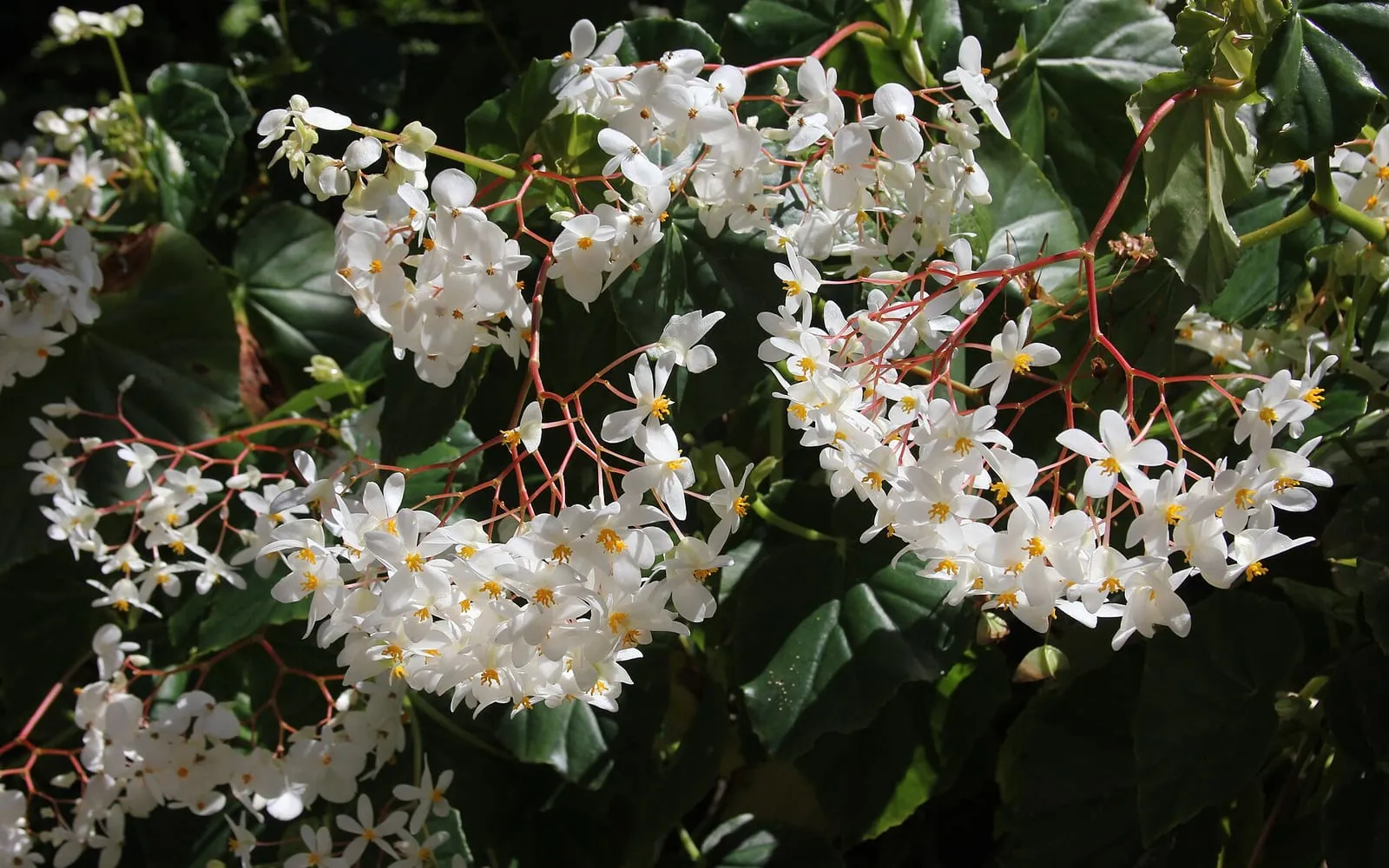
The leaves are large, lopsided and gently pointed, shaped a little like an angel’s wing, olive green above and flushed a striking coppery red beneath, with the same red running through the veins. Held on reddish stalks, the crimson undersides show clearly when low sun shines through them. From midsummer into autumn, loose sprays of nodding pink flowers hang on branching red stems above the foliage. Each spray carries both sexes in the begonia manner, the female flowers marked by the little three-winged capsule that ripens the seed.
The bulbils in the leaf joints
Look in the angle where each leaf meets the stem in late summer and you will find small round bulbils, greenish then brown, no bigger than a peppercorn. These drop when ripe and root where they fall, which is how the plant spreads and how a grower most easily makes more of it. Gather a pinch of them in autumn and press them into a tray of damp compost to raise a batch of young plants for the following year.
Its natural home
In the wild it grows on shaded, moist slopes and woodland edges in eastern Asia, in cool, humid air and soil rich with leaf litter. That habitat explains its need for dappled shade, its dislike of baking sun and its need for soil that stays moist through the growing season yet drains freely so the dormant tubers do not rot in winter wet.
Light and siting
Bright shade suits it, the kind of light found beneath deciduous trees or beside a wall out of the midday sun. Morning sun does no harm, but hot afternoon rays through glass scorch the thin leaves and dull the red undersides. In a pot indoors, an east-facing spot or a bright position out of direct sun keeps the foliage in good colour. Given too little light the flowering stems grow lax and few.
Watering in growth and rest
Through spring and summer, when the plant is in full leaf, keep the compost evenly moist, watering once the top has begun to dry and never letting it wilt. As the leaves yellow and fall in autumn the plant enters dormancy, and watering should drop right back; a dormant tuber sitting in cold, wet compost can rot. Keep an overwintering pot barely moist and cool instead of warm and sodden, and resume normal watering only when new shoots push through in late spring.
Warmth and dormancy
In a pot it grows happily in ordinary room warmth through the season, and the leaves are damaged by frost. Its dormant tubers can tolerate cold down to about -15 deg C in well-drained soil, so the species can be grown in the ground in gardens with cold winters as well as mild ones. Do not throw a pot away when the top dies down in autumn; it is resting, not dead, and will regrow.
Feeding
Feed every couple of weeks through the growing season with a balanced liquid fertiliser at half strength, from the time the shoots appear until the leaves begin to fade. Feeding builds the tubers that carry the plant through winter and support next year’s growth. Stop entirely once the plant starts to die back, and give nothing while it is dormant.
Propagation
The bulbils are the simplest method, sown thinly on damp compost in autumn or spring. Division of a dormant clump of tubers in early spring, before the shoots lengthen, gives instant new plants. Seed, though fine and slow, germinates readily and usually produces plants like the parent species. Stem cuttings taken in summer will also root in warm, moist compost, useful for bulking up a favourite form.
Health and problems
This is a sturdy plant with few troubles. Vine weevil grubs can attack the tubers of a pot kept outdoors, hollowing them over winter, so check the compost when repotting. In a dry indoor room spider mites may stipple the leaves; raised humidity and rinsing help control them. Grey mould can spot foliage left cold and wet in poor air. A tuber that fails to sprout in spring has usually rotted in winter-wet compost, the main mistake to avoid.
Through the year
Spring brings the tubers back into growth; divide, sow bulbils and begin feeding as the shoots rise.
Summer is full leaf and the start of flowering; keep the compost evenly moist and feed regularly.
Autumn brings flowers, then dieback and the ripe bulbils; gather them, and ease off water as the leaves fade.
Winter is dormancy; keep the tuber cool and barely moist, and wait for spring instead of watering heavily.
Questions growers ask
My plant died back in autumn, is it dead? No. It dies down to underground tubers every year and regrows in late spring; keep the pot cool and barely moist meanwhile.
What are the little beads in the leaf joints? Bulbils, the plant’s own means of spreading. Sow them on damp compost to raise new plants.
How much light does it need? Bright shade or morning sun; keep it out of hot afternoon sun, which scorches the leaves.
How do I make more of it? Sow the bulbils, divide the dormant tubers in early spring, or take summer stem cuttings.
Is it safe around pets? No. The oxalates in begonias burn the mouth, and the tubers hold the most, so keep it away from pets that chew.
Hardy Begonia problem guides
Not sure what is wrong? See the common houseplant pests guide.