
Outdoor plant
Great Wood-Rush
Luzula sylvatica
Also known as Greater woodrush, Great woodrush
How to grow great wood-rush, Luzula sylvatica, a true rush rather than a grass and one of the best evergreen groundcovers for dry shade under trees.
At a glance
- Difficulty
- Easy
- Water
- Regular watering while establishing, drought-tolerant in shade once mature
- Light
- Full shade to partial sun
- Hardiness
- USDA 4-9, RHS H7, hardy to -25 C
- Type
- Hardy evergreen perennial rush
- Height
- 30-70 cm
- Native to
- Europe
Fully hardy through an ordinary temperate winter, and cold is not a meaningful limit on where this species grows well across a temperate climate. Its native range across European woodland, hedgerow and upland habitat gives it real tolerance of both hard frost and deep, dry shade, a combination few evergreen groundcovers manage together, and the main climate consideration is less about winter survival than about whether a given site offers the shade this species needs to look its best.
Hardiness zones describe winter cold alone. Summer heat, humidity, rainfall and the length of the growing season decide as much, so treat the range as the outer limit rather than as a recommendation.
Not known to be toxic
Great wood-rush carries no toxicity listing on the RHS potentially harmful garden plants list and no listing from the ASPCA as harmful to cats or dogs. It has no recorded history of causing illness in people or animals that come into contact with or chew on it, and it is widely planted as groundcover in gardens without any documented safety concern.
Sources: RHS potentially harmful garden plants, ASPCA toxic and non-toxic plants
About
Great wood-rush is not, botanically, a grass at all. It belongs to the rush family, Juncaceae, distinct from the true grasses, Poaceae, that make up the rest of this collection, and the difference shows in practical ways as much as taxonomic ones: its leaves are broader, softer and glossier than most true grasses, and it tolerates a use case where almost every true grass in this collection fails outright, deep, dry shade under a mature tree canopy.
That single trait is why the species earns a place in so many shaded garden schemes. Dry shade, the combination of low light and root competition for moisture under an established tree, is one of the hardest conditions to plant successfully, and great wood-rush is consistently named among the small handful of plants, alongside a few true shade-tolerant ferns and hardy geraniums, that reliably form a dense, weed-suppressing evergreen carpet there.
Appearance and character
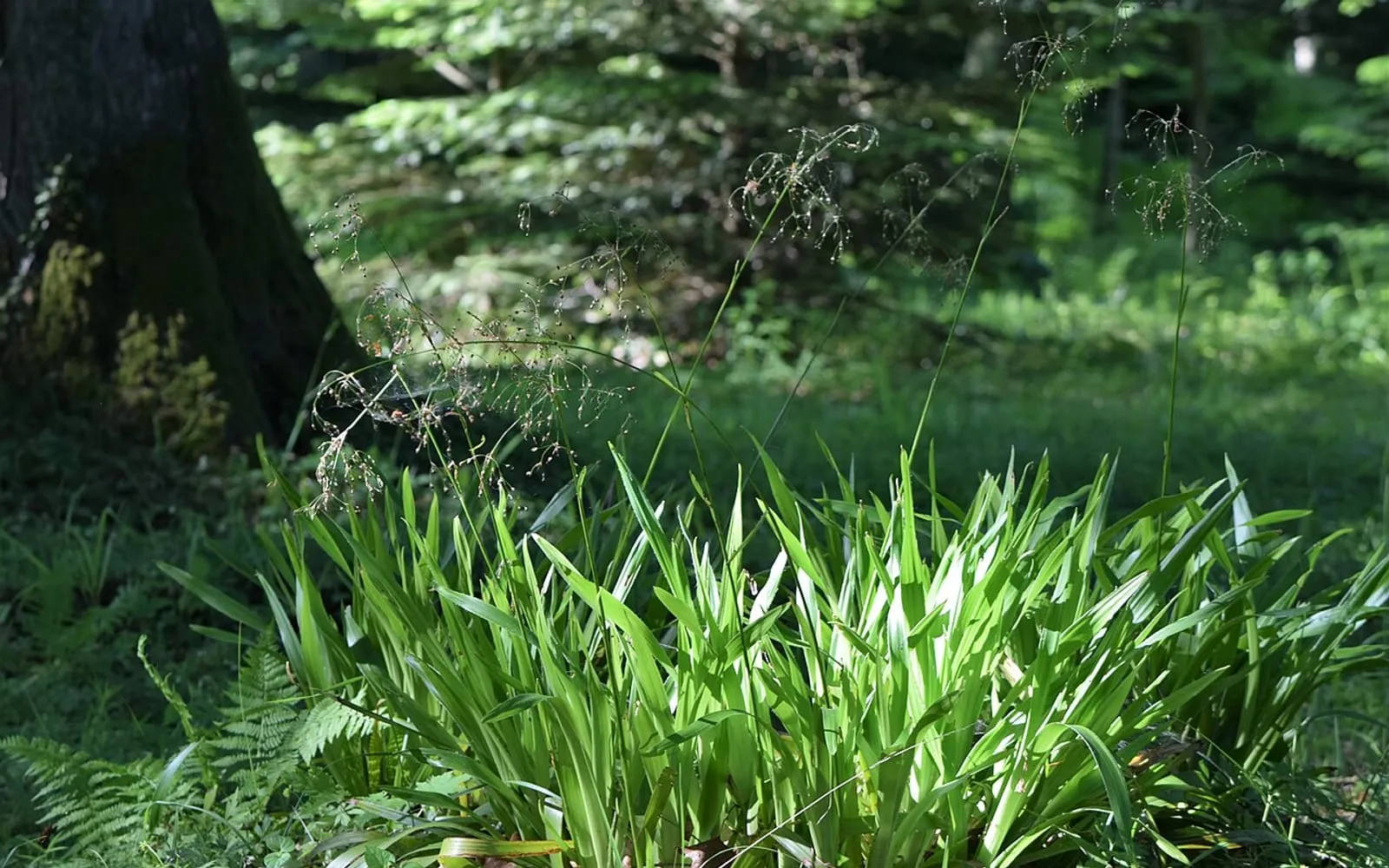
Broad, glossy, dark green leaves grow in loose, arching tufts that spread gradually to form a dense, even carpet, evergreen through the year rather than dying back for winter the way most true grasses in this collection do. The foliage has a soft sheen distinct from the matte or waxy surface typical of grass leaves, one of the easiest ways to tell this species apart from a true grass at a glance.
Airy, branched flower panicles rise above the foliage in late spring into summer, carrying small, brown, star-shaped flowers that add subtle texture rather than bold colour, followed by seed capsules that persist into autumn. Several cultivars carry golden or variegated foliage, brightening a dark corner in a way the plain green species cannot, though the true species itself is valued primarily for its reliable, glossy dark green coverage.
Where it is from
Luzula sylvatica is native across a wide swathe of Europe, from Britain and Ireland through much of the continent and into parts of western Asia, growing in woodland, on shaded banks and hedgerows, and in damp upland habitat, including areas too shaded or too poor in soil for many other plants to establish. That woodland-floor origin explains both its shade tolerance and its evergreen habit, since a plant that relies on low light for much of the year gains real advantage from foliage that photosynthesises through winter rather than dying back.
Its tolerance of poor, dry ground once established reflects the reality of growing under a dense woodland canopy, where tree roots absorb most available moisture and nutrients and a plant has to make do with whatever the canopy leaves behind.
How it grows
Plant in spring or autumn into humus-rich soil where possible, though this species establishes reasonably well even in poorer ground provided some organic matter is present, in partial to full shade. Growth is steady, spreading gradually by short rhizomes to form a dense, even carpet over a few seasons rather than a single fast-growing season.
Water regularly while a new planting establishes, particularly under a mature tree where root competition for moisture is intense. Once settled, an established planting tolerates real drought and needs very little supplemental watering, drawing on its adaptation to the dry conditions typical of a woodland floor.
Little routine pruning is needed. Remove faded flower stems and any tattered winter foliage in spring to tidy the planting, and divide an established patch if it becomes congested or if new areas need planting from an existing clump, lifting and splitting sections in spring or autumn.
Through the seasons
Spring brings a tidy-up of faded winter foliage and old flower stems, followed by the season’s new flower panicles rising above the evergreen leaves from late spring.
Summer is a season of steady, quiet growth, with the glossy foliage continuing to spread and fill in as a dense groundcover.
Autumn brings little visible change, since the foliage stays evergreen and green rather than colouring or dying back the way most true grasses in this collection do.
Winter the glossy leaves persist through the coldest months, holding colour and providing continuous groundcover exactly when a deciduous woodland floor would otherwise be bare.
Care difficulty
Easy, and one of the lowest-maintenance options in this collection for a difficult site. Once established under a tree or in another shaded position, it needs minimal watering, little to no feeding and only an occasional tidy, doing the practical work of suppressing weeds and covering bare ground with very little ongoing input.
Watering
Water regularly while a new planting establishes, especially under a tree where existing roots compete strongly for available moisture. Once settled, this species tolerates real drought in shade, drawing on its adaptation to the dry, root-filled conditions typical of a woodland floor, and established plantings rarely need supplemental watering beyond an unusually severe dry spell.
Warning signs, diseases and pests
No significant pests or diseases are commonly reported on this species in cultivation, and it is generally left alone by the slugs and snails that trouble many other shade-loving plants, its tougher, glossier leaves offering less of a target than the soft new growth of a hosta or a shade perennial nearby.
Thin, patchy coverage generally points to a site that is too dry during establishment or too exposed to direct sun rather than to any pest or disease, and the fix is more consistent watering in the first season or a move to deeper shade rather than any treatment.
Yellowing foliage on an otherwise established planting is more often a sign of waterlogging than of drought, since this species tolerates dry shade far better than it tolerates soil that stays saturated for extended periods, an unusual combination worth remembering given how often “yellowing grass-like foliage” is blamed on too little water by default.
Growing environment
Full shade to partial sun both suit this species well, and it is one of the most shade-tolerant plants covered anywhere in this collection, performing best where many grasses and even many shade perennials struggle. Humus-rich soil produces the strongest growth, though it adapts to poor, dry ground once established, which is exactly the combination of conditions found under a mature tree canopy.
Feeding
Little to none is usually needed on suitable woodland-type soil rich in leaf litter and organic matter. Where planted in poor soil, a light mulch of leaf mould or garden compost in autumn does more for this species than any bagged fertiliser, replicating the leaf litter it would receive on a natural woodland floor.
Troubleshooting
Coverage is thin and patchy rather than forming a dense carpet. Check soil moisture during establishment and how much direct sun the spot gets. This species needs consistent watering in its first season and performs best in shade, and either dry establishment conditions or too much sun can leave coverage sparse.
Can this really be grown under a mature tree where nothing else has succeeded? Yes, this is one of the situations the species is specifically valued for. Its tolerance of both shade and the dry soil typical under an established tree canopy makes it one of the more reliable options for exactly that difficult site.
Is this a grass, or is that a mislabelling somewhere? It is a rush, in the family Juncaceae, not a true grass in the family Poaceae, despite being sold and used in gardens alongside ornamental grasses for similar groundcover and textural purposes.
When should I tidy the plant up? Spring, removing any tattered winter foliage and the previous year’s faded flower stems, is generally enough; this species does not need the hard annual cutback that many true grasses in this collection require.
Does it spread aggressively enough to be a problem in a smaller garden? Spread is gradual via short rhizomes rather than aggressive, and an expanding patch is easily contained by lifting and trimming its edge if it starts to exceed the space allotted to it.
Is it safe for a garden with pets and children? Yes. It carries no toxicity listing from the RHS or the ASPCA and has no history of causing harm to people or animals, making it one of the more straightforward choices in this collection from a safety standpoint.
What can I plant alongside it in a shaded bed? Ferns, hardy geraniums and other shade perennials that share its tolerance for dry, root-filled soil under trees generally combine well, since none of them compete for the same narrow band of resources any more aggressively than the wood-rush itself does, and the contrast between its glossy, strappy foliage and a fern’s finer texture reads well in a shaded planting.