
Outdoor plant
Giant Sequoia
Sequoiadendron giganteum
Also known as Giant redwood, Sierra redwood, Wellingtonia
How to grow giant sequoia, Sequoiadendron giganteum. Fire-resistant bark, cones that need heat to open, and why a garden specimen is a fraction of its eventual scale.
At a glance
- Difficulty
- Moderate
- Water
- Regular, deep watering while young and establishing; more drought-tolerant once well-rooted
- Light
- Full sun
- Temperature
- Tolerates both hard winter cold and hot, dry summers once established
- Hardiness
- USDA 6-9, RHS H6, hardy to -23 C
- Type
- Hardy evergreen conifer
- Height
- 50-95 m and up to several thousand cubic metres of trunk volume in its native Sierra Nevada groves, the largest trees on Earth by that measure. In cultivation elsewhere it grows just as tall given centuries, but a planted specimen after 30-50 years is usually 15-25 m, a fraction of its eventual scale
- Native to
- Western slopes of the Sierra Nevada, California, in about 70 isolated groves at 1,400-2,150 m elevation
Its native range combines cold, snowy Sierra Nevada winters with hot, dry summers and a long fire-return interval, which is why the species tolerates a wider combination of winter cold and summer heat than its reputation as a giant of cool, damp forest might suggest. Deep, moist but well-drained soil matters more to long-term success than the exact zone number; young trees are considerably less drought-tolerant than the mature, deep-rooted giants the species is known for.
Hardiness zones describe winter cold alone. Summer heat, humidity, rainfall and the length of the growing season decide as much, so treat the range as the outer limit rather than as a recommendation.
Not known to be toxic
Giant sequoia carries no established toxicity to people or common pets. Neither the RHS nor the ASPCA lists the species among plants of concern, and there is no documented case of poisoning from foliage, bark or seed. The practical hazards this tree presents are physical rather than chemical: sharp, awl-like young foliage can scratch skin, and a mature specimen's sheer eventual size and shallow, wide-spreading root system are what a planting site needs to be chosen around, not any toxin in the tree itself.
Sources: RHS potentially harmful garden plants, ASPCA toxic and non-toxic plants
About
Giant sequoia is the largest living thing measured by volume anywhere on Earth, a title held by trees such as General Sherman in California’s Sequoia National Park, whose trunk alone contains roughly the volume of a large multi-storey building. A tree planted in an ordinary garden will never approach that scale within a human lifetime, but the same genetics are behind it, and a young specimen already shows the thick, spongy, fire-red bark and the dense, upward-sweeping foliage that make the species unmistakable even at a fraction of its eventual size.
Fire shapes this tree at every stage. Its bark protects the living tissue beneath from all but the hottest blazes, and some cones release seed only after heat dries and opens their scales.
Appearance and character
Foliage consists of small, blue-green, scale-like leaves pressed tightly along the shoots in a spiral arrangement, sharper and more awl-shaped on young growth than the flattened sprays of the false-cypresses in this list, giving the whole tree a slightly bristly texture up close despite its soft appearance from a distance.
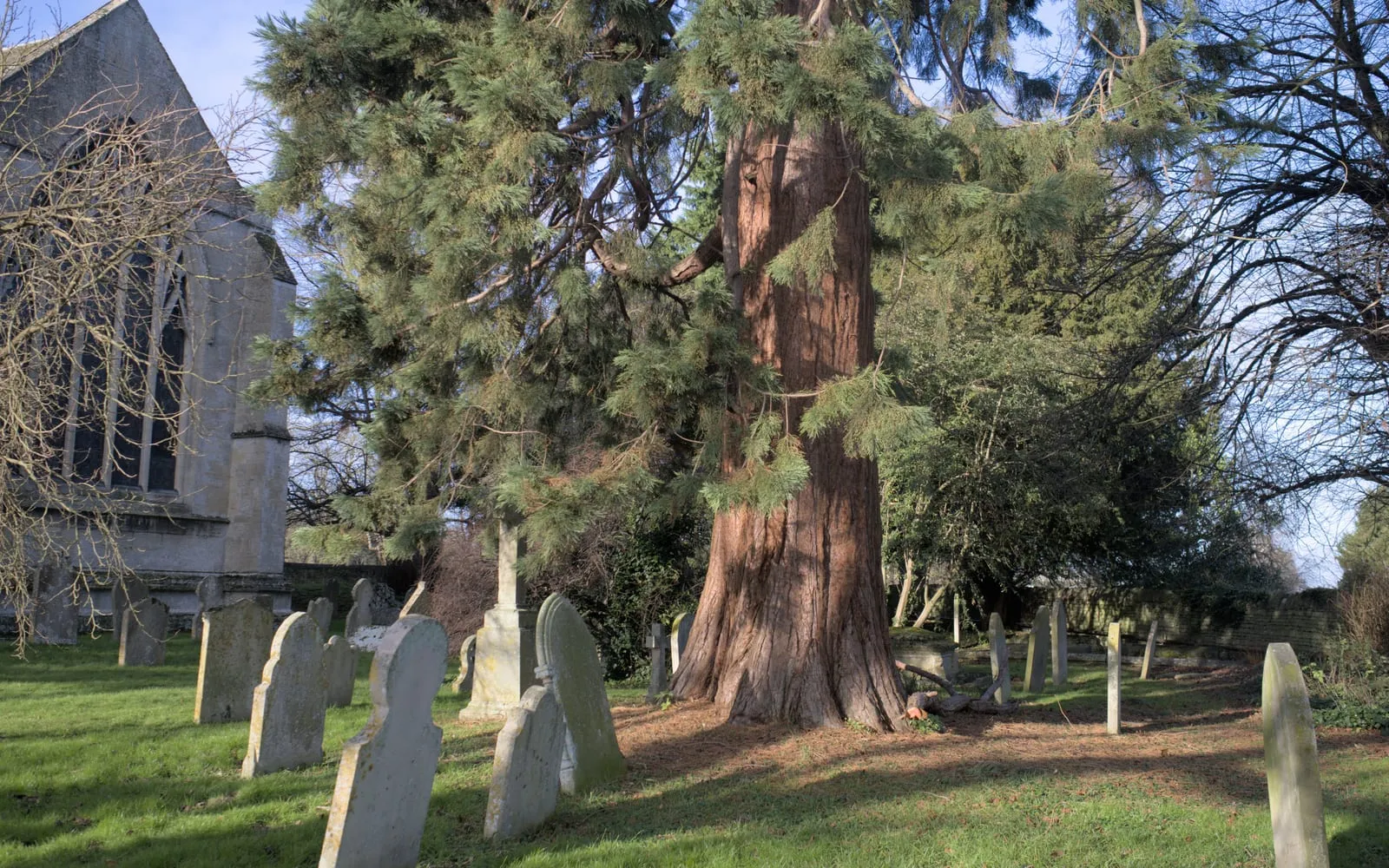
Bark is the tree’s most celebrated feature after its size: thick, fibrous, cinnamon-red to grey-brown, and deeply furrowed, reaching up to 30 to 60 cm thick on the largest mature trunks. It is soft enough to punch a fist into without much resistance and contains almost no flammable resin, a combination that lets the living wood beneath survive fires that would kill almost any other tree species outright.
The crown is broadly conical on a young tree, developing the massive, buttressed, columnar trunk and rounded, irregular crown of an old giant only after centuries of growth, a form no cultivated specimen anywhere in the world has yet had time to reach, since even the oldest garden plantings date back less than two centuries.
Cones are small relative to the tree that bears them, five to eight centimetres long, woody and egg-shaped. Many stay closed and attached to the tree for years, some releasing their seed only when a fire’s heat dries and cracks the cone scales open, a trait called serotiny that ties the tree’s reproduction directly to the natural fire cycle of its native range.
Where it is from
Sequoiadendron giganteum grows naturally only in about 70 isolated groves scattered along a narrow band of the western slopes of California’s Sierra Nevada, typically between 1,400 and 2,150 m elevation, where winters bring heavy snow and summers are warm and largely dry. Unlike its taller relative the coast redwood, it does not form continuous forest, surviving instead as discrete, widely separated groves that together cover a remarkably small total area for a species this famous.
Fire has shaped every one of those groves for thousands of years. Without periodic low-intensity fire clearing competing vegetation and opening mineral soil, sequoia seedlings struggle to establish beneath the shade of other trees, and decades of fire suppression across the twentieth century left many groves overcrowded with young growth until land managers reversed course and reintroduced controlled and prescribed burning as part of active management.
It is the largest tree on Earth by trunk volume, not by height. Several other species, including its coast redwood relative, grow taller.
How it grows
Plant in a deep, moist, well-drained site with plenty of room, thinking in terms of decades and centuries rather than the first ten years alone; this species eventually outgrows almost any residential garden, and it is more often planted as a specimen in a park, arboretum or large estate for exactly that reason.
Water young trees deeply and regularly through their first several summers, since despite the drought tolerance of a mature, deep-rooted tree, a young sequoia has a comparatively shallow root system and is considerably more vulnerable to drought stress than its reputation for toughness suggests.
Avoid compacted or shallow soil. Roots need real depth to develop the wide, stable base a tree of this eventual size requires, and compacted ground around building foundations or driveways limits that development from the start.
Little formal pruning is needed or wanted; the tree naturally sheds its own lower branches as it matures in the way its native groves do, and the resulting bare lower trunk with foliage held high is part of an old specimen’s characteristic form.
Through the seasons
Spring brings a flush of soft, bright blue-green new growth at the shoot tips, and it is a good season to plant, giving young roots a full growing season to establish before the following winter.
Summer tests a young tree’s water needs most, since the species’ native range brings warm, largely dry summers that an established, deep- rooted tree handles far better than a recently planted one still developing its root system.
Autumn is a suitable secondary planting window in a mild climate, and it is also the season this year’s cones, having formed over the growing season, begin hardening toward maturity, though many will remain closed on the tree for years afterwards.
Winter cold and snow are well tolerated by an established tree, given its mountain origin at elevations with reliable heavy snowfall each year; young trees benefit from some protection from the harshest exposure in their first few winters.
Care difficulty
Moderate, largely because success depends more on site selection made once, at planting, than on ongoing routine care. A giant sequoia given deep, well-drained soil, full sun and enough space needs relatively little attention as it matures. The genuine difficulty is upfront: choosing and preparing a site that can accommodate a tree whose eventual scale most residential gardens cannot, and keeping a young tree watered through its first several summers while its root system is still shallow.
Watering
Water deeply and regularly through the first several growing seasons, since young trees are considerably less drought-tolerant than mature ones and a shallow, still-developing root system dries out faster than the species’ toughness suggests.
Once well established, with roots reaching real depth, the tree tolerates the warm, largely dry summers of its native range reasonably well, though a deep occasional soak in a prolonged drought supports healthier growth than letting the soil dry out completely.
Good drainage matters throughout the tree’s life; despite wanting consistent moisture, it does not tolerate permanently waterlogged ground.
Warning signs, diseases and pests
Root-rot follows poorly drained or compacted soil more often than any external pathogen, and it is a more realistic threat to a garden specimen than anything the tree faces in its native, well-drained mountain groves.
Canker diseases occasionally affect stressed or wounded trees, showing as sunken, discoloured patches on the bark; a generally healthy, well-sited tree resists these far better than one already struggling with poor drainage or drought.
Bark beetles are a serious concern in native California groves during severe, prolonged drought, when a weakened tree’s defences fail, but they are rarely a significant problem for an isolated ornamental specimen outside that native range and its associated beetle populations.
Drought stress in a young tree shows as browning foliage and slowed growth, and it is the most common cause of poor establishment in this species, disproportionate to how drought-tolerant a mature specimen eventually becomes.
Scorch or dieback on the side of a young tree facing intense afternoon sun in a hot, dry climate can occur before the bark has thickened enough to provide the insulation a mature trunk has.
Growing environment
Full sun suits it at every life stage, reflecting the open, high-elevation groves it grows in naturally.
Deep, moist, well-drained soil is essential; shallow or compacted ground limits root development in a way that matters more for this species, given its ultimate size, than for almost anything else planted in an ordinary garden.
Space is the defining requirement, and it needs to be considered at planting rather than deferred, since a specimen tree at 40 years old is already substantial and one at 100 years old dwarfs most surrounding planting; this is a tree suited to parks, arboreta and large estates rather than a typical suburban plot.
Shelter from the most extreme, sustained exposure benefits a young tree, though an established specimen tolerates wind, snow and a wide range of conditions well once its root system and trunk have developed.
Feeding
A balanced, slow-release fertiliser once in spring supports a young tree through its establishment years, particularly on soil that is naturally poor or sandy.
Established trees on reasonable soil need little additional feeding, and mulching to retain moisture generally does more for long-term health than fertiliser does.
A tree showing poor colour or slow growth despite feeding is more often constrained by shallow or compacted soil, or by drought stress while young, than short of nutrients.
Troubleshooting
How big will my newly planted tree get, and how fast? Given decades, it will grow considerably larger than almost any other tree commonly planted, potentially exceeding 50 m given a century or more, though a specimen at 30 to 50 years old is typically only 15 to 25 m tall, a small fraction of its eventual scale. Plant only where that long-term size is wanted.
Do the cones need fire to open? Some do. A share of the tree’s cones stay closed and attached for years, opening fully only when dried and cracked by fire’s heat, a trait called serotiny that ties reproduction directly to the natural fire cycle of its native Sierra Nevada groves, though many cones also open gradually without fire over time.
The bark looks soft and spongy. Is something wrong with it? No. The thick, fibrous bark is naturally soft to the touch and contains very little flammable resin. It helps protect the living wood beneath from all but the most intense fires.
My young tree is struggling in a dry summer. Young sequoias have comparatively shallow root systems and need more consistent watering through their first several summers than their reputation for toughness suggests. Deep, regular watering while the tree establishes matters more than for almost any other conifer in this list.
Is this the same tree as coast redwood? No, a different though related species. Coast redwood, Sequoia sempervirens, grows taller but with a slenderer trunk in foggy coastal California and Oregon; giant sequoia grows in isolated Sierra Nevada mountain groves and is the larger of the two by total trunk volume.
Can I really grow this in an ordinary garden? Only if there is genuine long-term space, since even a slow start belies an eventual scale that outgrows most residential plots within a few generations. It is better suited to a park, arboretum or large estate than a typical garden boundary.
The lower branches are dying back on an older specimen. This is normal. Mature trees naturally shed lower branches as they age, holding foliage higher on the trunk in the way old trees do in their native groves, rather than a sign of disease on an otherwise healthy specimen.