
Houseplant
Chilean Mitre Flower
Asteranthera ovata
Also known as Asteranthera ovata
How to grow Asteranthera ovata, the chilean mitre flower, a scarlet-flowered Chilean rainforest climber for cool, moist, lime-free shade.
At a glance
- Difficulty
- Easy
- Water
- When the top few centimetres of mix have dried
- Light
- Bright indirect light to light shade
- Temperature
- Cool; tolerates a few degrees of frost when sheltered
- Humidity
- Average to high
- Hardiness
- USDA 9-10, RHS H3, hardy to -5 C
- Type
- Perennial
- Height
- 1-2 m
- Native to
- Chile and Argentina
A climber from the cool, permanently wet temperate rainforest of Chile and Argentina. It tolerates a few degrees of frost in shelter, but it dislikes hot summers, dry air and lime, so the zone numbers say nothing of the cool, humid, shaded summer it needs to thrive.
Hardiness zones describe winter cold alone. Summer heat, humidity, rainfall and the length of the growing season decide as much, so treat the range as the outer limit rather than as a recommendation.
Not known to be toxic
Asteranthera ovata is the only species in its genus and has no ASPCA entry of its own. Neither the ASPCA nor the RHS lists it as toxic, and its relatives in the African violet family are listed as non-toxic to cats and dogs. A pet or child that chewed a leaf is unlikely to be badly harmed, though mild stomach upset is possible.
Sources: ASPCA toxic and non-toxic plants, RHS potentially harmful garden plants
About
Asteranthera ovata is the only species in its genus, a climbing member of the African violet family that grips bark and wet rock with short clinging roots instead of twining stems or tendrils. It comes from the cool, wet temperate rainforests of southern Chile and neighbouring Argentina, where it climbs the mossy trunks of southern beech and creeps through the leaf litter at their feet.
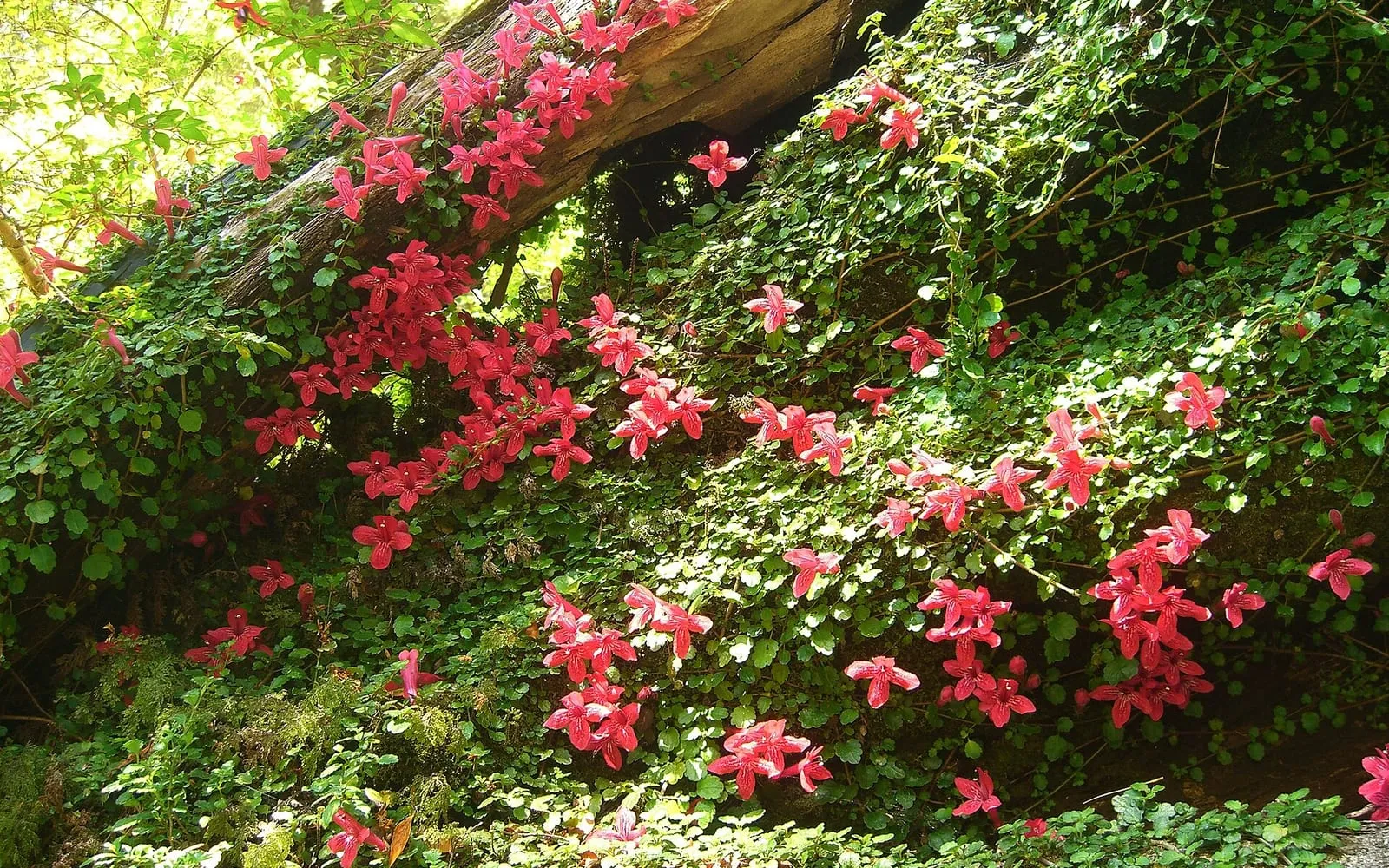
Growers keep it for the flowers, which are large for so slender a plant. Each one is a solitary scarlet trumpet with five flaring lobes and a paler, streaked throat, sitting tight against the foliage from late spring into summer. Set against small dark leaves the colour is vivid, and a well-grown plant can cover a shaded wall or a mossed log with red flowers for weeks.
It has a name for being particular, though its needs are straightforward. Cool air, steady moisture, deep shade and lime-free compost cover almost everything it needs. The most common way to lose it is to let the roots dry out or to bake it in sun.
Appearance and character
The stems are wiry and trailing, clothed in pairs of small rounded leaves with toothed edges and a covering of fine hairs that catches droplets in humid air. Left to lie flat, the plant forms a loose creeping carpet; given something rough to climb, the same stems press themselves to the surface and climb, so the habit shifts with whatever you offer it.
Flowering is the reason to bother. The blooms open one at a time from the leaf joints, tubular at the base and widening to a broad crimson face a couple of centimetres across, marked with darker veins that steer pollinators towards the throat. In the wild these are worked by hummingbirds, which accounts for the red colour and the long tube.
Where it is from
The plant belongs to the Valdivian temperate rainforest of southern Chile, and it crosses the Andes into a narrow band of Argentina. This is one of the wettest and mildest forest zones in South America. Rain falls through much of the year, the air stays humid, and a canopy of beech and evergreen trees keeps the forest floor in permanent shade.
Those conditions map directly onto how it should be grown. Keep water at the roots at all times, shelter it from direct sun, give it cool nights and use an acidic, spongy rooting medium built from decayed leaves. Hard water and dry heat both lead quickly to poor growth.
How it grows
Growth is slow until the plant is settled enough to flower freely. Give it a support with a rough, water-holding surface, such as a slab of bark, a moss pole or a lump of tufa, and keep that surface damp so the aerial roots take a grip.
Increase it from short stem cuttings, which strike readily in a closed, humid case, or by pegging a trailing stem onto damp compost and letting it root where it touches before you sever it. Both work best in the warmth of late spring and early summer, while the plant is pushing new growth.
Through the seasons
Spring starts growth and flowering, which can continue through the warmer months. Resume regular feeding and make sure the compost never dries as the days lengthen.
Summer carries the main display, with red trumpets opening in succession. Keep the roots cool and damp, screen the plant from midday sun, and damp down around it in warm, dry weather to hold the humidity up.
Autumn slows growth as light fades. Reduce feeding, but carry on watering, since this is an evergreen from a climate with no proper dry season.
Winter is a slower period. Keep the plant frost-free and above its stated minimum, water enough that the compost stays barely moist, and give it the brightest shade you can manage while keeping direct sun off the leaves.
Care difficulty
Easy if you can provide the right conditions, but those conditions are narrow. Give it cool, shaded, evenly moist, lime-free conditions and it grows well; move away from them and it declines. A cool porch, a shaded conservatory corner or a sheltered wall in a mild, damp garden all suit it far better than a warm, dry sitting room.
Two habits catch people out. Letting the compost dry between waterings damages the fine roots, and standing the plant in sun to coax more flower reduces the display. Steady moisture and bright shade produce far more bloom than heat and direct light.
Watering
Keep the rooting medium damp to the touch all year, easing back only a little through the darkest weeks. A plant that never meets drought in the wild can be set back badly by a dried-out pot.
Rainwater or another low-mineral supply suits it best, because the roots dislike the lime in hard tap water. Water drawn from a butt, given often and in modest amounts, keeps the compost evenly moist without leaving it airless and sodden.
Warning signs, diseases and pests
Crisp brown leaf margins point to air that is too dry or roots that have been allowed to dry, and sometimes to scorch from stray sunlight. Move the plant into steadier humidity and shade and keep the compost damp.
Collapse and blackening at the base usually mean cold, waterlogged compost has rotted the fine roots. An open, leafy mix in a pot that drains freely heads it off.
Under glass, watch for aphids clustering on soft new shoots and for the pale mottling and fine webbing of red spider mite, which appears once the air turns warm and dry. Raising the humidity discourages mites, and both pests are easier to clear while their numbers are still low.
Growing environment
Give it a shaded, sheltered spot out of direct sun, with cool, humid, moving air instead of the dry warmth of a heated room. A north wall under glass, a shaded cold frame or a place tucked among other foliage plants all work well.
Pot it into an open, lime-free mix based on composted bark and leaf mould, with enough grit or perlite worked through to keep it draining. The target is a medium that holds water like a wrung-out sponge and never turns to mud.
Feeding
Feed with a dilute, lime-free liquid fertiliser through spring and summer, at about half the strength you would give a hungrier plant. A feed formulated for ericaceous or acid-loving plants matches its dislike of alkalinity.
Stop feeding over winter while growth is at rest. After a repot into fresh compost, hold off for several weeks, since the new medium already contains enough nutrients for early growth.
Troubleshooting
Why will not my plant flower? Too little moisture and air that is too warm and dry are the usual culprits, not too much shade. Keep it cool, humid and evenly watered in bright shade, and allow a season or two for it to build up before you expect a full show.
The leaf edges keep going brown and crisp. Dry air, a dried-out pot or hard water are the likely causes. Raise the humidity, water more evenly with rainwater, and keep it off sunny sills.
The stems trail but will not climb. The plant clings with roots that need a damp, rough surface to grip. Offer bark, moss or tufa and keep that support moist, and the stems will attach themselves.
How do I make more plants? Take short stem cuttings in late spring and root them in a covered, humid container, or layer a trailing stem into damp compost and detach it once it has rooted.
Is it safe around pets? Refer to the toxicity note above. It carries no serious poisoning record, though it is sensible to keep any plant you are unsure of away from animals that chew.
Chilean Mitre Flower problem guides
Not sure what is wrong? See the common houseplant pests guide.