
Houseplant
Cabbage Tree
Cordyline banksii
Also known as Cordyline banksii
How to grow Cordyline banksii, the forest cabbage tree, a branching New Zealand plant with slender stalked leaves grown indoors for a fountain of foliage.
At a glance
- Difficulty
- Easy
- Water
- When the top few centimetres of mix have dried
- Light
- Bright indirect light to light shade
- Temperature
- Cool to warm; keep above about 5 deg C indoors
- Humidity
- Average to high
- Hardiness
- USDA 9b-11, RHS H3, hardy to -3 C
- Type
- Perennial
- Height
- Up to 4 m
- Native to
- New Zealand
A temperate forest-margin plant from New Zealand, less cold-tolerant than the common cabbage tree. It takes a light frost of about minus 3 deg C in a sheltered spot once established, but a hard freeze kills the foliage and it does best protected from frost. It prefers bright filtered light and evenly moist soil, and cold, waterlogged compost or dry air spoils it.
Hardiness zones describe winter cold alone. Summer heat, humidity, rainfall and the length of the growing season decide as much, so treat the range as the outer limit rather than as a recommendation.
Harmful to cats and dogs if eaten
- Do not eat
- The leaves, which contain saponins
- Harm from
- Eating it
- Affects
- Cats and dogs
Cordyline banksii, the cabbage tree, is toxic to cats and dogs. The ASPCA lists the genus (as palm lily or cabbage palm) for its saponins instead of this species by name, and the same compounds occur throughout Cordyline. Chewing or swallowing the leaves can cause vomiting, sometimes with blood, along with drooling, a loss of appetite and, in cats, dilated pupils. The effect is usually gastrointestinal and mild to moderate. The RHS does not list it as harmful to people, though saponins can upset the stomach if a child eats the foliage.
Sources: ASPCA palm lily (Cordyline), RHS potentially harmful garden plants
About
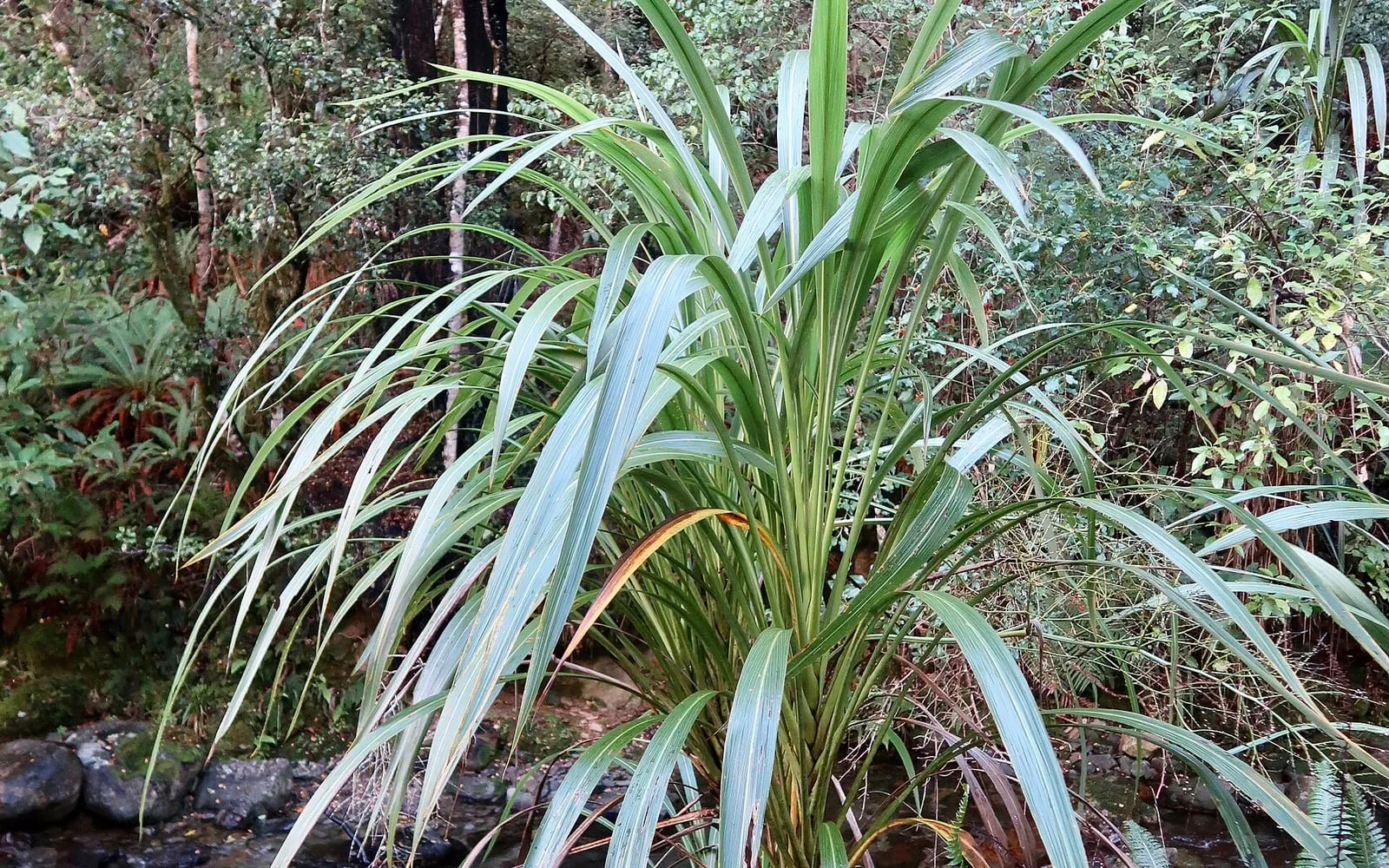
Cordyline banksii is the forest cabbage tree, a smaller relative of the roadside cabbage trees seen across its homeland. Where those grow as thick single-trunked giants, this one branches near the ground into a cluster of slim stems, each topped by a loose head of narrow, drooping leaves. It grows as a loose, many-stemmed plant rather than a single stiff trunk.
The leaves help identify it. Each blade tapers to a long stalk, a petiole, before it joins the stem, so the foliage hangs and sways instead of standing rigid. The species is named after Joseph Banks, the botanist who sailed with Cook, and to Maori it is one of several plants grouped as ti.
None of the cabbage trees is a true palm. They are monocots in the asparagus family, storing starch in a fibrous stem that thickens with age. Grown in a pot, banksii stays a manageable clump of arching leaves for many years before it grows much taller.
Appearance and character
The leaves are narrow, flexible and up to a metre long on an established plant, with a pale midrib and a slender stalk at the base. They arch outward and downward from each growing tip, giving the whole plant a loose, weeping outline that older cabbage trees lose.
Branching is the other useful feature. Instead of a lone trunk, banksii sends up several stems from a shared base, so a good specimen looks like a small thicket of foliage heads. In the wild a mature plant produces sweet-scented sprays of tiny flowers, though a potted one rarely reaches that stage.
Where it is from
Cordyline banksii is native to New Zealand, where it grows along forest margins, in clearings and beside streams from the coast up into the hills. It favours the sheltered edge of the bush instead of open exposed ground, so it is used to broken light and a moist, cool root run.
That streamside, forest-edge habitat shapes what it needs indoors. It likes light without glare, air that is not bone dry, and a mix that stays damp but never stagnant. It tolerates more shade than the sun-loving cabbage trees of open country, which makes it forgiving of an ordinary room.
How it grows
The plant grows steadily through the warm half of the year and slows in winter. It thickens its clump by branching and by adding leaves to each head, and older leaves brown off from the underside of every crown as new ones replace them, which is normal.
Grow it in a light, free-draining mix that still holds some moisture, using a peat-free compost opened with grit or bark. Set it in bright, filtered light, keep the roots evenly damp in growth, and repot in spring when the clump fills its pot.
Increase it by teasing rooted offshoots from the base, by stem cuttings taken from the branching stems, or from fresh seed. Because it branches naturally, division of an established clump is the easiest method.
Through the seasons
Spring restarts active growth. Resume watering in full, start a light feed, and divide or repot a crowded clump.
Summer is the main growing season. Keep it in bright but filtered light, water whenever the surface has begun to dry, and raise the humidity if the room is warm and dry.
Autumn eases the plant towards rest. Reduce feeding and let the mix dry a little more between waterings.
Winter is a slower period. Keep it cool but above about 5 deg C, water lightly, and keep it away from hot, dry draughts.
Care difficulty
This is one of the easier cabbage trees to keep indoors, forgiving of shade and steady in growth, provided the room does not run hot and arid for months on end. It needs a damp root run, filtered light and air with some moisture in it.
Trouble shows up in two ways. Crisp brown leaf edges follow dry air or a pot left to dry out too hard. A soft, sour base follows cold, waterlogged compost. Fix those conditions early and new growth should improve.
Watering
Water once the top few centimetres of mix have started to dry, soaking the rootball thoroughly and tipping away whatever drains through. In growth the plant likes to stay evenly moist, and a clump with several stems drinks more than its size suggests.
Scale back through winter, letting the surface dry further between drinks so the roots never sit cold and wet. If your tap water is very hard, an occasional drink of rainwater helps keep the leaf tips clean.
Warning signs, diseases and pests
Brown, dry leaf tips and edges mean the plant needs moister air or a wetter root run. Move it off any heat source, mist around it, and keep the compost from drying out fully.
Yellowing lower leaves over a soft stem base signal root rot from cold, sodden compost. Improve the drainage, warm the plant up, and let the mix dry before watering again.
Warm, dry indoor air encourages spider mites, seen as fine mottling, and mealybugs, seen as white woolly clusters in the leaf axils. Wipe the leaves down, raise the humidity, and treat a persistent infestation with an insecticidal soap.
Growing environment
Bright, filtered light gives the best foliage, and this species copes with more shade than most cabbage trees, so a spot away from direct sun suits it. Strong midday sun through glass can scorch the thin leaves.
Keep it warm and out of cold draughts, and give the air around it some moisture. Grouped with other plants or stood on a damp gravel tray, it holds its arching leaves without browning.
Feeding
Feed through spring and summer with a dilute balanced liquid fertiliser, around half strength, every few weeks while the plant is growing. Weak, regular feeding is better than occasional strong feeding, since heavy feeding forces soft, floppy leaves.
Taper feeding off in autumn and give none in winter. A newly potted plant can draw on the fresh mix for several weeks before it needs feeding at all.
Troubleshooting
Why are the leaf tips going brown? Dry air or a pot allowed to dry out too far. Raise the humidity and keep the root run evenly moist.
Should I worry about old leaves browning at the base? No. Each crown sheds its oldest leaves as it makes new ones, and this is normal for the plant.
It has flopped and the base feels soft. What now? Cold, waterlogged compost has caused root rot. Improve drainage, move it to warmth, and water sparingly while it recovers.
How do I propagate it? Divide the branching clump, take stem cuttings, or sow fresh seed. Division is the simplest.
Is it safe around pets? No. The ASPCA lists Cordyline as toxic to cats and dogs because of its saponins, so keep it out of reach of pets that chew leaves.
Cabbage Tree problem guides
Not sure what is wrong? See the common houseplant pests guide.