
Outdoor plant
Blue Fescue
Festuca glauca
Also known as Grey fescue, Blue sheep's fescue
How to grow blue fescue, Festuca glauca, a compact needle-leaved grass grown for its intense blue-grey colour, sharp drainage needs, and short lifespan.
At a glance
- Difficulty
- Moderate
- Water
- Occasional watering while young, then only in prolonged drought
- Light
- Full sun
- Hardiness
- USDA 4-8, RHS H6, hardy to -20 C
- Type
- Hardy evergreen perennial grass, short-lived
- Height
- 20-30 cm in leaf, to 40 cm in flower
- Native to
- Central and southern Europe
Cold is rarely what kills a mature clump. Blue fescue takes a hard frost without complaint, and the failures reported in mild, wet climates almost always trace back to soggy winter soil rather than low temperature. It wants a dry, open, sun-baked position more than it wants shelter from the cold, and a bed that drains fast after rain matters more to its survival than the zone number on the label.
Hardiness zones describe winter cold alone. Summer heat, humidity, rainfall and the length of the growing season decide as much, so treat the range as the outer limit rather than as a recommendation.
Not known to be toxic
Blue fescue has no toxicity listing from the RHS or the ASPCA and is considered safe around pets and children. Its fine, needle-like leaves are tough rather than sharp enough to cut skin, and a cat or dog that chews a blade gets nothing worse than a mouthful of fibrous plant material.
Sources: RHS potentially harmful garden plants, ASPCA toxic and non-toxic plants
About
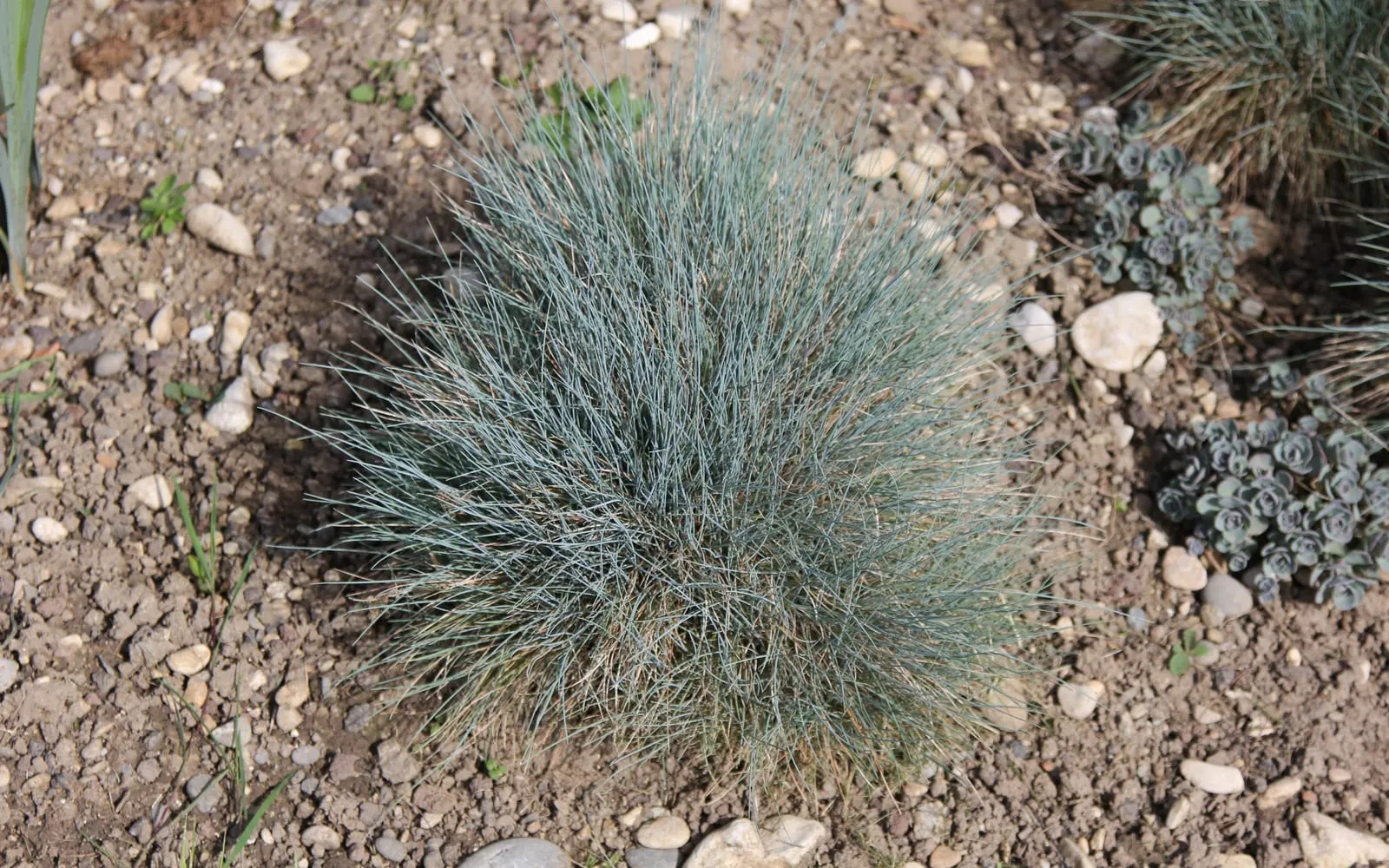
Blue fescue earns its place in a border almost entirely on colour. Each clump is a tight dome of needle-fine leaves in a blue-grey so intense it reads as artificial from a distance, closer to painted metal than to ordinary foliage, and it holds that colour year-round rather than fading to green in summer the way some blue-leaved plants do. Gardeners plant it in rows along a path edge, in gravel among stones, or dotted through a border as a repeating note of cool colour against warmer greens and flowers.
The trade-off for that colour is a short working life. A well-sited clump stays tight and vivid for three or four years before the centre begins to thin and die out, at which point the plant looks patchy rather than older, and the honest fix is lifting and dividing it or replacing it outright rather than waiting for it to recover on its own. Gardeners who plant blue fescue expecting a permanent fixture are often disappointed; gardeners who plant it expecting to renew it every few years are not.
Appearance and character
Hair-fine, rolled leaves pack densely into a symmetrical, spiky dome that keeps its shape without staking or shearing. That foliage is the plant’s main appeal. The blue-grey colour comes from a waxy bloom on the leaf surface rather than from pigment, the same mechanism that gives some succulents and conifers their glaucous look, and it is strongest on young growth in full sun.
Slender flower stems rise just above the foliage in early summer, carrying narrow, pale flower spikes that add little to the display and that many gardeners remove before they set seed, since the seed heads fade to a dull tan that does nothing for the plant’s colour. Left in place, they scatter seed readily enough to produce a scatter of seedlings around a mature clump, some true to the parent’s blue colour and some reverting to plain green.
Where it is from
Festuca glauca is native to dry, rocky, sun-exposed ground across central and southern Europe, growing in short turf and open grassland on thin, free-draining soil over limestone and other porous rock. That origin explains almost everything about how the plant behaves in a garden: it evolved on ground that sheds water fast and offers little in the way of stored nutrients, and it never developed any tolerance for sitting wet.
Gardeners in a damper, richer-soiled climate are effectively asking the plant to grow somewhere unlike anywhere it grows naturally, which is why a struggling clump so often traces back to soil rather than to cold, pests or disease.
How it grows
Plant in spring or early autumn into a spot that drains fast after rain, working grit or coarse sand into heavy soil before planting rather than after. A young plant establishes quickly in the right conditions, reaching close to full size within its first full growing season.
Growth is steady rather than vigorous, forming a tight, self-contained tuft that does not spread by runners and stays exactly where it is planted. That makes it predictable in a formal edging scheme, where an aggressive spreader would blur the line the planting is meant to hold.
The plant’s short lifespan is a known and manageable part of growing it rather than a failure to prevent. Divide a clump every two to three years in spring, before the centre visibly dies out, lifting the whole plant, discarding the tired middle and replanting the vigorous outer sections a little apart. Left undivided, most clumps decline within four or five years regardless of how well they are sited.
Through the seasons
Spring is when the strongest new growth appears, and the best time to divide a clump that has started to thin, replanting the healthy outer sections while temperatures are still cool.
Summer brings the pale flower stems, which many gardeners cut off at the base to keep the display focused on foliage rather than on the comparatively dull flowers.
Autumn foliage holds its colour well as growth slows, and this is a reasonable second window for planting or dividing in a mild climate.
Winter foliage stays evergreen and largely unchanged by cold, holding its shape and colour through frost, though a wet winter is the single greatest threat the plant faces and standing water at the crown can kill it outright regardless of temperature.
Care difficulty
Moderate, and almost entirely a matter of drainage and timely division rather than any ongoing routine. A clump in the right spot needs little attention beyond an occasional tidy of dead foliage, but a clump in the wrong spot, wet, shaded or crowded by taller neighbours, declines quickly whatever else is done for it, and the difficulty in growing this species well lies in reading that signal early rather than in any single demanding task.
Watering
Water a newly planted clump while it establishes, then step back almost entirely. Established plants draw on rainfall alone through most climates and need supplemental watering only in an unusually long, dry spell. Overwatering is a far more common problem than underwatering, since consistently damp soil at the crown invites the rot that kills this species faster than drought ever does.
Warning signs, diseases and pests
Rust occasionally appears as small orange pustules on the leaf blades, usually in a humid summer, and rarely does more than mark the foliage without threatening the plant’s survival.
Crown rot is the more serious risk, showing as a clump that browns and collapses from the centre outward, particularly after a wet winter or in soil that holds moisture around the base of the plant. There is no cure once it has taken hold; the practical response is lifting and discarding the affected plant and improving drainage before replanting anything in the same spot.
Vine weevil grubs occasionally attack the roots of container-grown plants, causing a clump to wilt and fail despite apparently adequate watering. Checking the compost for the pale, C-shaped grubs is the way to confirm it.
Growing environment
Full sun is essential for the tightest habit and the most intense colour; in shade the foliage stretches, loosens and turns a duller grey-green. Sharp drainage matters as much as sun, and this species performs far better in poor, gritty or sandy soil than in rich, moisture-retentive ground, where its natural resistance to rot is overwhelmed. A gravel garden, a raised bed or a container with generous drainage holes all suit it better than an ordinary damp border.
Feeding
Little to none is the right approach. Fertile soil and routine feeding both push soft, lax growth that loses the tight, upright dome this grass is grown for, and they do nothing to extend its naturally short lifespan. A single light feed in spring is reasonable on poor soil; anywhere else, leaving it unfed produces the better plant.
Troubleshooting
The centre of the clump has died out and looks patchy. This is normal age-related decline rather than a disease. Lift the plant in spring, discard the dead centre, and replant the healthy outer sections; most clumps need this every two to three years.
The foliage has lost its blue colour and turned greyish-green. Check how much sun the spot gets. Colour intensity depends on full sun, and a clump that has become shaded by taller neighbours as a border matures will fade even if nothing else about the site has changed.
The plant has collapsed and browned from the middle out after a wet winter. This points to crown rot from standing water rather than cold damage. There is no effective treatment; remove the plant and improve drainage substantially before replanting in the same spot.
Seedlings keep appearing around the base of the parent plant. Blue fescue self-seeds readily once flower spikes are left to mature. Cut the flower stems off before they set seed if unwanted seedlings are a nuisance, or weed out the ones you do not want.
Is it worth planting if it only lasts a few years? For most gardeners, yes. Treat it the way you would a short-lived perennial rather than a permanent shrub, dividing or replacing it on a predictable cycle, and the intense colour it provides in the meantime is difficult to match with a longer-lived grass.
The plant looks fine in summer but rots over winter in a damp climate. Improve drainage before the next winter arrives, working grit into the surrounding soil or moving the plant to a raised position, and consider growing it in a container with sharp drainage if the surrounding garden soil stays consistently damp.
Can it be grown in a container rather than in the ground? Yes, and a pot with generous drainage holes and a gritty, free-draining compost often suits this species better than open ground in a wetter climate, since the grower has direct control over how fast water drains away from the crown.