
Outdoor plant
Autumn Daffodil
Sternbergia lutea
Also known as Winter daffodil, Lily-of-the-field, Yellow autumn crocus
How to grow autumn daffodil, Sternbergia lutea. Planting a true bulb in high summer for golden autumn flowers, and why it is not a daffodil at all.
At a glance
- Difficulty
- Moderate
- Water
- None through summer planting and dormancy, moderate once leaves appear
- Light
- Full sun, and as much summer heat as the site can give it
- Temperature
- Fully hardy once established, needs a hot dry summer to flower well
- Hardiness
- USDA 7-9, RHS H4, hardy to -15 C
- Type
- Bulbous perennial, flowering in autumn
- Height
- 10-15 cm
- Native to
- The Mediterranean and the Middle East, from southern Europe through Turkey to Iran
Established bulbs tolerate ordinary winter cold within this range without trouble. What determines whether the display happens each year is the summer before it, since the bulb needs a proper baked dormancy through the hottest months to flower reliably, and a cool or damp summer produces leaves with few or no flowers even where the winter itself was never in question. It is planted while still dormant in high summer instead of in the cooler autumn window most bulbs prefer, which is the detail most likely to trip up anyone used to ordinary bulb planting.
Hardiness zones describe winter cold alone. Summer heat, humidity, rainfall and the length of the growing season decide as much, so treat the range as the outer limit rather than as a recommendation.
Toxic if eaten
- Do not eat
- The bulb above all, and the leaves and flowers to a lesser degree
- Harm from
- Eating it and handling it
- Affects
- People, cats and dogs
Sternbergia sits in Amaryllidaceae, the same family as daffodil, snowdrop and amaryllis, and it carries the same class of toxic alkaloid, principally lycorine, concentrated most heavily in the bulb. Eating any part causes vomiting, abdominal pain and diarrhoea in a person or a pet, with a larger ingestion capable of causing lethargy and tremors. It does not appear on the RHS harmful plants list under its own name as commonly as its Amaryllidaceae relatives do, and documented poisoning cases are scarce, but the alkaloid profile of the genus is well established in the scientific literature and there is no reasonable basis for treating the bulb as safe to eat. Handling bulbs while planting or dividing causes contact irritation in some people, so gloves are sensible. The more urgent safety point is not this plant's own toxicity but telling it apart from autumn crocus, *Colchicum autumnale*, which produces a broadly similar golden or pink autumn flower from bare ground and is dramatically more dangerous, containing colchicine, for which there is no antidote.
Sources: RHS potentially harmful garden plants, ASPCA toxic and non-toxic plants
About
Nothing about this plant is a daffodil, whatever the common name suggests. True daffodils belong to Narcissus, and Sternbergia lutea sits instead in Amaryllidaceae alongside snowdrop and true amaryllis, sharing that family’s alkaloid chemistry rather than the traits of a true daffodil. The name autumn daffodil describes nothing more than a passing resemblance in colour, a cheerful golden yellow that happens to recall a spring daffodil, seen at entirely the wrong time of year.
What it resembles more closely, at first glance, is a crocus: a simple, upright, chalice-shaped flower rising straight from the ground with little stem showing. That resemblance has earned it the alternative name yellow autumn crocus, and it is also where identification matters, since true crocuses flower in autumn too, and so does the far more dangerous Colchicum autumnale, properly called autumn crocus despite belonging to neither the crocus genus nor this one.
The flower structure separates all three reliably, where colour and season cannot. A true crocus carries three stamens, since it belongs to the iris family; Sternbergia and Colchicum both carry six, placing them among the lilioid monocots instead. Colchicum’s six stamens sit atop an extraordinarily long, thin floral tube that runs down into the ground to an ovary hidden below soil level, a structure unlike anything in this plant. Sternbergia’s ovary sits in the ordinary position, just above ground at the base of the flower, with none of that hidden underground tube. Few gardeners think to count stamens, but doing so gives an unambiguous test where colour and timing alone can still mislead.
Appearance and character
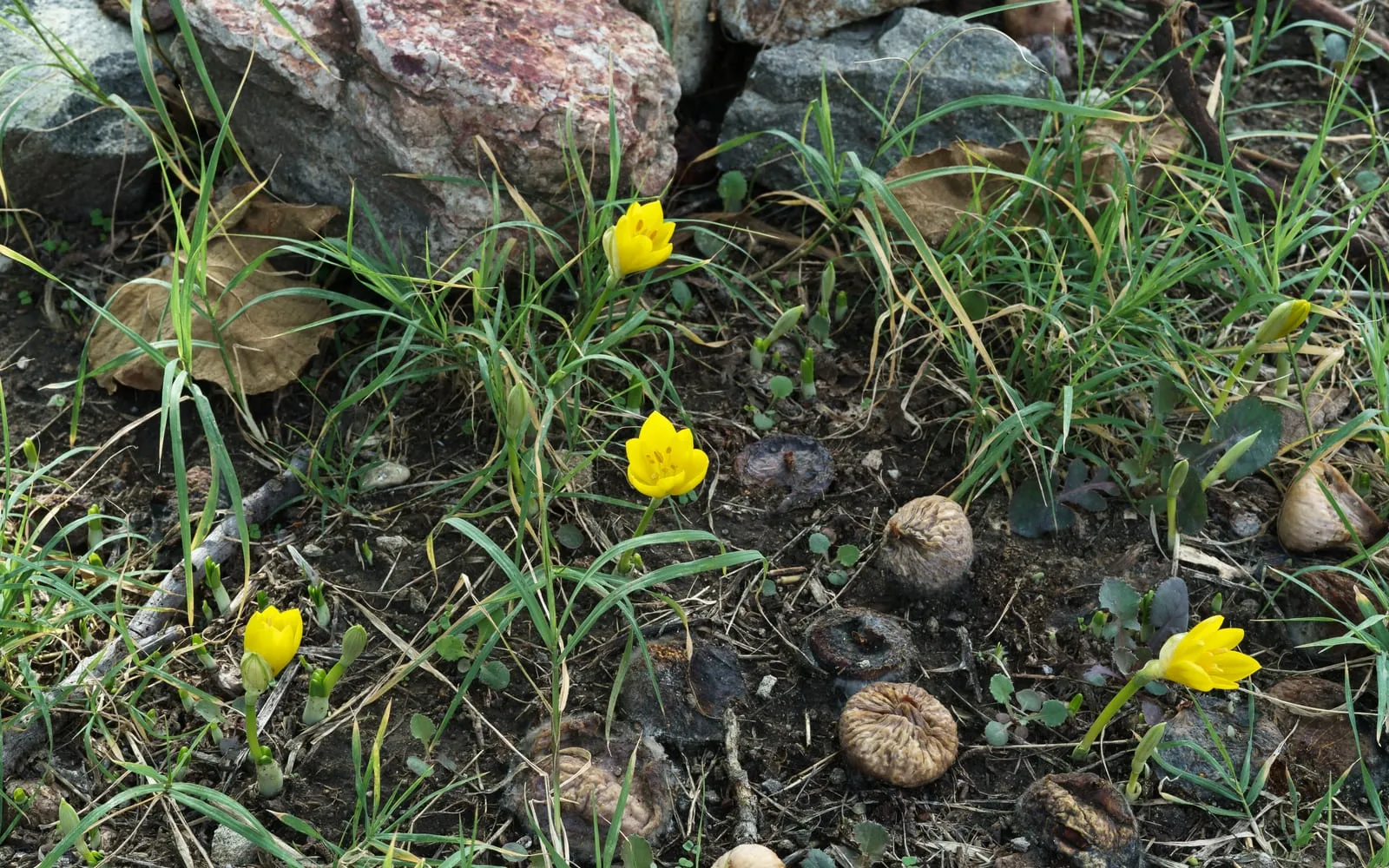
A goblet-shaped flower, six petals fused at the base into a short tube, rises directly from the bulb on a very short stem, with little to no stalk visible above ground, in a glossy, saturated golden yellow.
Narrow, strap-shaped, dark green leaves usually appear alongside the flowers or shortly after, instead of the wide gap between flower and leaf seen in the true naked-flowering bulbs of this collection, and they persist through winter before dying back in late spring.
A single bulb typically produces one to three flowers per season, opening in strong sunshine and closing in dull weather in broadly the same way a crocus does, and a well-established clump can produce a striking carpet of gold against bare autumn soil.
The bulb itself is dark-tunicked, rounded and typically 3 to 4 cm across, notably larger than a spring crocus corm despite the superficial similarity of the open flower.
Where it is from
The Mediterranean basin and the Middle East, native from southern Europe and the Balkans through Turkey, the Levant and into Iran, growing wild on dry, stony hillsides and among scrub at low to moderate altitude.
That is classic Mediterranean-climate ground: a long, baking summer with next to no rain, followed by autumn rains that trigger both flowering and the start of the growing season in one movement. The bulb’s entire strategy depends on that dry summer, storing enough reserve during winter and spring leaf growth to flower as soon as autumn rain and cooling temperatures arrive, without any leaves present yet to support it.
The genus commemorates Count Kaspar von Sternberg, an Austro-Bohemian botanist and a founder of the Bohemian National Museum, and the species has been in cultivation in European gardens since at least the sixteenth century, prized from early on for a flowering season almost nothing else in a garden shares.
How it grows
A bulbous perennial with a growth cycle built entirely around a hot, dry summer rest, flowering as that rest breaks in autumn.
Plant while the bulb is still dormant, in high summer, from July into August, instead of waiting for the cooler autumn planting window most other bulbs prefer. A bulb planted this early is already in the ground and ready to respond the moment autumn conditions arrive; one planted late, after the usual autumn bulb-planting rush, often misses that first season’s flowering entirely, or flowers late and poorly.
Plant 12 to 15 cm deep in sharply drained soil, ideally worked with grit where the native ground is at all heavy. This is deep planting relative to the bulb’s size, and it matters both for anchoring the flower stem and for keeping the bulb properly insulated during its baking summer rest.
Leaves typically follow the flowers within a few weeks and persist through winter, building the bulb’s reserves for the next cycle before dying back in late spring, at which point the ground should be left alone and kept as dry as the local rainfall allows until the following summer’s planting or replanting window comes round again.
Established clumps resent disturbance and are best left in place for several years, since a bulb that has just been lifted and replanted often skips a season of flowering while it resettles.
Through the seasons
Summer is planting time for a new bulb, in July or August while it is still fully dormant, and for an established clump it is the peak of the dry rest that makes the following autumn’s flowering possible.
Autumn is the flowering season, typically September into October, with the leaves following the flowers within a few weeks in most gardens.
Winter sees the strap-shaped leaves persist and continue growing through the cold months, building reserves in the bulb for next year’s flower.
Spring brings the leaves to their fullest before they yellow and die back completely by late spring, after which the bulb goes fully dormant into the summer rest that starts the cycle again.
Care difficulty
Moderate. The main hurdle is timing, not ongoing complexity, since the summer planting window runs against the instinct most gardeners have built up from every other autumn bulb they have ever handled.
Sharp drainage matters as much as timing. A bulb planted in ground that holds any real moisture through summer is prone to rot before it ever gets the chance to flower, and the fix, working grit through the planting area or choosing a naturally free-draining spot such as the base of a warm wall, usually needs to be made before planting rather than corrected afterwards.
Watering
Give no water at all through the summer planting and dormancy period. A freshly planted or established bulb sitting in irrigated summer soil is being denied exactly the dry rest it needs to flower, and watering during this window is one of the more common reasons a planting fails to bloom in its first autumn.
Once the flowers and leaves appear in autumn, natural rainfall is generally enough in most temperate climates, and only in an unusually dry autumn is supplementary watering worth considering.
Reduce watering again as the leaves begin to yellow in late spring, moving the bulb back into its summer rest well before the heat of the season properly arrives.
Warning signs, diseases and pests
Bulb rot, showing as a planting that never produces flowers or leaves at all, or that rots visibly when checked, follows summer moisture almost without exception. There is no cure once rot sets in; the remedy is replanting fresh bulbs in properly drained ground, ideally raised or gritted if the native soil cannot be relied upon to stay dry through summer.
Squirrels and mice occasionally disturb newly planted bulbs before roots have anchored them, particularly in the weeks immediately after summer planting. A layer of wire mesh pegged just below the surface over a new planting deters this until the bulbs are established.
The most important check here is identification. A goblet-shaped autumn flower rising from bare ground with no leaves yet showing could be this plant, a true autumn-flowering crocus, or the seriously toxic Colchicum autumnale. Count the stamens if there is any doubt: three means a true crocus, six with an ordinary flower base means Sternbergia, and six sitting atop a long tube running down into the soil means Colchicum. Treat an unidentified plant as the dangerous one until proven otherwise, particularly around children or grazing pets.
Growing environment
Full sun and real summer heat are essential. A south-facing bed, the base of a warm wall, or a raised gritty bed all suit it far better than an ordinary border position that holds moisture through summer.
Sharply drained soil matters more than fertility, and the bulb performs noticeably better in thin, stony, even poor ground than in anything rich and moisture-retentive. Working coarse grit through the top 20 to 30 cm of soil before planting is worth the effort on anything heavier than a light loam.
Shelter is less important than drainage and heat, though a position that avoids being overshadowed by taller summer perennials, which would shade and cool the soil during exactly the months the bulb needs to bake, helps considerably.
Group bulbs generously at planting, spacing them 8 to 10 cm apart, since a single planting reads far better as a dense drift than as scattered individuals, and an established clump left undisturbed for years slowly thickens into exactly that on its own.
Feeding
Very little feeding is needed. The bulb comes from thin, stony Mediterranean ground and does not want rich soil at any point in its cycle.
A light application of balanced granular feed as the leaves are actively growing in autumn or winter, on poor soil only, is enough to support a struggling planting; most established clumps in reasonable ground need nothing at all.
Do not feed at any point during the summer dormancy, and avoid a high-nitrogen feed altogether, since it encourages soft leaf growth at the expense of the flowering the bulb is grown for.
Troubleshooting
Is this a daffodil? No. It is unrelated to true daffodils, which belong to the genus Narcissus. Sternbergia sits in the Amaryllidaceae family alongside snowdrop and true amaryllis, and the common name refers only to a passing similarity in flower colour.
When should I plant the bulbs? In high summer, July or August, while they are still fully dormant, instead of waiting for the cooler autumn window most bulbs prefer. Late planting often means a missed or delayed first flowering.
How do I know this is not the dangerous autumn crocus? Count the stamens. Three means a true crocus. Six on an ordinary flower base means this plant. Six on a long tube running down into the soil means the seriously toxic Colchicum autumnale. If in doubt, treat it as the dangerous one.
It produced leaves but no flowers this autumn. The most likely cause is a cool or damp summer that failed to give the bulb the baked dormancy it needs. There is nothing to do for that season; choose a hotter, drier spot for future plantings if this happens repeatedly.
The bulb rotted before it ever flowered. Almost certainly summer moisture in the soil. Replant fresh bulbs in sharply drained, gritty ground, ideally somewhere that gets no watering at all through summer.
Can I move an established clump? Only if necessary. Lifting and replanting sets flowering back, often for a full season, while the bulb resettles, so leave a thriving clump undisturbed if at all possible.
Is it dangerous to pets? It carries lycorine-type alkaloids typical of its family, and the bulb is moderately toxic if eaten. The greater safety concern in practice is confusing it with the far more dangerous Colchicum autumnale, so correct identification matters more here than with most plants in this collection.