
The last commit of 2025, followed by fifty-two days of nothing:
e4ddb0f: “Add CLAUDE.md: Session setup guide for Windows cmd.exe”
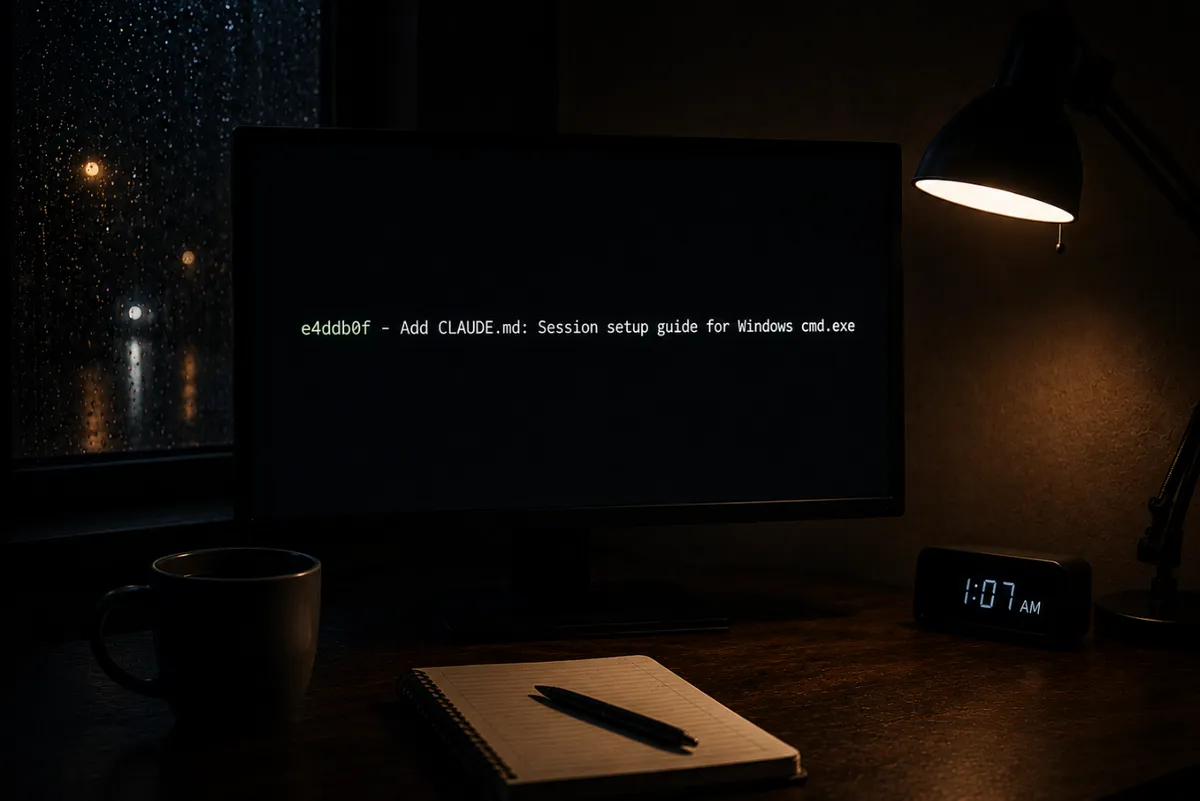
CLAUDE.md is a file you write for an AI coding agent. It tells the agent how your environment is set up, what tools are available, and how to behave in your codebase. It is a hand-off note.
I hadn’t been using an AI coding agent on this project. Months earlier, I had decided that I would build it myself, understand every part, and avoid shortcuts. If I couldn’t build it end to end on my own, did I really understand it?
There was ego in that. I can see it now. At the time it felt like rigour.
The awkward question is: when does discipline become a way of avoiding help? I did not have that question written down in December. I had a rule, and the rule made me feel serious. It also meant I had built a system too large for one person to keep honest and then refused the most obvious form of external pressure.
Writing the CLAUDE.md file was the first admission that the rigour wasn’t working. I needed help, and I had found a way to ask for it while pretending I wasn’t asking.
Then I shut down the computer and flew to Australia.
Burning out in slow motion
I’d stopped being useful to the project weeks before the commit. I just hadn’t admitted it yet.
The symptoms weren’t dramatic. No crashes. No visible failures. I’d sit down to work and every change felt like it might be fixing the wrong thing. Every run produced outputs I couldn’t quite trust. Every subsystem looked correct in isolation and felt wrong in aggregate. Five months in, hundreds of commits, dozens of subsystems, a codebase that had grown beyond what I could hold in my head, and I couldn’t tell you, honestly, whether any of it was working.
You don’t notice burnout the way it happens in stories. You don’t collapse. You just get slower. The obvious next steps stop feeling obvious. You open the project and close it again without doing anything. You tell yourself you’ll look at it properly tomorrow.
By the time I wrote the CLAUDE.md commit, I’d been unproductive for weeks.
Writing it felt like failure. Not a crash or a systems failure, just a slow loss of momentum, clarity, and motivation.
That is how projects usually die. They don’t fail. They just… stop.
Christmas gave me the excuse I needed. Family in Australia gave me a reason to leave the country that wasn’t ‘I can’t do this anymore’. I took it.
What I couldn’t do over Christmas
The project didn’t get better while I was away, but it also didn’t get worse. That was the first time that had been true in a while.
The distance mattered. I’d been effectively not working on the project for weeks before the flight, so the break itself was not new. What changed was being on a different continent, in a different time zone, around people who didn’t know or care about data pipelines. The project stopped sitting in front of me all day as proof that I wasn’t fixing it.
I didn’t think about the project much. When I did, it wasn’t useful. It was the kind of thinking where you circle the same problem and reach the same dead ends you’d already reached, except now you’re doing it on a beach.
The thing I was avoiding became more specific. At the start of the trip, the project felt like something I’d failed at. By the end, it felt like something I’d approached in the wrong way. That was easier to face, because a specific mistake can be investigated.
I flew home in January. I still didn’t want to turn on the computer. But I could.
The audit
When I sat back down, I didn’t start by writing code.
I’d been writing code for five months, and it had produced a system I couldn’t trust. I needed to stop adding code and figure out what I had actually built.
So I did the simplest, most boring thing I could think of. I traced the pipeline end to end.
Data collection. Ingestion. Preprocessing. Training.
On paper, everything was there. Five collectors, parallel orchestration, rate limiting, quality scoring. Weeks of work. I’d written most of it twice.
In reality, at runtime, zero of those collectors were being invoked.
The code was there. The configuration was there. The tests passed. Each collector ran correctly in isolation, and the pipeline ran end to end without errors. At runtime, the critical path was still never executing. The part I thought was feeding the entire system wasn’t running.
The system had been running on residual data. Whatever had been collected before the bug was introduced, plus the scattered successful test runs, was enough to keep training alive, produce metrics, and make the loss curves move in the right direction.
Everything I’d been doing in the previous year, including the cleaning, deduplication, augmentation, and rebalancing, had been done on a dataset that wasn’t growing.
Why it fooled me
Nothing crashed. That was the class of failure.
A system that crashes tells you something is wrong. A system that runs, produces outputs, and updates metrics tells you everything is fine. From the outside, those signals are almost identical. The only difference is whether they’re true.
I had trusted the wrong signals. I’d assumed that if it runs, it’s working. That if metrics improve, it’s learning. That if outputs look plausible, the pipeline is correct.
None of those are true. A system can run without executing its critical path. Metrics can improve on stale data. Outputs can look convincing for the wrong reasons.
What I’d built wasn’t a functioning system. It was a convincing simulation of one.
I had built it, so I trusted the signals that made it look less broken than it was.
That is the general lesson I took from this part of the project. A dashboard is not evidence by itself. It only shows the thing you decided to measure. If you measure the wrong thing, a green graph can still mean the system is broken.
What actually ended
Fixing the collectors was a day’s work once I was looking in the right place. The break mattered because it separated the technical problem from the rule I had attached to it. When I came back, I could look at the system without needing it to prove something about me.
The CLAUDE.md commit is still there in the repo. I haven’t deleted it. It was the first honest thing I’d written in weeks: an admission that the rule I’d set for myself wasn’t working.
The goal had quietly changed too. It was no longer to build something alone. It was to ship something that worked. The constraints I’d set myself, to do it all myself, understand every line, and take no shortcuts, had been the point of the project for five months. They weren’t anymore.
I didn’t hand the project over to an agent when I got back. I did the audit myself, and I found the bug myself. But the rule had broken, and I no longer needed it.
The technical discovery was the visible part. The larger change was that I had stopped treating working alone as proof that the work counted.
To be continued.